
- The Presidency
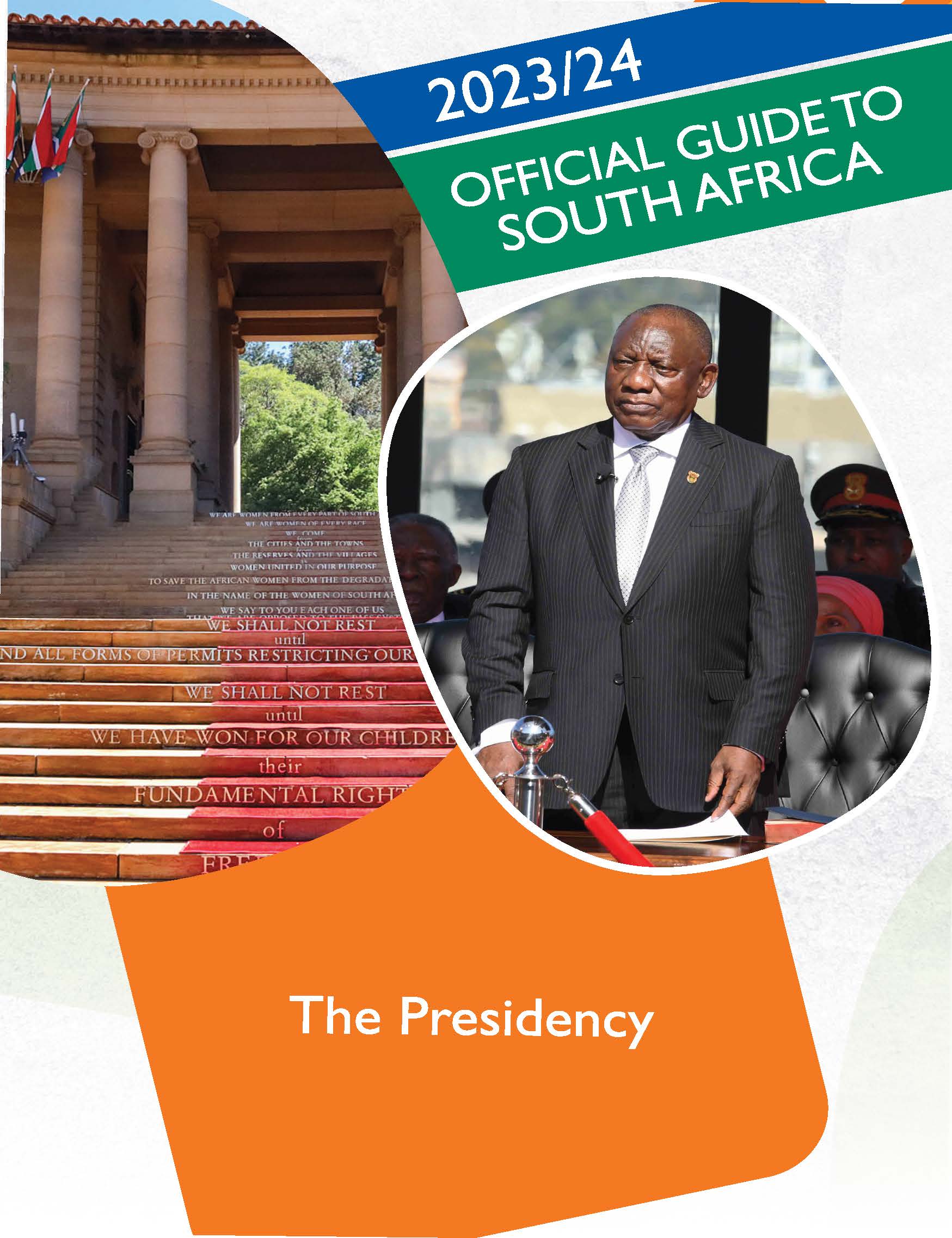
The Presidency The Presidency is mandated to ensure that the president can execute his constitutional responsibilities in leading and galvanising government and society to implement the electoral mandate. The department provides support to the president and deputy president in the execution of their responsibilities as outlined in chapter 5 of the Constitution of the Republic of South Africa of 1996. As such, over the period ahead, the department will focus on enhancing leadership and partnerships through stakeholder engagements to promote the country's social transformation agenda; strengthening governance, state capacity and service delivery through leadership and coordination; and coordinating government policies, legislation and programmes. Enhancing leadership and partnerships In partnership with the South African National AIDS Council, the office of the deputy president has continued to lead nationwide initiatives targeted at improving South Africa's health results, particularly reducing the spread of HIV and AIDS, TB and sexually transmitted infections (STls). The department oversees the implementation of the 2023-2028 National Strategic Plan for HIV.TB and STls. The department continues to promote national unity and accelerate social transformation through the commemoration of national days and days of significance such as Freedom Day, Day of Reconciliation and Human Rights Day. Strengthening governance, state capacity and service delivery The department continues to provide support to the National Prosecuting Authority's investigating directorate, the Special Investigating Unit (SIU) and its special tribunal, the anti corruption task team's fusion centre and all state entities involved in fighting corruption. This includes the department's oversight of other departments' implementation of referrals by the SIU and recommendations of the state capture commission. The District Development Model (DDM) is a department initiative aimed at improving service delivery by enhancing coherence and integrated planning in South Africa's 44 districts and eight metros. To enhance coordination between the spheres of government, the department will continue to provide leadership and play a coordinating role through its oversight of the model and, through the presidential imbizo, oversee its implementation. The department planned to produce two reports per year on annual oversight visits by the President. Coordinating government policies, legislation and programmes To improve legislative and executive accountability, and to ensure that government business is dealt with and synchronised properly, the deputy president is responsible for managing the affairs of the executive in Parliament, setting the agenda for parliamentary business initiated by the executive within the timeframe allocated, and performing any function provided for by the joint rules or resolutions adopted in the National Assembly or the National Council of Provinces. Over the medium term, the department will continue to support the Deputy President in monitoring the implementation of the annual legislative and Cabinet programme. This entails prioritising legislation in Parliament, including bills with Constitutional Court deadlines. Part of the department's coordination imperative also entails ensuring executive accountability to Parliament, building relations between the executive and leaders of opposition parties, and enhancing the electorate's participation in policy and law-making processes. Operation Vulindlela (OV) OV is a joint initiative of The Presidency and National Treasury to accelerate the implementation of structural reforms and support economic recovery. OV aims to modernise and transform network industries, including electricity, water, transport and digital communications. These network industries are the bedrock of economic growth, and are essential to creating a globally competitive economy. In addition, reforms to the visa regime are being prioritised to attract skills and promote growth in tourism. A total of 19 priority reforms have been identified in these focus areas, which together represent a bold and ambitious reform agenda to fundamentally change South Africa's economic trajectory. OV is not a new plan, but aims to ensure effective implementation of plans that already exist. Infrastructure and Investment Office (110) The 110 was established by The President of South Africa to coordinate and align the work of various structures responsible for economic and social infrastructure development. As the demand for infrastructure in Africa continues to grow, the government will need to leverage public and private funds to marshal investments to bridge the infrastructure divide. New approaches to delivering infrastructure are needed, and so is innovative technology and effective collaboration between policymakers, sector agencies, financiers, and investors to fund and deliver projects to yield financial and nonfinancial returns for all stakeholders. A further key role of the 110 is its mandate to solve regulatory and other bottlenecks which are prohibitive to investment.as well as play a leading role in accelerating decision-making in order for high priority investments to be speedily and efficiently implemented. Minister in The Presidency The Minister is responsible for the: Statistics South Africa (Stats SA); Government Communication and Information System (GCIS) State Security Agency (SSA); Media Development and Diversity Agency (MDDA); and Brand South Africa (Brand SA). Statistics South Africa Stats SA is a national department accountable to the Minister in The Presidency. The department's activities are regulated by the Statistics Act of 1999, which mandates it to advance the production, dissemination, use and coordination of official and other statistics to help organs of state, businesses, other organisations and the public in planning, monitoring, policy development and decision-making. The Act also requires that the department coordinates statistical production among organs of state in line with the purpose of official statistics and statistical principles. Over the medium term, the department aimed to continue focusing on modernising its operating model, conducting the continuous population survey and implementing statistical reform. Modernising the operating model To deliver better, faster and cost-effective statistical products and services, the department will continue to modernise its operating model. This includes the implementation of the digital business transformation strategy and roadmap, which entails the rollout of cloud infrastructure and tools that enable self-enumeration, the establishment of secure data-sharing platforms, and research on the adoption of innovative technologies such as artificial intelligence (Al) and machine learning. Self-enumeration through web-based technology is intended to allow respondents to capture survey information on an online platform. The initiative will reduce fieldworker interaction in areas that are difficult to access. The establishment of secure data-sharing platforms is expected to make data easily accessible on various platforms to relevant stakeholders. This is intended to reduce duplication and will facilitate the country's responses to national, continental and global reporting requirements on economic, social and developmental issues. In response to the increasing demand for data and statistics, the department also plans to establish an interconnected statistical system over the medium term that facilitates data acquisition, integration, analysis and visualisation. Conducting the continuous population survey The continuous population survey is being re-conceptualised to integrate several existing household surveys within the department's survey programme to produce frequent lower level data. The department plans to create a geospatial multimodal framework as a sampling frame, as well as testing methods and processes for the survey in 2024/25, and to collect data from the first survey module in 2025/26. The department has collected insightful data on household income and expenditure patterns, and therefore living conditions, through its income and expenditure survey. The results of the survey are scheduled to be released in 2024/25. Thereafter, the survey, along with the living conditions survey and general household survey, will be integrated into the continuous population survey. Strengthening statistical reform The Statistics Amendment Bill was drafted in 2019/20 to drive statistical reform and was approved by the Portfolio Committee on Planning, Monitoring and Evaluation in December 2023. It is expected to be enacted in 2024/25. The Bill makes provision for developing and implementing a national statistics system and strategy for the development of statistics, and for enhancing coordination and collaboration among producers of statistics, among other things.It also stipulates that the population census must be conducted every IO years. Government Communication and Information System The mandate of the GCIS is derived from section I 95(g) of the Constitution, which stipulates that the public should be provided with information that is timely, accurate and accessible. This is in support of the constitutional principles of freedom of expression, and transparent and open governance. The department is responsible for providing strategic leadership and coordinating government communication to ensure that members of the public are informed and have access to government programmes and policies that benefit them. Over the period ahead, the department will focus on providing and facilitating strategic government communication, coordinating communication across government, and facilitating active citizen participation. Providing and facilitating strategic government communication The GCIS aims to meet citizens' information needs through advertising government programmes, communicating government priorities and providing civic education. This will be achieved through using various media platforms, including community radio stations, social media, television, newspapers, and leaflets and flyers. Key messages and information to be disseminated on these platforms include: the 2024 Presidential Inauguration, government's Economic Reconstruction and Recovery Plan, anti-corruption initiatives, awareness of gender based violence (GBV) and civic education. Strengthening governance, state capacity and service delivery The department continues to provide support to the National Prosecuting Authority's investigating directorate, the Special Investigating Unit (SIU) and its special tribunal, the anti corruption task team's fusion centre and all state entities involved in fighting corruption. This includes the department's oversight of other departments' implementation of referrals by the SIU and recommendations of the state capture commission. The District Development Model (DDM) is a department initiative aimed at improving service delivery by enhancing coherence and integrated planning in South Africa's 44 districts and eight metros. To enhance coordination between the spheres of government, the department will continue to provide leadership and play a coordinating role through its oversight of the model and, through the presidential imbizo, oversee its implementation. The department planned to produce two reports per year on annual oversight visits by the President. Coordinating government policies, legislation and programmes To improve legislative and executive accountability, and to ensure that government business is dealt with and synchronised properly, the deputy president is responsible for managing the affairs of the executive in Parliament, setting the agenda for parliamentary business initiated by the executive within the timeframe allocated, and performing any function provided for by the joint rules or resolutions adopted in the National Assembly or the National Council of Provinces. Over the medium term, the department will continue to support the Deputy President in monitoring the implementation of the annual legislative and Cabinet programme. This entails prioritising legislation in Parliament, including bills with Constitutional Court deadlines. Part of the department's coordination imperative also entails ensuring executive accountability to Parliament, building relations between the executive and leaders of opposition parties, and enhancing the electorate's participation in policy and law-making processes. Operation Vulindlela (OV) OV is a joint initiative of The Presidency and National Treasury to accelerate the implementation of structural reforms and support economic recovery. OV aims to modernise and transform network industries, including electricity, water, transport and digital communications. These network industries are the bedrock of economic growth, and are essential to creating a globally competitive economy. In addition, reforms to the visa regime are being prioritised to attract skills and promote growth in tourism. A total of 19 priority reforms have been identified in these focus areas, which together represent a bold and ambitious reform agenda to fundamentally change South Africa's economic trajectory. OV is not a new plan, but aims to ensure effective implementation of plans that already exist. Infrastructure and Investment Office (110) The 110 was established by The President of South Africa to coordinate and align the work of various structures responsible for economic and social infrastructure development. As the demand for infrastructure in Africa continues to grow, the government will need to leverage public and private funds to marshal investments to bridge the infrastructure divide. New approaches to delivering infrastructure are needed, and so is innovative technology and effective collaboration between policymakers, sector agencies, financiers, and investors to fund and deliver projects to yield financial and nonfinancial returns for all stakeholders. A further key role of the 110 is its mandate to solve regulatory and other bottlenecks which are prohibitive to investment.as well as play a leading role in accelerating decision-making in order for high priority investments to be speedily and efficiently implemented. Minister in The Presidency The Minister is responsible for the: • Statistics South Africa (Stats SA);• Government Communication and Information System (GCIS)• State Security Agency (SSA);• Media Development and Diversity Agency (MDDA); and• Brand South Africa (Brand SA). Statistics South Africa Stats SA is a national department accountable to the Minister in The Presidency. The department's activities are regulated by the Statistics Act of 1999, which mandates it to advance the production, dissemination, use and coordination of official and other statistics to help organs of state, businesses, other organisations and the public in planning, monitoring, policy development and decision-making. The Act also requires that the department coordinates statistical production among organs of state in line with the purpose of official statistics and statistical principles. Over the medium term, the department aimed to continue focusing on modernising its operating model, conducting the continuous population survey and implementing statistical reform. Modernising the operating model To deliver better, faster and cost-effective statistical products and services, the department will continue to modernise its operating model. This includes the implementation of the digital business transformation strategy and roadmap, which entails the rollout of cloud infrastructure and tools that enable self-enumeration, the establishment of secure data-sharing platforms, and research on the adoption of innovative technologies such as artificial intelligence (Al) and machine learning. Self-enumeration through web-based technology is intended to allow respondents to capture survey information on an online platform. The initiative will reduce fieldworker interaction in areas that are difficult to access. The establishment of secure data-sharing platforms is expected to make data easily accessible on various platforms to relevant stakeholders. This is intended to reduce duplication and will facilitate the country's responses to national, continental and global reporting requirements on economic, social and developmental issues. In response to the increasing demand for data and statistics, the department also plans to establish an interconnected statistical system over the medium term that facilitates data acquisition, integration, analysis and visualisation. Conducting the continuous population survey The continuous population survey is being re-conceptualised to integrate several existing household surveys within the department's survey programme to produce frequent lower level data. The department plans to create a geospatial multimodal framework as a sampling frame, as well as testing methods and processes for the survey in 2024/25, and to collect data from the first survey module in 2025/26. The department has collected insightful data on household income and expenditure patterns, and therefore living conditions, through its income and expenditure survey. The results of the survey are scheduled to be released in 2024/25. Thereafter, the survey, along with the living conditions survey and general household survey, will be integrated into the continuous population survey. Strengthening statistical reform The Statistics Amendment Bill was drafted in 2019/20 to drive statistical reform and was approved by the Portfolio Committee on Planning, Monitoring and Evaluation in December 2023. It is expected to be enacted in 2024/25. The Bill makes provision for developing and implementing a national statistics system and strategy for the development of statistics, and for enhancing coordination and collaboration among producers of statistics, among other things.It also stipulates that the population census must be conducted every IO years. Government Communication and Information System The mandate of the GCIS is derived from section I 95(g) of the Constitution, which stipulates that the public should be provided with information that is timely, accurate and accessible. This is in support of the constitutional principles of freedom of expression, and transparent and open governance. The department is responsible for providing strategic leadership and coordinating government communication to ensure that members of the public are informed and have access to government programmes and policies that benefit them. Over the period ahead, the department will focus on providing and facilitating strategic government communication, coordinating communication across government, and facilitating active citizen participation. Providing and facilitating strategic government communication The GCIS aims to meet citizens' information needs through advertising government programmes, communicating government priorities and providing civic education. This will be achieved through using various media platforms, including community radio stations, social media, television, newspapers, and leaflets and flyers. Key messages and information to be disseminated on these platforms include: the 2024 Presidential Inauguration, government's Economic Reconstruction and Recovery Plan, anti-corruption initiatives, awareness of gender based violence (GBV) and civic education. Although the Vuk'uzenze/e newspaper has been an effective means of communicating and providing citizens with information on government's key priorities, as media consumption patterns have shifted towards digital platforms, from 2024/25, the newspaper will be produced and distributed only digitally (22 editions per year). However, 13 200 Braille copies will still be produced at a projected cost of R 1.6 million per year over the medium term. Digital distribution is expected not only to reduce costs, but also increase reach, with an emphasis on photography and audio-visual content creation. In addition, the department plans to repurpose R 14 million of Vuk'uzenzele's budget over the MTEF period to fund an over-the top streaming service, which is expected to contain content previously disseminated through the newspaper, as well as other government content. The department's social media platforms will be updated regularly to ensure that they effectively share government content. The intention is to create awareness about the challenges facing the country, provide information on how government plans to mitigate them, and suggest ways in which citizens can play a part in resolving them. Coordinating communication across government Over the next three years, the GCIS will focus on ensuring effective and coordinated communication between government departments. As such, it will provide support to all government departments in conceptualising campaigns, developing communication strategies and content, and facilitating the dissemination of information and stakeholder engagement. Support for the DDM, which aims to improve coherence among all spheres of government, as well as the 44 districts and 8 metros across the country, will be reinforced in an effort to enhance service delivery. The department's footprint at the provincial and municipal levels ensures the alignment and coherence of intergovernmental communication systems, processes and messages. This is driven through the coordination of communication forums across government to harmonise the planning of communication campaigns, the alignment of government communication norms and standards, the sharing of best practices, the coherence of messaging, and engagement with domestic and international media. Facilitating active citizen participation To encourage citizen participation, the GCIS will initiate outreach programmes such as localised community dialogues, community radio talk shows, and campaign activations in taxi ranks, shopping centres and commuter trains. A targeted 26 engagement sessions at the national level are planned with senior journalists and two engagements with government heads of communication, as well as forum meetings such as the Government Communicators' Forum. Through media engagements, briefings and infographics, the department intends to keep citizens updated on energy-generation initiatives to overcome the energy crisis. Media Development and Diversity Agency Over the medium term, the agency will continue to provide financial and non-financial support to community and small commercial media, with an emphasis on promoting indigenous languages and contributing to community development. The agency also plans to intensify its focus on ensuring the sustainability of media projects in communities that are underserved by mainstream media. As such, most of the agency's budget over the period ahead is directed at grant funding for 66 community broadcast projects, to help initiate new projects and strengthen existing ones; and 18 community and small commercial media print and digital projects. In line with the agency's plans to ensure the sustainability of community media, over the medium term, it plans to provide training in areas such as governance and social media to 120 community media projects through partnerships with stakeholders and training providers. The training will be supported by 16 media literacy initiatives that will be held across the country in areas with a strong community media presence. Brand SA Brand SA was established in 2002 to manage South Africa's nation brand with the aim of improving the country's global reputation and competitiveness. The entity's primary objective is to develop and implement proactive and coordinated reputation management, communications and marketing strategies for South Africa to attract investment, trade and tourism. Globally, countries are facing unprecedented economic conditions characterised by high cost of living and inflation, energy crises and unemployment, among other things. This makes protecting South Africa's reputation even more pressing. Over the medium term, the entity will focus on implementing activities that contribute positively to shaping South Africa's image and reputation. This will be done through interventions such as assuring investors and profiling the country as an attractive and stable destination. A nation brand encompasses all the attributes, strengths and innovations that a nation has to offer in all spheres of activity (business, arts, tourism, science and innovation, infrastructure, manufacturing and governance), and depends on much more than government activity, policy or leadership. State Security Agency The mandate of the SSA is to provide government with intelligence on domestic and foreign threats or potential threats to national stability, the constitutional order, and the safety and well-being of the people. Examples of such threats are terrorism, sabotage and subversion. This allows government to implement policies to deal with potential threats and to better understand existing threats and thus improve their policies. Among the areas of focus of the SSA are the following matters of national interest: Terrorism, which refers to deliberate and premeditated attempts to create terror through symbolic acts involving the use or threats of lethal force for creating psychological effects that will influence a target group or individual and translate it into political or material results. Sabotage, which refers to activities or purposeful omissions conducted or planned for purposes of endangering the safety, security or defence of vital public or private property, such as installations, structures, equipment or systems. Subversion, which includes activities directed towards undermining by convert unlawful acts or directed towards, or intended ultimately to lead to the destruction or overthrow by violence of the constitutionally established systems of government in South Africa. Espionage, which refers to unlawful or unauthorised activities conducted for acquiring information or assets relating to sensitive social, political, economic, scientific or military matters of South Africa or for their unauthorised communication to a foreign state. Organised Crime, which includes analysis of the origins and reasons behind organised crime, the identification of key role players, the nature and extent, as well as the modus operandi of organised crime syndicates. Minister in The Presidency for Planning, Monitoring and Evaluation The Minister is responsible for the: Department of Planning, Monitoring and Evaluation. Department of Planning, Monitoring and Evaluation The DPME is mandated to: support the National Planning Commission (NPC); facilitate the implementation of the NDP through the development of sector-specific and outcome-specific medium-term plans and delivery agreements, and monitor and evaluate their implementation; ensure the alignment of departmental strategic and annual plans and budget allocations with government's Medium-Term Development Plan (MTDP); monitor the performance of individual national and provincial government departments and municipalities, and facilitate targeted intervention programmes; monitor frontline service delivery and manage the Presidential Hotline; develop and implement the annual national evaluations plan, and support the national evaluations system; and promote good planning, monitoring and evaluation practices in government. Over the medium term, the department will focus on strengthening its planning, monitoring, research and evaluation programmes to support the implementation and achievement of government priorities. This will be achieved through supporting the implementation of the NDP, coordinating and strengthening the national planning system, and monitoring and evaluating the implementation and achievement of government programmes and priorities. Supporting the implementation of the NDP The DPME is tasked with facilitating the implementation of the NOP. This is carried out by the NPC and its secretariat, which is mandated to provide an independent and critical view of the country's developmental trajectory, monitor its implementation, and provide feedback and guidance. Over the medium-term period, the commission planned to participate in and initiate three research projects in support of the ND P's implementation while engaging all social partners and forging new partnerships. It also planned to facilitate one strategic engagement and partnership in each year over the medium term to develop cross-cutting views on specific issues to find sustainable and innovative solutions to obstacles that hinder the NDP's implementation. Coordinating and strengthening the national planning system The implementation of the NDP and improving the country's development outcomes will be supported by the 2024-2029 MTDP, which translates the NDP's objectives into strategic priorities, interventions and targets for the five-year period. To this end, in 2024/25, the department plans to produce the 2024-2029 MTDP, which entails research and consultation with government and nongovernmental organisations. In improving and strengthening integrated planning across government, the department convenes various planning forums that provide strategic leadership and enhance coherence across the spheres of government. Key among these forums is the national steering committee on integrated planning, which is a platform for engagements, consultations and communication between the department, other national departments and provincial departments. Over the period ahead, the department plans to improve the systematic spatialisation of the planning system to ensure sustained spatial transformation in the country. As such, the department will support other departments in all spheres of government in analysing spatial trends and dynamics during their planning processes to ensure targeted government interventions and investment. The department also plans to integrate the priorities of the national spatial development framework into the 2024-2029 MTDP and develop guidelines for the spatialisation of strategic plans and annual performance plans. Monitoring and evaluating the implementation and achievement of government programmes and priorities The DPME is tasked with monitoring frontline services to improve the overall quality of government services. Over the period ahead, this entails managing the presidential hotline and producing two reports on frontline service delivery per year. Over the period ahead, the department will support the performance management of heads of departments and political principals. These measures are complemented with the implementation of capacity development measures to improve planning, monitoring and evaluation within departments. The department will continue to develop the centralised data management system, which is expected to provide users - including government departments, members of the public and academics - with an improved interface for accessing, retrieving, analysing and reporting on government performance information. The system is envisaged to act as a knowledge hub to enable a greater understanding of the effectiveness of government interventions and their impact on society. Minister in The Presidency for Women, Youth and Persons with Disabilities The Minister is responsible for the: Department of Women,Youth and Persons with Disabilities (DWYPD); and National Youth Development Agency (NYDA). Department of Women, Youth and Persons with Disabilities The mandate of the DWYPD is to lead in socioeconomic transformation for the empowerment and participation of women, youth and people with disabilities through mainstreaming, advocacy, monitoring and evaluation. Over the medium-term period, the department aimed to continue focusing on strengthening the coordination of the national response to GBV; promoting responsive planning, budgeting, monitoring and evaluation in government; protecting the rights of people with disabilities; and supporting the participation of young people in the economy. Addressing GBVF and supporting empowerment The President assented to the National Council on GBVF Act of 2024 in May 2024 and the operation of the Act commenced on 15 November 2024,just days before the commencement of the annual 16 Days of Activism for No Violence against Women and Children Campaign (on 25 November 2024; which is also the International Day of No Violence against Women). The National Council was conceptualised as a national multi-sectoral structure mandated by the declaration made at the First Presidential Summit on GBVF in 2018 - which in turn was intended to, amongst other things, identify key interventions to address GBVF, as well as wider challenges negatively affecting the rights and freedoms of women and children. The department will also conduct public awareness and advocacy events, and support and monitor the implementation of the economic empowerment of women. Promoting gender responsive planning, budgeting, monitoring and evaluation. Over the period ahead, the department aimed to continue coordinating and monitoring the implementation of the gender-responsive planning, budgeting, monitoring, evaluation and auditing framework; and conduct research, monitoring and evaluation to inform policy planning and decision-making across government. The department will also continue to assess the strategic and annual performance plans of other departments to ensure that they are responsive to policy priorities relating to women, young people and people with disabilities, and promote compliance with international commitments in support of these core constituents. Promoting the rights of people with disabilities and supporting the empowerment of young people The department will continue to advocate for and support policy reviews, work towards the finalisation of the Disability Rights Bill and frameworks to guide government in mainstreaming the inclusion of people with disabilities, strengthen the direct involvement of the disability sector, and enhance awareness programmes. Part of this includes hosting awareness events. To advance the socio-economic empowerment of young people, the department will continue to develop and review polices, legislation and frameworks to guide government and other stakeholders. National Youth Development Agency The founding legislation of the NYDA is the NYDA Act of 2008. The agency's role is to initiate, implement, facilitate and monitor youth development interventions aimed at promoting the empowerment of young people and their participation in economic activities. As such, over the medium-term period, the agency aimed to continue focusing on implementing interventions to support skills development, entrepreneurship and the creation of employment for young people. These include providing financial and non-financial enterprise support, and placing young people into jobs. Financial support will be provided through grants to youth-owned enterprises, while non-financial support will include the provision of business support services, market access and relevant skills needed to ensure that young people gain the most effective entrepreneurial applications within and across economic value chains. Over the medium-term period, the agency planned to provide financial support and business development interventions to 9 000 enterprises owned by young people to benefit more than 90 000 young people through creating job opportunities. Commission for Gender Equality Although the Vuk'uzenze/e newspaper has been an effective means of communicating and providing citizens with information on government's key priorities, as media consumption patterns have shifted towards digital platforms, from 2024/25, the newspaper will be produced and distributed only digitally (22 editions per year). However, 13 200 Braille copies will still be produced at a projected cost of R 1.6 million per year over the medium term. Digital distribution is expected not only to reduce costs, but also increase reach, with an emphasis on photography and audio-visual content creation. In addition, the department plans to repurpose R 14 million of Vuk'uzenzele's budget over the MTEF period to fund an over-the top streaming service, which is expected to contain content previously disseminated through the newspaper, as well as other government content. The department's social media platforms will be updated regularly to ensure that they effectively share government content. The intention is to create awareness about the challenges facing the country, provide information on how government plans to mitigate them, and suggest ways in which citizens can play a part in resolving them. Minister of Electricity and Energy in The Presidency The Minister is responsible for overseeing all aspects of the electricity crisis response, including the work of the National Energy Crisis Committee. This will provide a single point of command for government's efforts to close the shortfall in electricity supply. The Minister works full-time with the Eskom Board and management to end load-shedding and ensure the implementation of the Energy Action Plan. Among other things, the Minister of Electricity and Energy has the powers to direct the procurement of new generation capacity and ensure security of supply. Source: Official Guide to South AfricaRelated links South Africa Yearbook Estelle Greeff Tue, 05/06/2025 - 13:45
- Forestry, Fisheries and the Environment
Forestry, Fisheries and the Environment Forestry, Fisheries and the EnvironmentRole playersForestry Forestry, Fisheries and the Environment In April 2021, the Department of Environment, Forestry and Fisheries changed its name to the Department of Forestry, Fisheries and the Environment (DFFE). The DFFE is mandated to give effect to the right of citizens to an environment that is not harmful to their health or well- being, and to have the environment protected for the benefit of present and future generations. To this end, the department provides leadership towards sustainability in environmental management, conservation and protection for the benefit of South Africans and the global community.The National Development Plan (NDP) sets out a vision for promoting environmental sustainability in South Africa by making an equitable transition to a low‐carbon economy and transforming human settlements for improved local governance and spatial integration. Broadly, the NDP envisions environmental sustainability and transformation within the context of an integrated and inclusive economy that is supported by a capable and developmental state.This vision is given expression by Priority 1 (Economic transformation and job creation), Priority 4 (Spatial integration, human settlements and local government) and Priority 6 (A capable, ethical and developmental state) of government’s 2019 – 2024 Medium Term Strategic Framework, with which the work of the DFFE is closely aligned.Accordingly, the department’s ongoing objective is to develop strategies and policies aimed at regulating and promoting the sustainable use of inland and coastal natural resources; and reducing carbon emissions, atmospheric pollutants and the effect of climate change. As part of the national macro organisation of government, the forestry and fisheries functions of the former Department of Agriculture, Forestry and Fisheries were shifted to the DFFE.Government is prioritising the need to protect natural resources while growing a post-COVID-19 economy. Key to the recovery is the Green Stimulus Recovery Programme, which forms part of the post-COVID-19 Economic Reconstruction and Recovery Programme for South Africa. It will contribute to equitable economic growth, provide employment to marginalised communities and grow economic sectors reliant on the environment without destroying it.Over the medium term, the department will continue to focus on supporting an equitable transition to a low-carbon economy and a climate‐resilient society; creating an enabling environment for South Africa’s transition to a circular economy and creating work opportunities and jobs through public employment programmes. Supporting an equitable transition to a low-carbon economy and a climate-resilient society The DFFE will prioritise the implementation of the approved low- emissions development and growth strategy over the medium term, and seek to build capacity for the Presidential Climate Change Coordination Commission secretariat. It will also spearhead the development of job resilience plans in the five sectors identified as the most vulnerable to climate change (coal, agriculture, tourism, petrol-based transport and metals).These initiatives feed into the National Climate Change Bill, which, once promulgated, will serve as the overarching legislative framework for the implementation of climate adaptation and mitigation within provinces and municipalities, and ensure the coordination of climate change interventions across the three spheres of government.These activities will be carried out in the Climate Change, Air Quality and Sustainable Development programme, which has a budget of R1.4 billion over the MTEF period. Spending in the programme is set to decrease at an average annual rate of 6.7%, from R612.8 million in 2021/22 to R497.7 million in 2024/25, mainly due to the repurposing of funding to augment the operational budget of public entities. Improved waste management towards a circular economy Over the medium term, the DFFE will focus on creating an enabling environment to support the transition to a circular economy, which entails transitioning from the current wasteful economy to a more regenerative, inclusive and equitable one. Accordingly, the department will continue with the implementation of the Recycling Enterprise Support Programme and Operation Phakisa initiatives that contribute to job creation in the waste management sector. In addition, it will implement the national waste management strategy, which is aimed at minimising waste and diverting 40% of waste from landfills over the next five years.In an effort to reduce plastic waste and encourage plastic recycling, over the period ahead, the levy on plastic bags is expected to be extended to all single‐use plastics used for retail consumption – including plastic straws, utensils and packaging – to curb their use, encourage reuse and recycling, and divert waste from landfill. In partnership with the Council for Scientific and Industrial Research and the Department of Trade, Industry and Competition, the department will work towards implementing a waste management plan for the tyre industry.The plan includes establishing sustainable markets for recycled tyre products and developing processing capacity to support the recycling of old tyres in environmentally sustainable ways.Expenditure for these activities is within an allocation of R1.9 billion over the medium term in the Chemicals and Waste Management programme. Creating jobs and work opportunities through the Expanded Public Works Programme The departments commitment to job creation is reflected in its medium- term targets of providing 103 659 full‐time equivalent jobs and 210 780 work opportunities through the expanded public works programme. These jobs and work opportunities will be made available through projects and initiatives that focus on: restoring and rehabilitating degraded ecosystems (environmental protection and infrastructure programme); expanding the conservation estate (Working for Ecosystems); protecting, restoring and rehabilitating wetlands (Working for Wetlands); protecting water resources (Working for Water); managing sustainable land use (Working for Ecosystems); sustaining production, growth and transformation in the forestry sector (Working for Forests); and addressing the challenges faced by the fisheries sector (Working for Fisheries). The Environmental Programmes section is allocated 41.9% (R11.6 billion) of the department’s total budget to fund these initiatives over the MTEF period. Legislation and policies The DFFE’s mandate is derived from the following legislation: National Environmental Management Act (NEMA), 1998 (Act 108 of 1998), which provides for specific legislation on biodiversity and heritage resources, oceans and coasts, climate change and air quality management, and waste and chemicals management; National Environmental Management Amendment Act, 2004 (Act 8 of 2004), which streamlines the process of regulating and administering the Environmental Impact Assessment process; National Environmental Management: Air Quality Act, 2004 (Act 39 of 2004), which reforms the law regulating air quality in order to protect the environment by providing reasonable measures for preventing pollution and ecological degradation, and securing ecologically sustainable development; and provides for national norms and standards that regulate the monitoring of air quality; National Environmental Management: Biodiversity Act (NEMBA), 2004 (Act 10 of 2004), which significantly reforms South Africa’s laws regulating biodiversity; National Environmental Management: Integrated Coastal Management Act, 2008 (Act 24 of 2008), which promotes the conservation of the coastal environment, and ensures sustainable development practices and the use of natural resources; the National Environmental Management: Waste Act, 2008 (Act 59 of 2008), which reforms the law regulating waste management in order to protect health and the environment by providing reasonable measures for the prevention of pollution; the National Environmental Management: Protected Areas Amendment Act, 2009 (Act 15 of 2009), which provides for the assignment of national parks, special parks and heritage sites to South Africa in terms of the World Heritage Convention Act, 1999 (Act 49 of 1999); National Forests Act, 1998 (Act 84 of 1998), which promotes sustainable management and development of forests for the benefits of all; creates the conditions necessary to restructure forestry in state forests; provides special measures for the protection of certain forests and trees; promotes the sustainable use of forests for environmental, economic, educational, recreational, cultural, health and spiritual purposes; promotes community forestry; promotes greater participation in all aspects of forestry and forest products industry by person disadvantaged by unfair discrimination; National Veld and Forest Fire Act, 1998 (Act 101 of 1998), which provides for the prevention and combating of veld, forest and mountain fires across South Africa; and Marine Living Resources Act, 1998 (Act 8 of 1998), which deals with the long-term sustainable utilisation of marine living resources. Budget and funding The DFFE was allocated R9.1 billion for the 2021/22 financial year. The department receives allocations amounting to R27.2 billion over the medium term, increasing at an average annual rate of 0.9%, from R9.1 billion in 2021/22 to R9.3 billion in 2024/25. Spending on goods and services accounts for an estimated 53% (R14.5 billion) of the department’s total allocation over the MTEF period, with spending on compensation of employees comprising an estimated 21.4% (R5.8 billion). Forestry The DFFE is the custodian of South Africa’s forest resources, which cover over 38 million hectares (ha) – about 31.1% of the country’s land surface area. Forest products contribute about R36.34 billion to the economy. Export value decreased by 5%, from R26 to R24.7 billion.This is underpinned by 1.2 million ha of well-developed plantation forestry.The forestry sector is responsible for 147 400 direct jobs. A forest sector review conducted in preparation for the Forestry Sector Master Plan revealed that forestry products contribute at least 4.5% to the total manufacturing in the country, putting it among the top five sectors within the manufacturing industry. It also revealed that export earnings had increased almost threefold, providing a positive trade balance of up to R10 billion in less than a decade.Much of forestry operations are rurally based, making it a significant contributor to rural economies and social wellbeing. Forestry provides livelihood support to 648 000 people in the country’s rural areas. The pulp and paper industry provides about 16 000 direct and 10 000 indirect employment opportunities. Some 18 100 direct workers are employed and 6 000 indirect in sawmilling, and 3 600 in the timber- board and 2 000 in the mining timber industries, while a further 7 500 workers are employed in miscellaneous jobs in forestry.The forest sector (forestry and forest products) contributes about 0.6% to the Gross Domestic Product (GDP), a considerable decline from the usual average of 1.2% to the GDP in the previous years. Forestry products contribute at least 4.5% to total manufacturing making it among the top five sectors within manufacturing. In terms of regional GDP, forestry in KwaZulu-Natal contributes 2.7%; Mpumalanga 3.0%; the Eastern Cape 0.7%; Limpopo 0.5% and the Western Cape about 0.2%.Mpumalanga has the highest investment in plantations at R21.06 billion (42.2%) followed by KwaZulu-Natal with R18.18 billion (36.4%), the Eastern Cape at R6.8 billion (13.6%), Limpopo R2.3 billion (4.6%) and the Western Cape at R1.6 billion (3.5%).Forestry is one of the sectors that have huge potential in job creation whilst ensuring the sustainable use of natural resources. Through the Plantation Forestry and the Forestry Stewardship Council, the DFFE will be able to enhance on the existing natural forests and woodlands. Of the 1.2 million ha of plantations, some are leased by government to private companies, and 3.7% of these are owned by small growers.There are three categories of forests in South Africa, namely indigenous forests, woodlands and plantation forests. Natural forests cover approximately half a million ha of land in total, plantation forestry covers about 1.2 million ha and the woodlands collectively cover between 36 and 38 million ha, depending on the classification used.Forestry activities in indigenous forests and woodlands are not limited to the protection of the resource as a natural heritage, but include its development, use and management, as well as the management and processing of non-timber forest products. Plantation forestry practices include, among other things, the establishment of vast areas of land with exotic tree species that are harvested and processed into pulp for the paper and packaging industries; sawn timber for the production of structural and industrial timber used in the construction industry; poles for telephone and electricity supply; mining timber for use as underground support structures in primarily the gold and platinum mining sectors. The balance of other timber produced is used for a variety of other products, such as charcoal and match manufacture.Although large forestry companies do not own all the certified forests, having their own specialist environmental departments has helped the rapid expansion of certification, as they ensure that land is managed according to their own stringent environmental codes of practice. To promote transparency, members of the public are invited to join company staff when regular audits are conducted.There has been an increase in the number of non-corporate growers who have become certified. This may be attributed to factors such as the Forest Stewardship Council’s (FSC) acceptance of group-certification schemes and the availability of local FSC auditors, both of which have reduced the cost of certification considerably. The introduction of small, low-intensity managed forest audits enables small and community forestry schemes to be FSC-certified.The DFFE is working towards a transformed forestry sector in which resources are sustainably managed. This will include the publication of the State of Forests Report in the 2021/22 financial year, as well as the introduction of skills development, legislative and policy development and tree planting programmes. Additional steps are also being taken to ensure that forests are protected against threats such as fires, timber theft, pests and diseases. Indigenous forests Only about 0.5% of South Africa’s total land area is covered by natural forests. About half of the more than 1 700 indigenous tree and shrub species, representing some 530 000 ha of dense growth, grow along the south and east coasts and on the southern and south-eastern slopes of inland mountains. The other half is spread over the interior plateaux in isolated valleys and ravines.A number of these natural forest regions, such as the Tsitsikamma National Park, are important tourist attractions. The large Afro- temperate forests of the southern Cape, although distributed close to the coast, are aligned with the inland forest types of the Eastern Cape, KwaZulu-Natal, Mpumalanga and Limpopo. This is because the southerly temperate latitudes compensate for the altitude of inland forests. Almost half of all natural forests in South Africa are found on private property or land under communal tenure. A detailed inventory of natural forests helps government to monitor changes in forest areas.Although the country’s low natural forest coverage has led to the development of the commercial forestry sector over the past century, natural forests have continued playing a major role in the livelihoods and well-being of many rural communities. The use of natural forests as sources of building material, fuel wood, food and medicine is increasing, with an estimated 80% of South Africa’s population still using medicinal plants, most of which are sourced from natural forests.The forest-type classification for natural forests represents 24 broad forest types. The Natural Forests Protected Areas System guides the setting aside and demarcation of natural forests as protected areas. Systematic timber harvesting occurs in certain areas of southern Cape forests and on a smaller scale, in the Amathole forests in the Eastern Cape.This sustainable harvesting system concentrates on the removal of small quantities of senile trees dying off within the forest. On average, 3 750 cubic metres (m³) of round logs are harvested annually (150 m³ of stinkwood, 750 m³ of yellowwood, 2 500 m³ of Australian blackwood and 350 m3 of other species).The seven-week fern (Rumohra adiantiformis), harvested in the Knysna and Tsitsikamma forests, is another valuable product of indigenous forests. The South African market for this fern is considerable and reaches its peak in September, when sales have been known to exceed 420 000 bunches. Woodlands The woodlands, also known as savannahs, constitute a forest resource of major importance in South Africa. It is the most accessible forest resource for poor communities and contributes in the region of R2 000 to R5 000 to poor households annually. Natural forests cover less than one million ha of land in total, plantation forestry covers less than 1.3 million ha and the woodlands collectively cover between 29 million and 46 million ha.The cover includes extensive areas in the low-lying, drier areas of Limpopo, KwaZulu-Natal and Mpumalanga. Rich biodiversity is found in savannah woodland comprising 5 900 plants, 540 bird species and 175 mammals.These include iconic species such as the Big Five group of mammals that are important to the tourism industry. Several protected tree species of the savannah, such as camel thorn and leadwood, contribute substantially to the lucrative braai wood market, and guidelines have been set for licensing processes to assist with the control of their use.Kathu Forest in the Northern Cape is the first woodland area to be declared protected woodland under the National Forests Act of 1998.In the past, this resource was not really recognised as a forestry responsibility, except where woodland occurred on state-forest land in conservation areas. However, the National Forestry Action Programme of 1997 identified woodland management as a key area of operation for forestry. The National Forests Act of 1998 also includes woodland in its definition of forests and mandates monitoring and reporting on the state of the woodlands. This legislation protects woodlands on private and communal land, as well as in state forests, while promoting sustainable use.Savannah woodlands are the most extensive vegetation type in southern Africa and dominate Africa as a whole. Globally, woodlands cover between an eighth and a sixth of the Earth’s land surface.The woodlands are a valuable source of fuel, building material, craft timber and a variety of non-timber products. These include fruit, fodder, medicinal compounds, honey, meat and mushrooms. They form the backbone of the livelihoods of millions of people. The annual marula fruit (Sclerocarya birrea) harvest, for example, is worth some R1.1 billion a year to rural communities.There are 87 savannah woodland types, and although the biome as a whole is fairly well protected in formal and private reserves, many underprotected savannah types have been identified.Another woodland type is the Albany Thicket Biome, characterised by dense growth of woody and succulent plant species. There are 13 thicket types, which together cover about three million ha. Commercial forests Commercial forest plantations predominantly meet South Africa’s demand for wood. During the 1930s, the country started extensive commercial plantations to make South Africa self-sufficient in its timber requirements, and to provide more job opportunities.Commercial plantations of exotic species proved to be a sound investment and the private sector established large plantations of pine, eucalyptus and wattle. South Africa’s plantation forests cover about 1% of the combined cultivated (arable) and grazing land.The commercial forestry industry in South Africa is committed to practising sustainable forest management and is a world leader in forest certification. Stringent environmental codes of practice are implemented in all plantation and processing activities.The Institute for Commercial Forestry Research completed its role in developing the National Forest Protection Strategy for the department, a project funded by the Food and Agriculture Organisation.Another development which will assist in enhancing forest protection is the memorandum of understanding, formalising Forestry South Africa’s support and funding for these activities at the Forestry and Agriculture Biotechnical Institute, which has been entered into with the University of Pretoria.South Africa’s intensively managed commercial forestry plantations are recognised as some of the most productive in the world. Consequently, from a limited geographic footprint of 1.2 million ha, the industry can produce, on a sustainable and annual basis, between 15 and 18 million tons (t) of timber a year. Community forestry Community forestry is designed and applied to meet local social, household and environmental needs and to benefit local economic development. Community forestry is implemented by communities or with the participation of communities and includes tree-centred projects in urban and rural areas, woodlots and woodland being managed by communities and individuals.Community forestry has gained impetus through more focused core functions, particularly in urban greening and forest enterprise development.Participatory forest management of the DFFE is an integrated approach that contributes to achieving the sustainable management of South African forests.Elements of participatory forest management were initially developed for indigenous state forests.However, the aim is to use participatory forest management as an approach to managing all forest types, where feasible (indigenous forests, plantations, woodlots and woodlands) and where different types of ownership and management (state, provincial, communal, private and community) exist. Participative forestry The DFFE supports the establishment of community projects through regional forestry staff. An estimated R2 million has already been spent from the Community Facilitation Fund to support the establishment of projects on the ground. Projects include the establishment of medicinal plant nurseries, in partnership with various stakeholders, and beekeeping, in partnership with the Agriculture Research Council. In addition to producing honey, beekeepers play a critical role in agriculture, contributing to crop pollination and the development ofproducts worth billions of rand.The honey industry in South Africa has an average annual turnover of R3.2 billion and produces some 2 000 t a year. Government’s investment in KwaZulu-Natal aims to increase national production to 100 000 t and employ over 100 000 people. Forestry Master Plan The Forestry Sector Master Plan is in support of the Reimagined Industrial Strategy for South Africa. Forestry is also one of the sectors that is being prioritised under the Public Private Growth Initiative – a partnership between government and the private sector to stimulate investment.The primary objective of the master plan process is to develop an agreed-upon set of actions, with time frames, that all stakeholders commit to implementing for the benefit of the sector or value-chain. Its objectives include encouraging sector growth, investment, job creation and competitiveness. It was developed using available research and extensive consultations with industry, specialist entities and relevant government departments and agencies.The master plan could result in as much as 50% black and community ownership of land available for plantations if the ongoing land reform programme was expedited and effectively implemented. National Arbor Month South Africa celebrates Arbor Month in September every year. Arbor Week is commemorated in the first week of September annually.Historically, South Africa did not have a culture of tree planting, and it was in the 1970s that a real need to promote tree planting was recognised. The concept of National Arbor Day ensued from the 1973 Green Heritage Campaign.To date, the campaign has graduated to Arbor Month, which is a national campaign initiated to celebrate South Africa’s trees and to raise awareness about their importance. The theme for Arbor Month 2021 was; “Forest Restoration: a path to recovery and well-being”. The event was used as an opportunity to encourage citizens to protect indigenous forests, help prevent veld and forest fires, plant a tree to green the country and mitigate against climate change, plant indigenous trees that save water, use water conserving methods when planting trees and integrate fruit trees into their food gardens.National Arbor Month serves to promote awareness for the need to plant and maintain indigenous trees throughout South Africa, especially for the many disadvantaged communities who often live in barren and water stressed areas. It further intends to: raise awareness of South Africa’s urban and rural greening initiatives; promote better understanding of trees, particularly indigenous trees and fruit trees; highlight the important role trees play in sustainable development and the livelihoods of people and their environment; and encourage communities to participate in various greening activities within their own surroundings. To promote greening, especially the planting of indigenous trees that are becoming scarce, the concept of trees of the year was born some years ago. Arbor Month 2021 promoted the planting of three indigenous species that were identified and named as trees of the year – common tree, tree for promotion and tree for appreciation. The common tree for 2021 was Vachellia karoo (Sweet Thorn); the tree for promotion was Portulacaria afra (Pork Bush) and the tree for appreciation was Warburgia salutaris (Pepperbark Tree). National Arbor City Awards The National Arbor City Awards are greening competitions that take place in line with the National Greening Strategy. The purpose of the competition is to encourage municipalities to green their areas of jurisdiction and promote environmental conservation and development, thereby securing a healthy living environment for residents in all settlement areas. It provides incentives and rewards to municipalities that are doing their best in terms of greening and landscape management, especially in townships and new settlement areas.The competition further encourages the municipalities to create awareness around the importance of green landscapes and provide a platform for the diagnosis of challenges facing municipalities in the area of greening.There are three categories – metropolitan municipalities, local municipalities and rural-based municipalities. For each category the winner receives prize money to promote greening in their area. Champion Tree Project The purpose of the Champion Tree Project is to identify and protect trees that are of national importance and worthy of special protection, due to their remarkable size, age, aesthetic, cultural, historic or tourism value.Since the start of the project in 2003, 86 trees or groups of trees have been declared as champion trees, based on criteria such as size, age and historical value. These trees are all protected under the National Forests Act of 1998. They include the Tsitsikamma Big Tree along the Garden Route, the Post Office Milkwood Tree of Mossel Bay, the Sagole Baobab in Limpopo and camphor trees planted at Vergelegen Estate in the Western Cape three centuries ago.The Sagole Baobab has the second-biggest trunk in the world, while a stand of saligna gum trees planted in 1906 near Tzaneen in Limpopo are the tallest trees in Africa. In May 2021, the governments of Mexico and South Africa signed a cooperation agreement aimed at sharing technical expertise on the management of the two thickest trees in the world the Tule Tree of Mexico and the Sagole baobab. This is the first twinning of trees agreement in the world.A few champion trees have died since the launch of the project, including the Platland Baobab in Limpopo, which collapsed in 2017. In Cape Town, the Tokai Arboretum was damaged by fire, and extensive work had to be undertaken by arborists to fell trees and prune or treat others.The oldest planted tree in South Africa is a saffron pear, brought from the Netherlands and planted in the Dutch East India Company’s gardens in Cape Town more than three centuries ago, supposedly by Jan van Riebeeck. Historic trees include a poplar tree, which served as a landmark for refugees, during the apartheid regime, who found a safe haven in the Johannesburg house of Ruth Fischer, the daughter of Bram Fischer, who was a founding member of the South African Communist Party.In 2015, a new record-breaking tree was discovered in an old tree lane in the Boschendal Wine Estate. This Karri Gum Tree of 50.4 metres (m) tall has a massive crown and a trunk circumference of over 8 m and is now officially the largest tree in South Africa.A group of international and local tree climbers has visited and climbed the champion trees around the country, contributing to more accurate height measurements, and installing nesting boxes for the rare Cape Parrot in some of the large champion trees that occur in natural forests.All the trees have also been visited by a professional photographer, to create a proper photographic record. Million Trees Programme The Million Trees Programme was launched in 2007 as part of a United Nations (UN) greening initiative to encourage countries worldwide to plant more trees. Its purpose is to ensure that at least one million trees, including fruit trees and indigenous ornamental shade trees, are planted every year in various member states of the UN. In South Africa, the Million Trees Programme is a partnership between the three spheres of government, non-governmental and community-based organisations, schools and the corporate sector.It is part of the South African contribution to the UN Environment Programme’s Plant for the Planet: Billion Tree Campaign, where communities, industry, civil society organisations and governments are encouraged to plant at least one billion trees worldwide. Socio-economic reform and growth The forestry vision states that forests are managed for people and that there is a need to create an enabling environment for economic and social development through sustainable forestry, especially at local level.Strategies to achieve this vision include forestry enterprise development, aimed at creating opportunities for people to use forests, including indigenous forests, woodlands and plantations, and forest- based resources for economic growth, income-generation and job creation.The forestry enterprise development concept is central to government’s pro-poor agenda and also a key component of broad- based black economic empowerment in the forestry sector. World Soil Day World Soil Day is observed and celebrated every year on 5 December by all UN member states, organisations of the UN system and other international and regional organisations, civil society, non-governmental organisations (NGOs) and individuals to emphasise the importance of soil.The 2021 theme for World Soil Day was; “Halt soil salinization, boost soil productivity”. The theme aimed to raise awareness of the importance of maintaining healthy ecosystems and human well-being by addressing the growing challenges in soil management, fighting soil salinization, increasing soil awareness and encouraging societies to improve soil health. Role players National Forest Advisory Council (NFAC) The function of the NFAC is to advise the Minister of Forestry, Fisheries and the Environment on matters related to forestry in South Africa. The Council has two permanent committees – the Committee for Sustainable Forests Management (CSFM) and the Committee on Forest Access (CFA).The CSFM’s role includes advising: the NFAC, the DFFE and the Minister of Forestry, Fisheries and the Environment on all aspects of sustainable forest management in the country; the DFFE and the Minister of Forestry, Fisheries and the Environment on the administration of criteria, indicators and standards for sustainable forest management; and the DFFE on convening forum for interested persons to participate in the formulation of criteria, indicators and standards. The CFA advises the Minister of Forestry, Fisheries and the Environment on promoting the granting and exercise of access to forests; promoting education on the sustainable management and use of forests, and the use of the National Forest Recreation and Access Trust funds. South African Forestry Company Limited (SAFCOL) The SAFCOL conducts timber harvesting, processing and related activities, both domestically and internationally.It employs about 5 000 people through direct and indirect employment and, by extension, is responsible for about 20 000 lives in communities adjacent to its operations.It subscribes to the Forest Sector Charter and plays a leading role in transformation within the industry. With the focus on communities adjacent to its plantations and specifically the youth in those communities, it makes a difference in the physical circumstances and networking in communities.The structured approach of community partnerships was strengthened, with the focus on implementing needs-driven development and making a positive impact in community members’ lives.Of special note was the launch of the SAFCOL-sponsored Forestry Chair at the University of Pretoria, which creates an opportunity for students who wish to further their studies in forestry-related fields. Forestry South Africa (FSA) The organisation was formed in 2002 through the amalgamation of the erstwhile Forestry Owners Association and the South African Timber Growers Association. It represents the interests of its members and the promotion and well-being of the South African commercial forestry industry. Although voluntary in its nature, FSA’s membership includes all 11 corporate timber companies and their subsidiaries, operating in South Africa, 1 100 commercial timber farmers and over 20 000 small- scale black timber growers.This membership represents over 90% of the industry as a whole and virtually all the private sector involved in the industry. Due to this representivity, FSA is viewed by both government and the private sector as the body which represents the South African forestry industry.FSA is involved in a host of areas such as research, education and training, water and environmental affairs, forest protection, bio-energy, business development and transport. Food and Trees for Africa (FTFA)The FTFA is the sub-Saharan African partner of Global Relief, an international greening organisation. The FTFA’s mission is to contribute to healthier living, especially in disadvantaged communities, through environmental awareness and greening programmes. It also addresses sustainable development through greening, climate change action, sustainable natural resource management and food security programmes.The FTFA works in partnership with government, the private and public sectors and civil society. Its goal is to provide trees to as many underserved communities as possible, with the help of sponsors and certificate programmes. It manages the Urban Greening Fund in conjunction with the departments of Water and Sanitation, Forestry, Fisheries and the Environment; and the Institute of Environment and Recreation Management.The fund supports partnerships aimed at sustainable development through tree planting, parks, food gardening projects and environmental education. Organisations, companies and individuals can contribute to the fund to help disadvantaged South Africans create a greener, healthier and more secure life. Research and training South Africa has world-class forestry research infrastructure and personnel, with almost 2% of the forestry industry’s turnover (private and public sectors) devoted to research. The forest research function within the DFFE has been coordinating a number of research projects focusing on sustainable management of forest resources.These include the monitoring and evaluation of bark-harvesting techniques used for two indigenous tree species in Letaba, forest sustainable harvesting of plants used for medicinal purposes, the sustainable use of monkey rope (Secamonealpini) by local subsistence farmers ex situ and in situ, conservation of the critically endangered Protea roupelliae sbsp. Hamiltonii, and conservation of the co-occurring endangered Leucospermum gerrardii within the Dr amilton Nature Reserve.Major institutes servicing the research needs of the industry are the Institute of Commercial Forestry Research in Pietermaritzburg, the Forestry and Agriculture Biotechnology Institute and the CSIR in Pretoria. The SANBI also plays an important role, in terms of species protection.The faculties of agricultural and forestry sciences at the universities of Stellenbosch, KwaZulu-Natal and Venda offer forestry degrees. The Nelson Mandela Metropolitan University (George Saasveld Campus) offers diplomas and limited degree courses in forestry disciplines.The Durban University of Technology offers a diploma in Pulp and Paper Technology, and the Fort Cox College of Agriculture and Forestry offers a diploma in Social Forestry. Skills training is provided by a number of industry-sponsored and in-house training centres.The Fibre Processing and Manufacturing (FPM) Sector Education and Training Authority (SETA), is responsible for ensuring that the training undertaken by the industry meets certain quality standards. The DFFE, together with the FPM SETA, offers study bursaries in forestry-related fields. Fisheries The South African fishing sector remains a significant contributor to food security and the economy. Stabilising the sub-sector through the allocation of longer-term fishing rights is critical to attracting investment into the industry. The fisheries sector is worth around R8 billion a year and the commercial sector directly employs approximately 28 000 people with many thousands more depending on fisheries resources to meet basic needs in the small-scale and recreational sectors. The South African coastline covers more than 3 000 km, linking the east and west coasts of Africa. These shores are particularly rich in biodiversity, with some 10 000 species of marine plants and animals recorded. South Africa is among the global fishing nations that have identified the challenges within their fishing industry. With 22 commercial fisheries sectors and new fisheries being explored and experimented with, South Africa has two fisheries sector components: Wild capture fisheries include three distinct components, namely commercial, recreational and subsistence fisheries, each of which requires specific research and management interventions. The aquaculture (fish farming) sector is considered underdeveloped and as a result, has been prioritised, owing to declining wild stocks. The productive waters of the West Coast support a variety of commercially exploited marine life, including hake, anchovy, sardine, horse mackerel, tuna, snoek, rock lobster and abalone.On the east coast, squid, linefish and a wide range of intertidal resources provide an important source of food and livelihood for coastal communities.Marine life that is not harvested, such as whales, dolphins and seabirds, is increasingly recognised as a valuable resource for nature- based tourism.The main challenge in fisheries is to create a balance between maximising the social and economic potential of the fisheries industry, protecting the integrity and quality of the country’s marine and coastal ecosystems, and addressing transformation in the sector.In line with international trends, the DFFE recognises fisheries as an economic activity rather than a purely environmental or biodiversity matter. Government has expanded the mandate for fisheries management by adding fresh water and inland fisheries, as well as aquaculture, to the department’s existing responsibilities.The fisheries sector contributes roughly 0.1% to the GDP. It is more important for economic development in the Western Cape where 11 of the 13 proclaimed fishing harbours are situated. These contribute more than 5% to provincial GDP.The total output is estimated at 600 000 t worth about R6 billion, depending on the pelagic catch of pilchards and anchovy, which could be as much as 600 000 t.It is estimated that direct employment in the industry constitutes approximately 27 000 jobs (16 000 in the primary sector and 11 000 in the secondary and tertiary sectors), while an additional 81 000 people are indirectly (net building and bait preparing, among others) employed in industries that are at least partially dependent on the fishing sector (figures based on industry estimates and the total allowable catch and total allowable effort, calculated as a function of tonnage).Fisheries output is determined by catch volumes, which in turn depends on the health and management of fish stocks, varying according to ecological changes and subjected to overexploitation through illegal, unreported and unregulated fishing activities.The DFFE seeks to prevent overexploitation by means of assigning total allowable catch and total allowable effort per species, which are adjusted regularly depending on the estimated state of the resource. The department has also sought to promote transformation in the sector through inclusion of small-scale fishing communities. The Marine Living Resources Amendment Act, 2014 (Act 5 of 2014), grants small-scale fishing communities better access to fishing rights and resources.The small-scale fishing sector is designed to address food security needs within the local community and allow fishers to derive maximum benefit through value-adding of products and accessing markets.The effective management of the existing harbours and proclamation of additional new harbours support resource management.Although wild catch fisheries appear unlikely to expand beyond their present levels, aquaculture is becoming more important as a substitute for wild capture fisheries. Securing sustainable markets for aquaculture products remains of crucial importance at this time when Asian markets have been disrupted by the COVID-19 pandemic and South African producers face competition from cheap imports. Securing the safety of domestic fish stocks is a central requirement for a sustainable fishing industry. High quality scientific information to inform management decisions is the cornerstone of sound fisheries management.Under tight resource constraints, the DFFE plans to rebuild this capacity in partnership with other branches, the industry and tertiary institutionsUnder the auspices of Phakisa Initiative 5, the DFFE, together with other law enforcement authorities, focused on preventing illegal harvesting of marine resources. To ensure more permanent deployment of security personnel, the department planned to undertake a marine and coastal sectoral threat, risk and opportunity analysis to inform where the country should focus on at a strategic and operational level. South Africa has acceded to the Indian Ocean Tuna Commission and the Commission for the Conservation of Southern Bluefin Tuna, thereby allowing the country greater influence in negotiating for increased tuna quota allocations and access. Small-scale fisheries sector The Small-scale Fisheries Policy seeks to address imbalances of the past and ensure that small-scale fishers are accommodated and properly managed. For the first time, fishing rights can be allocated on a group, rather than an individual. The policy further aims to support investment in community entities to take joint responsibility for sustainably managing fisheries resources and to address the depletion of critical fisheries stocks.The sector is aimed at redressing the inequality suffered by coastal fishing communities which, as a result of unintended consequences, have remained marginalised through previous rights allocation systems. Furthermore, the establishment of the small-scale sector seeks to empower small-scale fishers to contribute meaningfully to the national GDP and to play a meaningful role in food security and job creation.This process is informed by the Marine Living Resources Act of 1998, and the regulations thereof, which was amended to legally recognise small-scale fishers who have been living in coastal communities and depending on fishing and its related activities as a source of livelihood.The small-scale fisheries regulations, along with the Marine Living Resources Amendment Act of 2014, provide the legal mechanism for the implementation of the small-scale fisheries policy. These reforms give legal recognition to small-scale fishers and will promote the transformation of the subsector to assist fishing communities living along the coastal areas in creating sustainable livelihoods, generating income and creating jobs.Central to the success of small fishing cooperatives is an increase in the basket of species available to them. In 2021, the DFFE published, for public comment, an apportionment split for the squid, line fish and abalone sectors to enhance the high value species available for allocation to the small-scale sector. Recreational fishing While the illegal harvesting of abalone poses the greatest threat to management objectives, the DFFE will continue to work with all stakeholders in the abalone sector and continue to strengthen partnerships with other law enforcement agencies and communities to ensure that the country grows and protects its resources.South Africa’s extensive coastline, spanning two oceans, and its numerous dams, lakes, rivers and streams, make the country a recreational fisher’s paradise. However, recreational fishing may only be undertaken with a valid permit and is limited to certain times of the fishing season.To reduce user conflicts between commercial and recreational fishing and protect stocks during breeding periods, certain areas have been declared closed areas.Recreational fishers are also subject to bag limits of fish on a per-day basis.Annual recreational fishing licences in all industries total about 300 000, with income generated from these licences amounting to R18 million. The actual annual catch is about 17 000 t of high-value species. World Fisheries Day South Africa celebrates World Fisheries Day every year on 21 November – with fishing communities throughout the world.World Fisheries Day helps in highlighting the critical importance to human lives, of water and the lives it sustains, both in and out of water.Facts on fisheries: Small-scale fisheries (marine and inland) employ about 90% of those involved in fisheries. About 65% of the reported catch from inland fisheries is from low-income food-deficit countries. Estimates vary, but from around 30 million to over 60 million people in the developing world are involved in inland fisheries; it is thought that about 50% are women. More than 25% of the world’s dietary protein is provided by fish. The human population consumes over 100 million t of fish annually. Over 200 million, of Africa’s one billion, people regularly consume fish and nearly half of this comes from inland fisheries.In August 2021, Cabinet approved the National Freshwater (Inland) Wild Capture Fisheries Policy for implementation. The policy provides an efficient regulatory regime for the inland fisheries sector. It also formalises the currently informal and unrecognised activities of small-scale fisheries.The policy, amongst others, provides for the setting up of developmental fisheries’ governance institutions; support to growing inland fisheries value chains; management of sustainable inland fishing; and addresses the issues of equity and transformation of the sector. National Environmental Impact Assessment and Management Strategy The strategy consists of voluntary and regulated instruments where: regulated environmental impact assessments are used only when it is the most appropriate tool; environmental impact assessment and management occurs within the strategic context of environmentally informed spatial instruments, sector strategies and policies; authorities have enough capacity with skilled and experienced officials; other stakeholders have the capacity and skills to ensure maximum impact on the effectiveness and efficiency of the strategy; government regulatory processes have been integrated and aligned; and government, environmental assessment practitioners, developers and the community are equally committed to making it work. 4x4 regulations The Strategy Towards Co-regulation of the Off-road Sector in South Africa is aimed at minimising the impact of off-road driving on the environment, by giving direction to off-road users and owners to develop and use inland routes in sensitive areas responsibly. The strategy applies to the inland recreational use of off-road vehicles, including two-wheel, three-wheel and four-wheel vehicles, which include 2x4 and 4x4 motor vehicles, quad bikes and motorbikes.A key outcome of the strategy was the development, drafting and implementation of national norms and/or standards, with a supportive enabling legislative framework, to facilitate environmental compliance, responsible tourism and the long-term sustainability of the off-road industry.The banning of off-road vehicles in coastal zones has enabled several shore-breeding birds, especially the Damara tern and the African black oystercatcher, to breed successfully on beaches again. The number of loggerhead and leatherback turtles hatching successfully on KwaZulu- Natal’s northern beaches has also increased since the ban was enforced. Coastal management The ocean covers three quarters of the Earth, hence the importance of its protection. The DFFE recognises the challenges regarding the management of ocean spaces in South Africa’s adjacent ocean areas.Of the 200 estuaries found along the South African coast, 25% are in a degraded state. This is due to inappropriate developments along the banks of estuaries and in their catchment areas. The department is focusing its attention proactively on these degraded systems and prioritising developing management plans to improve the functioning of estuaries in associated hinterlands.The Buoy Oceans Monitoring System, which provides information on the state of the oceans at Storms River in the Tsitsikamma National Park, is the first in a series of observation and monitoring platforms, which will form the basis of the South African National Oceans and Coastal Monitoring System. The DFFE reviewed the Recreational Water Quality Guidelines for Coastal Waters intending to develop effective early warning systems to pre-empt the catastrophic impacts of possible hazards. Environment Nature positive future Throughout the world, countries and formations as diverse as the European Union, India, Canada, Rwanda, Gabon, China and Japan are recognising that what the World Economic Forum terms a “nature positive future”, can unlock enormous potential and investment opportunities for both developed and developing countries.A nature positive future can enable economies to recover and grow, successfully service their national debts and carry out their governmental responsibilities to citizens. This can be done in a way that sustains both the natural environment and human health and well- being.For South Africa, embracing a nature positive future as part of the overall economic recovery would have the following advantages – a positive impact on job creation in new industries, which offer potential for the creation of new enterprises using new technologies; dedicated international “green funds”, which offer an investment source for these new industries; green bonds, which have been shown to be cheaper than traditional vanilla bonds; and investment in green and sustainable solutions, which offers the country opportunities to promote long term economic competitiveness and climate resilience. International environment days South Africa has adopted the entire month of June to heighten awareness of environmental issues through various pertinent activities. It is during the month of June that the country celebrates World Environment Day, World Oceans Day and World Day to Combat Desertification. World Environment Day World Environment Day is the biggest, most globally celebrated day for positive environmental action. Every year, participants organise clean-up campaigns, art exhibits, tree-planting drives, concerts, dance recitals, recycling drives, social media campaigns and different contests themed around caring for the planet. World Environment Day is the UN’s principal vehicle for encouraging worldwide awareness and action for the environment. Over the years, it has grown to be a broad, global platform for public outreach that is widely celebrated by stakeholders in over 100 countries. It also serves as the ‘people’s day’ for doing something positive for the environment, galvanising individual actions into a collective power that generates an exponentially positive impact on the planet.The day is marked annually on 5 June as per the declaration of the UN in 1972. Each World Environment Day is organised around a theme that focuses attention on a particularly pressing environmental concern. The theme for World Environment Day 2021 was; “Reimagine. Recreate. Restore”. World Environment Day 2021 marked the beginning of United Nations Decade on Ecosystem Restoration. Important dates on the world’s environmental calendar World Oceans Day World Oceans Day is aimed at appreciating, protecting, restoring and honouring ecosystem services and resources provided by oceans.The international theme for World Oceans Day 2021 was; “The Ocean: Life and Livelihoods”. The theme shed light on the wonder of the ocean and how it is a life source – supporting humanity and every other organism on Earth World Day to Combat Desertification and Drought World Day to Combat Desertification and Drought is commemorated on 17 June. It aims to promote community and ecosystem resilience while improving the human condition, particularly in dry lands. According to the UN, droughts are among the greatest threats to sustainable development, especially in developing countries, but increasingly so in developed nations too.Forecasts estimate that by 2050 droughts may affect over three- quarters of the world’s population. World Day to Combat Desertification and Drought 2021 was held under the theme; “Rising up from drought together”, emphasising the need of an early action to avoid disastrous consequences for humanity and the planetary ecosystems. World Wildlife Day World Wildlife Day is celebrated annually on 3 March. World Wildlife Day 2022 was held virtually under the theme; “Recovering key species for ecosystem restoration”. The event brought together representatives of UN member States, UN System organizations and multilateral environmental agreements, civil society, and the private sector for a series of discussions along the theme. Marine Week Each year, the DFFE observes the National Marine Week to highlight the importance of oceans and the role they play in the life of all citizens. It seeks to promote the appreciation of the role of the oceans, and the importance of science, technology, engineering and mathematics support for ocean and coasts management. South Africa commemorated the 2021 National Marine Week from 7 to 11 October. National Marine Week is celebrated every year during the second week of October. Its purpose is to create awareness of the marine and coastal environment, the promotion of sustainable use and conservation of these resources, for the benefit of both present and future generations. Projects, programmes and initiatives Low carbon and climate resilient economy South Africa is a board member of three significant funding bodies – the Green Climate Fund (GCF), World Bank’s Climate Investment Fund and the Global Environment Facility. The memberships enable the country to shape the policies, programming and governance of these respective institutions. The country is also a member of the Partnership for Action on Green Economy.The SANBI and the Development Bank of Southern Africa are accredited as South African Direct Access Entities of the GCF. The increasing frequency and intensity of extreme weather events around South Africa – from flash flooding in some parts of the country to devastating drought in other parts, has prompted government to sign the Paris Agreement to Combat Climate Change as an acknowledgement that the problem requires a global effort. The country continues to play an active role on the international stage through participation in a number of key multilateral environmental agreements and their associated negotiations. South Africa’s Green Economy Strategy There is increasing global recognition that today’s economic growth and development trajectory is driven by the worldwide shift towards sustainable green economies.South Africa views green economy as a sustainable development path based on addressing the interdependence between economic growth, social protection and natural ecosystem. The South African approach is to ensure that green economy programmes are to be supported by practical and implementable action plans, emphasising the importance of building on existing best processes, programmes, initiatives and indigenous knowledge, in key sectors, towards a resource-efficient, low-carbon and pro-employment growth path and that government alone cannot manage and fund a just transition to a green economy – the private sector and civil society must play a fundamental role.Through the DFFE’s Green Economy Strategy, the department continues to work towards promoting equitable, inclusive, sustained and environmentally sound economic growth and social development to the benefit of all.The Green Economy Strategy has eight key pillars, namely: green buildings and the built environment; sustainable transport and infrastructure; clean energy and energy efficiency; natural resource conservation and management; sustainable waste management; water management; sustainable consumption and production; and agriculture food production and forestry. As outlined in the Integrated Resource Plan, by 2030 the DFFE aims to have sliced the country’s energy demand significantly through technological innovation, good behavioural practice and public commitment to more efficient, sustainable and equitable energy use. Green Fund Government set up the Green Fund to support the transition to a low- carbon, resource-efficient and climate-resilient development path, delivering high impact economic, environmental and social benefits. The DFFE appointed the Development Bank of Southern Africa as the implementing agent of the Green Fund.The Green Fund aims to provide catalytic finance to facilitate investment in green initiatives that will support poverty reduction and job creation. The Green Fund is additional and complementary to existing fiscal allocations supporting the transitioning of the South African economy to a low-carbon, resource-efficient and climate- resilient growth path.The Green Fund responds to market weaknesses currently hampering South Africa’s transition to a green economy by: promoting innovative and high impact green programmes and projects; reinforcing climate policy objectives through green interventions; building an evidence base for the expansion of the green economy; and attracting additional resources to support South Africa’s green economy development. Sustainable development and the green economySouth Africa continues to play an instrumental role within other global coordination mechanisms.The final adoption of the Paris Agreement to Combat Climate Change in December 2015 represented a major step forward in international cooperation towards sustainable green, low-carbon and climate- resilient economies globally. During the Paris negotiating process, South Africa played a key role as Chair of the Group of 77 plus China, representing 134 developing countries, and as lead negotiator for the Africa group.In April 2016, South Africa joined 174 other countries in New York as a signatory to the Paris Agreement. The DFFE started domestic ratification processes that would enable the entry into force of the agreement in 2020.This new legal framework will guide international efforts to limit greenhouse gas (GHG) emissions and enable the transition to climate resilient societies and economies, particularly through the commitment by developed countries to provide financial, technology and capacity building support to developing countries in their effort to address the climate change challenge.In the lead-up to the Paris climate change negotiations, South Africa submitted its Intended Nationally Determined Contribution (INDC) to the United Nations Framework Convention on Climate Change (UNFCCC). South Africa’s INDC is guided by the National Climate Change Response Policy and outlines national goals for the country’s adaptation effort; and it clearly outlines that South Africa will peak and plateau its GHG emissions by 2030. Good Green DeedsThe programme is led by the DFFE and aims to promote environmental actions that take into consideration sustainable living practices. At the centre of this campaign are principles of environmental justice, an understanding that becoming environmentally conscious starts with one small action, and one small action can go on to inspire global change. South African citizens have to work together to restore and maintain mother nature’s majesty. Climate Change Response Policy The National Climate Change Response Policy is guided by the vision of the NDP of a transition to an inclusive, equitable, low-carbon and climate-resilient economy and society by 2030. By 2030, South Africa plans to have an efficient, lower-carbon public transport system that makes everyday use of private vehicles an unnecessary extravagance. The development of the first phase of desired emission reduction objectives and carbon budgets are well underway. The Carbon Budget System is being introduced in five-year phases – an initial phase from 2016 to 2020, and the subsequent phases from 2021 onwards.Priority focus areas are communities most vulnerable to the impacts of climate change, namely the indigent, rural dwellers and women.Given its demonstrated capacity, the SANBI has been appointed the national implementing entity of the Global Adaptation Fund.Pilot projects include the Greater uMngeni Catchment area in KwaZulu-Natal, the Mopani District in Limpopo and the Namaqua District in Northern Cape.These projects, to the value of US$10 million, include the enhancement of early warning systems, protecting local communities from extreme weather events, and promoting climate smart agriculture practices.The SAWS continues to host the Global Atmospheric Watch Station at the Cape Point, which is one of only three in Africa. This network arose from the need to understand and control the increasing influence of human activity on the global atmosphere and provide climate change information and services. Presidential Climate Change Coordinating Commission In December 2020, President Cyril Ramaphosa announced the appointment of members of the inaugural Presidential Climate Change Coordinating Commission (PCCCC).The establishment of the commission emanated from the Presidential Jobs Summit held in October 2018, when social partners agreed that a statutory body be formed to coordinate and oversee the just transition towards a low-carbon, inclusive, climate change resilient economy and society.The PCCCC is tasked with advising on South Africa’s climate change response. This includes mitigation and adaptation to climate change and its associated impacts. It will furthermore provide independent monitoring and review of South Africa’s progress in meeting its emissions reduction and adaptation goals.Under the commission’s terms of reference, it will advise on and facilitate a common understanding of a just transition, cognisant of the socio-economic, environmental and technological implications of climate change. This covers adaptation, mitigation as well as means of implementation.It will also provide a platform for the engagement of key stakeholders on the National Employment Vulnerability Assessment and Sector Job Resilient Plans and ensure reporting of progress towards the implementation of these plans.Chaired by President Ramaphosa, the PCCCC comprises representatives from government departments and state entities, business organisations, labour, academia, civil society, research institutions and traditional leadership. People and parksSouth Africa is home to more than nine million ha of protected areas network, which includes national parks, nature reserves and world heritage sites, equating to about 8% of the country’s land. These protected areas, among other things, serve as sites for conserving South Africa’s ecosystems, protecting high biodiversity value and providing ecosystem services. Most of these protected areas are geographically located in rural areas, forming an integral system with rural communities whose livelihoods and cultures are closely depended on by these communities. Wildlife Economy South Africa is the third most biologically diverse country in the world, and therefore has one of the largest natural capital assets. This biodiversity is not only viable to the economic well-being of the country but can also be used as a vehicle for social upliftment.The country’s biodiversity comes with a number of challenges, ranging from poaching to overexploitation. The Wildlife Economy in South Africa is centred on the sustainable use of indigenous biological resources, including biodiversity-derived products for trade and bio- prospecting, the hunting industry, agriculture and agro-processing of indigenous crops, vegetables and livestock breeds, and indigenous marine resources and fisheries.The focus of the Wildlife Economy is centred on the socio-economic benefits of eco-tourism, co-managed conservation areas and ancillary services to protected areas. Harvesting indigenous biological resources is a significant source of income for communities. In many cases, one harvester supports an entire household, but the overdependence on these have led to the depletion and, at the extreme, the extinction of some of the biodiversity.For example, the existing commercial market for trade in South African bitter aloe, or aloe ferox is well established, as is the trade in pelargonium sidoides, buchu, rooibos, honeybush, devil’s claw and crocodile fat/oil. These indigenous biological resources are predominantly used in the manufacturing of herbal medicines, cosmetics, food flavours and fragrances.Additional products with commercial potential for industrial or pharmaceutical application are microorganisms, marine organisms, gums and resins, and venoms. Other significant drivers of the biodiversity economy include trophy hunting and the associated industry of taxidermy, sale of live game and sale of game meat. Further opportunities exist in the sale of game meat and skins for leather, bones and horns.Another example of biodiversity-based industry is in silk production. Other biodiversity-based products include bee-keeping products (honey, wax, propollis and royal jelly), mopane worms, and ostrich eggshells and feathers. Managing oceans and coastal conservation The DFFE continues to support annual research voyages to Antarctica, Marion Island and Gough Island.Servicing the contract with African Marine Solutions for the manning and operation of two research vessels, SA Agulhas II and SA Algoa, is one of the major cost drivers in the Oceans and Coasts programme, amounting to a projected R557 million over the medium term. Implementing the Oceans Economy Strategy forms part of Operation Phakisa, a fast results delivery programme launched by government in 2014. An estimated R311.1 million is provided over the MTEF period in the Oceans and Coasts programme for implementing the Oceans Economy Strategy, which includes activities in marine transport and manufacturing, offshore oil and gas exploration, aquaculture, marine protection services, ocean governance, small harbours, and coastal and marine tourism. Antarctic and Southern Ocean Strategy South Africa’s Antarctic and Southern Ocean Strategy (ASOS) provides for the coordination and implementation of the Antarctic Treaties Act, 1996 (Act 60 of 1996), relating to research, conservation, sustainable resource use and environmental management in support of the African agenda.This strategy was approved the day after the world commemorated Antarctica Day, which marked the 61st anniversary of the signing of the Antarctic Treaty. The treaty set aside almost 10% of the Earth forever to be used exclusively for peaceful purposes and in the interests of all humanity. Antarctica Day is not only a celebration of this important event, but also serves to highlight how diverse nations continue to work together peacefully using science as a common language for cooperation and stewardship of this global commons.The ASOS outlines national interests for the continued participation in the Antarctic Treaty and sets out the vision that Antarctica and the Southern Ocean are understood, valued, and protected in the interest of South Africa, Africa and the world, which is in line with the founding principles of protecting Antarctica as set out by the original signatories to the treaty.The strategy is the product of extensive engagement with key stakeholders, including the key government departments (and their entities) that are partners in South Africa’s National Antarctic Programme – the departments of Science and Innovation, International Relations and Coordination, Public Works and Infrastructure, and Transport. The DFFE also engaged newly identified role players in the space – the Agricultural Research Council, Medical Research Council, Human Science Research Council, and others.The strategy outlines an extensive implementation plan over the next five-year period (2021 – 2025). Entities iSimangaliso Wetland Park AuthorityThe iSimangaliso was established in 2000 in terms of the World Heritage Convention Act, 1999 (Act 49 of 1999). Its mandate is to ensure that effective and active measures are taken to protect and conserve the park; promote the empowerment of historically disadvantaged communities living adjacent to the park; promote, manage, oversee, market and facilitate optimal tourism and related development in the park; and encourage sustained investment and job creation. The authority’s ongoing aim is to support and maintain biodiversity conservation, and uphold the park’s status as a world heritage site.Over the MTEF period, the authority will focus on conserving the environment in the park to mitigate the impact of deforestation and illegal developments on flora and animal habitats, especially those of critically endangered and threatened species; monitoring compliance with governing legislation; removing invasive alien plants from a targeted 90 000 ha of protected wetland area; and ensuring that at least 8 000 m³ of earthworks in wetlands is rehabilitated.To support these activities, expenditure is expected to increase at an average annual rate of 4.6%, from R236.1 million in 2021/22 to R270.1 million in 2024/25.The authority expects to derive 87.2% (R705.8 million) of its revenue over the period ahead through transfers from the department, increasing at an average annual rate of 3.8%, from R219.6 million in 2021/22 to R245.7 million in 2024/25; and the remainder through visitor fees. The Marine Living Resources FundThe fund was established in terms of the Marine Living Resources Act, 1998 (Act 18 of 1998). Its mandate and core business are to manage the development and sustainable use of South Africa’s marine resources and protect the integrity and quality of the marine ecosystem. The fund also ensures fair and equitable access to South Africa’s marine resources for the benefit of all citizens.Over the medium term, the fund will focus on conducting a targeted 16 500 enforcement and compliance operations in prioritised fisheries sectors, enabling the effective protection of South Africa’s marine resources, creating a targeted 1 892 jobs in coastal and rural communities, and broadening the scope of the aquaculture sector by increasing the number of locations and species farmed. To fund these activities, expenditure is expected to increase at an average annual rate of 0.4%, from R481.2 million in 2021/22 to R487 million in 2024/25. The fund expects to receive 66.4% (R976.7 million) of its revenue over the period ahead through transfers from the department and the remainder through levies on fish and fish products; application, licence, permit and harbour fees; and fines and confiscations. South African National Biodiversity InstituteThe SANBI was established in 2004 in terms of the NEMBA of 2004. Its mandate is to monitor and report on the status of South Africa’s biodiversity; all listed threatened or protected species, ecosystems and invasive species; and the impact of any genetically modified organism released into the environment.Over the medium term, the institute will focus on providing biodiversity science and policy advice; maintaining and improving the existing national botanical gardens; and establishing 2 new national botanical gardens – in Kwelera (Eastern Cape) and Thohoyandou (Limpopo). Expenditure is expected to decrease at an average annual rate of 3.4%, from R917.2 million in 2021/22 to R827.3 million in 2024/25.The institute expects to derive 80.7% (R1.9 billion) of its revenue over the MTEF period through transfers from the department and the remainder through entry fees charged at botanical and zoological gardens. South African National ParksThe SANParks’ mandate is to conserve, protect, control and manage national parks and other defined protected areas and their biodiversity. The entity plays a significant role in the economy, as the presence of an efficiently managed system of national parks is a key component of the national tourism economy, and acts as a catalyst for local development. Through the implementation of the EPWP, the entity has provided significant support to small, medium and micro enterprises, particularly in rural areas.Over the medium term, the entity will focus on managing more than 4 million hectares of terrestrial and 369 657 hectares of marine protected biodiversity through a system of 21 national parks and 10 marine protected areas. While doing this, it aims to fight poaching, particularly rhino poaching in the Kruger National Park and abalone poaching in Western Cape; develop and upgrade infrastructure within national parks; and acquire 24 000 hectares of land as part of its land inclusion plan.Other initiatives that are intended to stimulate the development of rural enterprises include Wildlife Economy programmes, which involve the donation and loaning of wildlife, and the provision of technical expertise to communities and emerging game farmers to participate in the wildlife industry value chain. The entity also forms part of the National Wildlife Crime Reaction Unit, a multi-stakeholder operation established to combat poaching crimes in South Africa. Strategies to combat wildlife crime, such as poaching, involve the technological improvement of early warning systems and risk assessments, better coordination with law enforcement agencies and the deployment of additional rangers.The SANParks is responsible for 21 national parks in seven provinces, with a total area of just over four million ha and comprising 67% of the protected areas under state management. The national parks include: Addo Elephant National Park, Agulhas National Park, Ai-Ais/Richtersveld Transfrontier Park, Augrabies Falls National Park, Bontebok National Park, Camdeboo National Park, Garden Route (Tsitsikamma, Knysna and Wilderness) National Park, Golden Gate Highlands National Park, Karoo National Park, Kgalagadi Transfrontier Park, Kruger National Park, Mapungubwe National Park, Marakele National Park, Mokala National Park, Mountain Zebra National Park, Namaqua National Park, Table Mountain National Park (which incorporates the Cape of Good Hope, Table Mountain and Silvermine nature reserves), Tankwa Karoo National Park, and West Coast National Park. Tourism activities within the parks include self-drive safaris, game- viewing, accommodation tariffs, adventure activities, such as guided walks and hiking, birdwatching, 4x4 trails, sightseeing, cultural and historical experiences, mountain biking, golf, canoeing and swimming. Expenditure is expected to increase at an average annual rate of 19.3%, from R2.1 billion in 2021/22 to R3.5 billion in 2024/25, in line with an expected increase in revenue as national parks welcome more visitors following the easing of COVID‐19 restrictions. The entity expects to generate 67.5% (R6.6 billion) of its revenue over the period ahead through tourism activities in national parks and the remainder through transfers from the DFFE. South African National Parks WeekThe 2021 South African National Parks Week was held from 22 to 28 November. It is an annual campaign that gives all South African citizens the opportunity to enter most of the parks, managed by the SANParks, for free, with the exclusion of Namaqua National Park and Boulders section at Table Mountain National Park.The free access to parks does not include free access to accommodation facilities and other tourist activities. Every year, the SANParks aims to increase the number of citizens that are granted free access to national parks during this time. South African Weather ServiceThe SAWS’s core mandate is to provide two distinct services: the public good service, funded by government; and commercial services, where the user‐pay principle applies.Key activities include: maintaining, extending and improving the quality of meteorological services; providing risk management information; collecting meteorological data over South Africa and the surrounding southern oceans; and fulfilling government’s international obligations under the conventions of the World Meteorological Organisation and the International Civil Aviation Organisation. In an effort to combat climate change, the SAWS has adopted the approach of building a WeatherSMART nation. This is expected to enhance the early warning system to ensure that climate and weather data, products and applications are available to all South Africans. A WeatherSMART nation is Safe, More informed, Alert, Resilient and has Timeous access to relevant information and services.Over the medium term, the entity will focus on providing the following services: timeous and accurate impact‐ based early warnings, including climate‐response initiatives for inclement weather conditions; and alerts and advisories services to safeguard lives and property against the impact of severe weather. The weather service also plans to expand and optimise its infrastructure to increase its capacity to generate new scientific insights in its field. As a result, expenditure is expected increase at an average annual rate of 7.1%, from R482.4 million in 2021/22 to R592.1 million in 2024/25. The weather service expects to derive 66.5% (R1.1 billion) of its revenue over the medium term through transfers from the department and the remainder through commercial activities and services. These include the regulation of tariffs for aviation information supplied to the aviation industry; the rendering of non‐regulated commercial activities such as the provision of lightning data; the sale of products to the water and energy sectors; and the sale of air quality‐related products to various municipalities. Revenue is expected to increase in line with expenditure.Role playersUnited Nations Framework Convention on Climate ChangeIn support of the NDP, government is working through the SANBI to spearhead an innovative programme of work on analysing ecological infrastructure and costing natural capital. This body of knowledge will empower the DFFE to make informed development-related decisions.Its research management covers systematics and collections expansion, conservation and applied biodiversity science, and climate change. The SANBI is also responsible for ensuring that biodiversity knowledge influences policy, management and decision making.Its biome programmes, which focus on South Africa’s biodiversity hotspots, ensure that the country’s most important biodiversity regions, such as grasslands, wetlands and succulent Karoo, are protected in a sustainable and beneficial way.The SANBI is increasingly embracing biodiversity in its broadest sense through the inclusion of the country’s fauna as part of its taxonomic research mandate. It is coordinating a catalogue of all South Africa’s species (at least 100 000), including animals, through the South African Tree of Life Project.The institute operates environmental education programmes within its national botanical gardens, while outreach greening programmes focus on promoting indigenous gardening at disadvantaged schools in surrounding areas.The SANBI is South Africa’s official body for facilitating access to the Adaptation Fund, set up to help developing countries cope with climate change. It was established by the parties to the Kyoto Protocol of the UNFCCC to finance concrete adaptation projects and programmes in developing countries that are parties to the protocol.Environmental resourcesNational botanical gardensThe SANBI manages the 10 national botanical gardens, classified as conservation gardens, in seven provinces. Together, they conserve more than 7 500 ha of natural vegetation and associated biodiversity within their boundaries.The national botanical gardens are natural escapes close to some of the country’s urban centres, offering visitors a taste of the country’s uniquely rich and colourful biodiversity. They feature facilities such as restaurants, function rooms and conference venues and include activities such as hikes, picnics and shopping. The botanical gardens are: Kirstenbosh, Cape Town, Pretoria, Tshwane, Harold Porter, Betty’s Bay, Walter Sisulu, Roodepoort, Hantam, Nieuwoudtville, Free State, Bloemfontein, Karoo Desert, Worcester, KwaZulu-Natal, Pietermaritzburg, Lowveld, Nelspruit, and Kwelera, East London. The SANBI is also managing what is scheduled to become South Africa’s 11th national botanical garden – the Thohoyandou Botanical Garden, in the far north-eastern corner of Limpopo. National HerbariumThe National Herbarium, situated within the Pretoria National Botanical Garden, houses over one million scientific plant specimens in southern Africa.The Crompton Herbarium in Cape Town focuses mainly on the flora of the winter rainfall region of southern Africa, while the KwaZulu-Natal Herbarium in Durban primarily focuses on the flora of the subtropical eastern region of South Africa, in particular the flora of the province. Protected areasThe Convention on Biological Diversity (CBD), founded in 1992 at the Rio Summit, is a legally binding agreement on the use and conservation of biological diversity.The CBD provides the framework for 196 parties to guide efforts to conserve and sustainably use biological diversity and equitably share the benefits from the use of genetic resources. In October 2010, the parties approved the Strategic Plan for Biodiversity for 2011 – 2020, including 20 Aichi Targets. There are a number of management categories of protected areas in South Africa, which conform to the accepted categories of the International Union for Conservation of Nature (IUCN).South Africa has 528 protected areas, of which 20 are marine, totalling 7.5 million ha or 6.2% of the country’s land area. South Africa plans to expand the conservation areas under formal protection to the international standard of 10% of the total area of the country.The DFFE works closely with landowners to ensure their participation in the Stewardship Programme, which allows land owners to use their land for biodiversity and conservation purposes. This is aimed at expanding the country’s conservation estate. Scientific reservesScientific reserves are sensitive and undisturbed areas managed for research, monitoring and the maintenance of genetic sources. Access is limited to researchers and staff. Examples of such areas are Marion Island and the Prince Edward Islands near Antarctica.Wilderness areasThese areas are extensive, uninhabited and underdeveloped. Access is strictly controlled, with no vehicles allowed. The highest management priority is the maintenance of the intrinsic wilderness character.Wilderness areas include the Cederberg Wilderness Area and Dassen Island in the Western Cape, and the Baviaanskloof Wilderness Area in the Eastern Cape. Transfrontier conservation areas (TFCAs)A TFCA is a cross-border region. The conservation status of the areas within a TFCA ranges from national parks, private game reserves and communal natural resource management areas to hunting-concession areas. Although fences, highways, railway lines or other barriers separate the constituent areas, they are managed jointly for the long- term sustainable use of natural resources.Unlike in transfrontier parks, free movement of animals between the components of a TFCA is not always possible. TFCAs facilitate and promote regional peace, cooperation and socio-economic development.The success of TFCAs depends on community involvement. In turn, TFCAs provide local communities with opportunities to generate revenue.The seven TFCAs are: Ai-Ais/Richtersveld (Namibia, South Africa), Great Limpopo Transfrontier Park (Botswana, South Africa, Zimbabwe), Greater Mapungubwe, Kavango-Zambezi (Angola, Botswana, Namibia, Zambia, Zimbabwe), Kgalagadi Transfrontier Park (Botswana, South Africa, Lubombo Transfrontier Conservation and Resource Area (Mozambique, South Africa, Eswatini), and Maloti-Drakensberg Transfrontier Conservation and Development Area (Lesotho, South Africa). Biosphere reservesA biosphere designation is given by the United Nations Educational, Scientific and Cultural Organisation (UNESCO) to special landscapes where people are collaborating to ensure environmental integrity as the basis for their economic development. Biosphere reserves are nominated by their governments for inclusion in the Man and the Biosphere Programme.Whether they are terrestrial, freshwater, coastal or marine in nature, all are experimental areas where different approaches to integrated environmental management are tested. This helps to deepen knowledge of what works in conservation and sustainable development. South Africa’s biosphere reserves include: The 100 000-ha Kogelberg Reserve on the country’s southern coast is in the middle of the Cape Floral Region and home to 1 880 different plant species, 77 of which are found only in this region. The Cape West Coast Biosphere Reserve starts in Cape Town in the southern suburb of Diep River and stretches up the west coast as far as the Berg River, encompassing parts of the Cape Floral Region. The reserve includes the Ramsar-protected Langebaan Lagoon as well as Dassen Island, which is home to a penguin colony. The Cape Winelands Biosphere Reserve includes a part of the Cape Floral Region, as well as the wine-growing region. In the north there is the Waterberg Biosphere Reserve, an area of some 400 000 ha in Limpopo. It is an important catchment area for the Limpopo Basin, with four large rivers originating within its borders – the Lephalale, Mokolo, Matlabas and Magalakwena rivers.The Kruger-to-Canyons Biosphere Reserve stretches from the Kruger National Park to the Blyde River Canyon. It is an important conservation area as it covers three biomes. The Gouritz Cluster Biosphere Reserve is recognised by the UNESCO in terms of the Man and Biosphere Programme. World heritage sitesA UNESCO world heritage site is listed by the organisation as being of special cultural or physical significance. The organisation catalogues, names and conserves sites of outstanding cultural or natural importance to the common heritage of humanity.While each world heritage site remains part of the legal territory of the province wherein the site is located, the UNESCO considers it in the interest of the international community to preserve each site.For site to be awarded a world heritage status, it has to be recognised as having global historical or environmental significance‚ signify a phenomenal achievement of humanity or reveal ancient civilisations. The recognition allows the country to access funds for conservation from the World Heritage Fund. To be accepted onto the list‚ a country must meet stringent criteria and show how the site will be conserved. South Africa has 10 world heritage sites proclaimed by the UNESCO: Robben Island is situated 11 kilometres (km) offshore from Cape Town – the island is most famous as the place where Nelson Mandela was imprisoned. It is now home to the world-renowned Robben Island Museum and has become a popular tourist attraction. iSimangaliso was listed as South Africa’s first world heritage site in December 1999 in recognition of its natural beauty and unique global values The 332 000-ha park contains three major lake systems, eight interlinking ecosystems, 700-year-old fishing traditions, most of South Africa’s remaining swamp forests, Africa’s largest estuarine system, 526 bird species and 25 000-year-old coastal dunes – among the highest in the world. The name iSimangaliso means “miracle” and “wonder”. The park also has four Ramsar sites. The Cradle of Humankind consists of the hominid fossil sites at Swartkrans, Sterkfontein and Kromdraai. The world heritage status of Sterkfontein’s fossil hominid sites was extended in July 2005 to include the Taung skull fossil site in North West province and Mokopane Valley in Limpopo. The Cradle of Humankind has one of the world’s richest concentrations of hominid fossils that provide evidence of human evolution over the past 3.5 million years. Found in Gauteng and North West, the fossil sites cover an area of 47 000 ha. The remains of ancient forms of animals, plants and hominids are encased in a bed of dolomite deposited around 2.5 billion years ago. In April 2010, a new species of hominid, Australopithecus sediba, estimated to be two million years old, was discovered in the Cradle of Humankind. The Ukhahlamba-Drakensberg Park (a mixed natural and cultural site) is a world heritage site covering 242 813 ha (2 428 square km (km²). The park spans parts of South Africa and Lesotho. The park includes the Royal Natal National Park, a provincial park, and the Drakensberg National Park, which covers part of the Drakensberg, the highest mountain in southern Africa. Under the Ramsar Convention, the park is in the List of Wetlands of International Importance. Mapungubwe Heritage Site: In September 2011, the DFFE, SANParks and Coal of Africa Limited signed a historical Memorandum of Agreement (MoA) as part of the environmental authorisation issued in accordance with the NEMA of 1998, to ensure the integrity of the Mapungubwe Cultural Landscape World Heritage Site. According to the MoA, the integrity of the world heritage site will be maintained through comprehensive biodiversity offset programmes, thereby optimising benefits to local communities. Cape Floral Region: The smallest of the six recognised floral kingdoms of the world, is an area of extraordinarily high diversity and home to more than 9 000 vascular plant species, of which 69% are endemic. Much of this diversity is associated with the fynbos biome. The economical worth of fynbos biodiversity, based on harvests of fynbos products (e.g. wildflowers) and ecotourism, is estimated to be in the region of R77 million a year. In July 2015, the UNESCO approved the extension of the Cape Floral Region Protected Areas World Heritage Site. At the time of inscription, the site was made up of eight protected areas comprising about 553 000 ha. The eight protected areas are located in the Eastern Cape and the Western Cape. The extension brings the size of the world heritage site to 1 094 742 ha and increases the number of protected area clusters making up the Cape Floral Region from eight to 13. The Richtersveld Cultural and Botanical Landscape covers 160 000 ha of dramatic mountainous desert in the North West province. It is the only area where the Nama still construct portable rush-covered domed houses, or Iharu oms. Vredefort Dome: About 120 km south-west of Johannesburg, is a representative part of a larger meteorite impact structure, or astrobleme. Dating back more than two million years, it is the oldest astrobleme yet found on Earth. With a radius of 190 km, it is also the largest and the most deeply eroded.The Vredefort Dome bears witness to the world’s greatest known single energy release event, which had devastating global effects including, according to some scientists, major evolutionary changes. It provides evidence of the Earth’s geological history and is crucial to understanding the evolution of the planet. Despite the importance of impact sites to the planet’s history, geological activity on the Earth’s surface has led to the disappearance of evidence from most of them, and Vredefort is the only example to provide a full geological profile of an astrobleme below the crater floor. The Khomani Cultural Landscape covers 959 100 ha, forming part of the Kgalagadi Transfrontier Park and including the whole Kalahari Gemsbok National Park, associated with the former San hunter- gatherers. It is a vast desert area associated with Khomani San culture since the Stone Age. The Barberton Makhonjwa Mountains: Situated in Mpumalanga, the site comprises 40% of the Barberton Greenstone Belt, one of the world’s oldest geological structures. These represent the best-preserved succession of volcanic and sedimentary rock dating back 3.25 to 3.6 billion years. It features meteor-impact fallback breccias resulting from the impact of meteorites formed just after the Great Bombardment (4.6 to 3.8 billion years ago). It has attracted researchers from all over the world because of its most exposed layers of rock formations. Scientists found fossilised bacteria under thin layers of rock thought to be 3.2 billion years old.Habitat and wildlife management areasThese areas are subject to human intervention, based on research into the requirements of specific species for survival. They include conservancies; provincial, regional or private reserves created for the conservation of species habitats or biotic communities; marshes; lakes; and nesting and feeding areas.Protected land and seascapesThese areas are products of the harmonious interaction of people and nature, and include natural environments protected in terms of the Environment Conservation Act, 1989 (Act 73 of 1989), scenic landscapes and historical urban landscapes.Sustainable-use areasThese emphasise the sustainable use of protected areas such as the Kosi Bay Lake System in KwaZulu-Natal. Nature areas in private ownership are proclaimed and managed to curtail undesirable development in areas with high aesthetic or conservation potential.Conservancies are formed to involve the ordinary landowner in conservation. Landowners can establish a conservancy where conservation principles are integrated with normal farming activities.WetlandsThe IUCN identifies wetlands as the third most important support system on Earth. Wetlands make up only 2.4% of South Africa’s surface area but they are responsible for a disproportionately high value of ecological infrastructure that provides critical ecosystem services such as water purification and flood regulation, among others.Wetlands support a range of specialised plant, insect and mammal life and also supply food, grazing, building and craft material. They are able to improve water quality, reduce flood impacts, control erosion and sustain river flows. Of special importance is the role wetlands play in ensuring a steady supply of clean water for communities and helping government save hundreds of millions of rands that would be required to set up purification plants/facilities.South Africa was one of the first six countries to become a signatory to the Convention on Wetlands of International Importance, called the Ramsar Convention, when it came into force in 1975. It is an intergovernmental treaty that provides the framework for national action and international cooperation for the conservation and wise use of wetlands and their resources.The DFFE is responsible for the South African Wetlands Conservation Programme, which ensures that the country’s obligations in terms of the Ramsar Convention are met.South Africa has 22 Ramsar sites, including: Barberspan Blesbokspruit Nature Reserve De Hoop Vlei De Mond (Heuningnes Estuary) Kosi Bay Langebaan Makuleke Wetlands Ndumo Game Reserve Ntsikeni Nature Reserve Nylsvley Nature Reserve Orange River Mouth Wetland Prince Edward Islands in Antarctica Seekoeivlei St Lucia the turtle beaches and coral reefs of Tongaland Ukhahlamba- Drakensberg Park Verlorenvlei Nature Reserve Wilderness Lakes. World Wetlands Day is celebrated annually on 2 February. World Wetlands Day 2021 was held under the theme; “Wetlands and Water”. Wetlands are rich with biodiversity and are a habitat for a dense variety of plant and animal species. Latest estimates show a global decline of biodiversity, while wetlands are disappearing three times faster than forests. The theme is a unique opportunity to highlight wetland biodiversity, its status, why it matters and promote actions to reverse its loss.South Africa is one of the contracting parties to the Ramsar Convention. One of the obligations of the contracting parties to the convention is to commemorate World Wetlands Day.South Africa is a water scarce country, and the water in many streams is polluted. Both droughts and floods are common. In this regard, wetlands play a vital role by removing toxic substances and sediment from water, while also improving downstream water quality and the overall health of communities.Wetlands are able to reduce the severity of droughts and floods by regulating stream flow. They also help to purify water and provide a habitat for many different plants and animals. Besides these indirect benefits to society, wetlands provide many direct benefits in the form of resources, such as fibre for making crafts, as well as recreational opportunities. However, lack of community awareness on the value and benefits of wetlands often leads to their transformation by humans.Marine protected areas (MPAs)MPAs conserve natural environments and assist in the management of fisheries by protecting and rebuilding economically important stocks. They are also used to develop and regulate coastal ecotourism opportunities.Government shares joint responsibility for South Africa’s MPAs with the SANParks and Ezemvelo KwaZulu-Natal Wildlife.South Africa’s MPAs include: Aliwal Shoal, KwaZulu-Natal Betty’s Bay, Western Cape Bird Island, Eastern Cape De Hoop, Western Cape Dwesa-Cwebe, Eastern Cape False Bay, Western Cape Goukamma, Western Cape Hluleka, Eastern Cape iSimangaliso, KwaZulu-Natal Langebaan Lagoon, Sixteen Mile Beach, Malgas Island, Marcus Island, Jutten Island, Western Cape Pondoland, Eastern Cape Robberg, Western Cape Sardinia Bay, Eastern Cape Stilbaai, Western Cape Table Mountain, Western Cape Trafalgar, KwaZulu-Natal Tsitsikamma, Western Cape. Zoological gardensEstablished in 1899 in Pretoria, and given national status in 1916, the National Zoological Gardens (NZG) of South Africa is the largest zoo in the country and the only one with national status. Over 600 000 people visit it every year.The 85-ha NZG houses 3 117 specimens of 209 mammal species, 1 358 specimens of 202 bird species, 3 871 specimens of 190 fish species, 388 specimens of four invertebrate species, 309 specimens of 93 reptile species and 44 specimens of seven amphibian species. It plays a major role in the conservation of wildlife, maintaining one of the largest animal collections in Africa.The species are managed across two facilities stretching into Gauteng (Pretoria) and Limpopo (Mokopane). About 70% of the species are of African origin and 30% of global representation.As a member of the World Association of Zoos and Aquariums and the African Association of Zoos and Aquaria, the NZG participates in several endangered species management programmes and successfully breeds several endangered species of both continental and global significance. Among the endangered species the NZG contributes to conserving are the cheetah, rhino, ground hornbill, red- billed oxpecker and several endangered antelope species.The animal collections of the NZG are the direct responsibility of the Animal Collection and Conservation Department which operates in two facilities: the main facility in Tshwane and the Mokopane Biodiversity Conservation Centre 200 km north of Tshwane.The Johannesburg Zoological Gardens’ core business is the accommodation, enrichment, husbandry and medical care of wild animals.It also plays an important role in conservation projects of both indigenous and internationally endangered animals.The zoo joins other conservation organisations in programmes involving: wattled crane recovery; amphibian conservation; ground hornbill breeding and off-site surveys; vulture conservation; and chimpanzee conservation with the Jane Goodall Institute. The Endangered Wildlife Trust is a major partner. Mitchell Park in Durban is the country’s second-oldest zoo after the NZG. There are about 30 projects on the cards for the zoo, including cheetah and chimpanzee enclosures.Breeding centresThere are a number of game-breeding centres in South Africa. The NZG of South Africa is responsible for the management of the Mokopane Biodiversity Conservation Centre, covering 1 333 ha.The centre supplements the NZG’s breeding programme for various endangered animals, and its own animal collection. It is home to an abundance of exotic and indigenous fauna, such as the lemur, the rare tsessebe, roan antelope and black rhino. The De Wildt Cheetah and Wildlife Centre near Pretoria is best known for its captive breeding programme that contributed to the cheetah being removed from the endangered list in the South African Red Data Book – Terrestrial Mammals in 1986. De Wildt also breeds a number of rare and endangered African species.The most spectacular of these is the magnificent king cheetah, which is a true cheetah, but with a variation in coat pattern and colouring. De Wildt also plays a major role in breeding and releasing wild dogs.It has donated breeding nuclei of the highly endangered riverine rabbit and suni antelope to the Kruger National Park.The De Wildt Vulture Unit is a rehabilitation and holding facility for injured, poisoned and disabled vultures.The Hoedspruit Endangered Species Centre in Limpopo was established as a breeding programme for the then endangered cheetah. The centre caters for, among other animals, five species of vulture: Cape griffins as well as white-backed, hooded, white-headed and lappet-faced vultures. The centre is also known for its wild dog breeding programme. The Hoedspruit Research and Breeding Programme includes the rare black-footed cat, vulnerable African wild cat, ground hornbills (in cooperation with the NZG), the bald ibis and the endangered blue crane. Elephant, white rhino, buffalo, caracal, sable antelope, bushbuck and tsessebe have also been cared for and rehabilitated there.Aquariums and oceanariumsThere are aquariums in Pretoria, Port Elizabeth, Cape Town, Durban and East London. The Aquarium and Reptile Park of the NZG in Pretoria is the largest inland aquarium in Africa, with the largest collection of freshwater fish.It is also the only aquarium in South Africa that exhibits a large variety of marine fish in artificial sea water and the only inland aquarium housing ragged-tooth sharks. The Port Elizabeth Oceanarium is one of the city’s major attractions. Exhibits include an underwater observation area, a dolphin research centre, and various smaller tanks containing 40 different species of bony fish and two larger tanks that display sharks and stingrays.The Two Oceans Aquarium at the Victoria and Alfred Waterfront, Cape Town, has more than 3 000 specimens representing some 300 species of fish, invertebrates, mammals, birds and plants supported by the waters along the Cape Coast.The aquarium at uShaka Marine World in Durban incorporates both fresh and sea water species, and is the fifth-largest aquarium in the world by water volume. It comprises of Sea World, Dolphin World, Beach World, and Wet and Wild World.Sea World has a unique shipwreck-themed aquarium, a penguin rookery and a 1 200-seater dolphin stadium, the largest dolphinarium in Africa.Snake and reptile parksThe Port Elizabeth Snake Park at Bayworld has a wide variety of South African and foreign reptiles, including tortoises, boa constrictors, pythons, crocodiles, lizards and venomous snakes such as cobras, mambas and rattlers. Rare and threatened species, including the Madagascar ground boa, are housed in realistically landscaped glass enclosures.The Aquarium and Reptile Park at the NZG houses 80 reptile species from all over the world. The Hartbeespoort Dam Snake and Animal Park near Pretoria features one of the finest reptile collections in southern Africa. It offers seal shows and snake-handling demonstrations. The Pure Venom Reptile Farm is one of the largest of South Africa’s reptile parks. It is inland from Shelly Beach, on KwaZulu-Natal’s South Coast. The CrocRiver Enviro Park in Nelspruit is the largest facility of its type in Africa. The park offers, among other things, turtle, crocodile and fish ponds; the water monitor lizard pond; and the Desert House, in which a desert-like atmosphere has been created – this is home to the reptile gallery where indigenous and exotic reptiles from all over theworld are displayed.Khamai Reptile Centre’s primary aims are conservation, breeding of endangered reptiles and education. Located outside Hoedspruit in Mpumalanga, it offers a close-up look at many local as well as exotic snakes, crocodiles and lizards. Managing environmental resources Wildlife protection The Convention on the International Trade in Endangered Species of Wild Fauna and Flora (CITES) states that big cats, which are among the most widely recognised and admired animals, are facing many and varied threats caused mostly by human activities worldwide.South Africa adheres to the principle of sustainable utilisation of natural resources, as well as principles set out in the NDP aimed at creating a climate-resilient society while growing the economy and increasing jobs. As such, a range of measures have been introduced to ensure that lion, leopard and cheetah populations are conserved and properly managed. This includes the implementation of a Biodiversity Management Plan for the African Lion.The Scientific Authority of South Africa conducted a Non-Detriment Finding (NDF) as required by the CITES. The NDF for lions state that there are currently no major threats to the wild and managed lion populations in South Africa, although the management of re-introduced wild lion needs some improvement. Minor, but non-detrimental threats include over-utilisation, disease, poaching and conflict with communities around protected areas.Wildlife crime not only threatens natural resources, but also the economy through financial burdens and the loss of economic and development opportunities. As a country richly endowed with natural resources, South Africa is not immune to these challenges with criminal syndicates targeting iconic species, such as the cycad, rhino, elephant and lion, as well as species not often considered as being under threat – birds, tortoises, lizards and snakes. In the 2020/21 financial year, the Green Scorpions conducted three and a half thousand inspections, issued 971 administrative enforcement notices, and handed over 203 criminal investigations to the National Prosecuting Authority (NPA) for prosecution.The declaration of wildlife crime as a priority crime in South Africa has resulted in a multidisciplinary, multi-sectoral approach focused on collaboration through the national security structure. This involves border and customs officials, the NPA, the South African Police Service (SAPS) and institutions such as the Airports Company of South Africa, which manages international airports.The country has also introduced the development of critical skills aimed at increasing its capacity to detect and investigate these crimes. The DFFE is currently working with World Wide Fund for Nature on a project to increase the country’s ability to tackle wildlife trafficking. This project, funded by the United States Department of State’s Bureau of International & Law Enforcement Affairs, focuses on the development of further training materials to bolster the country’s national compliance and enforcement programme, including an e-learning platform for officials, audio visual materials, specific curriculum and manuals.Traveller awareness material has also been developed to highlight the threat that wildlife crime poses to the rich biodiversity and encouraging people not to support the illegal trade in wildlife.EMIs in the DFFE check consignments of wildlife for exports from South Africa to ensure that they meet all legal requirements. About 300 legal wildlife-related consignments are exported/imported on a monthly basis at the OR Tambo International Airport.The South African Revenue Service (SARS) K9 unit at OR Tambo International Airport uses specialist sniffer dogs to detect attempts to smuggle wildlife into South Africa.Rhino poachingRhino poaching has been declared a National Priority Crime, and government continues to work as a team in the implementation of the Integrated Strategic Management of Rhinoceros.This is a multi-sectoral, interdisciplinary approach which involves various stakeholders, including the SANParks, the Department of Home Affairs, the Department of Defence, the the SAPS and the Hawks, the State Security Agency, the SARS, the Department of Justice and Constitutional Development (DOJ&CD) and provincial conservation authorities.South Africa’s largest game reserve, the Kruger National Park, houses a court which is expected to combat rhino poaching. The Skukuza Regional Court periodically sits once a week.While South Africa has recorded a 24% decrease in rhino poaching compared to the pre-COVID period in 2019, there has been an increase in poaching on private properties. A total of 451 rhino were poached in South Africa in 2021, with 327 poached within government reserves, while 124 were poached on private property.In 2021, a total of 209 rhino were poached for their horns in South African National Parks (SANParks) – all in the Kruger National Park.This was a decrease in comparison to 2020, when 247 rhino were poached within the national parks. None of SANParks’ smaller rhino parks experienced rhino losses from poaching in 2021, in comparison to the two rhinos that were poached in 2020.The steady decline in rhino poaching in the Kruger National Park is related to an increase in the intensity of anti-poaching activities. A close working relationship between the police’s endangered species unit, the SANParks Environmental Crimes Inspectorate has resulted in increased arrests and convictions.South Africa remains committed to safeguarding the country’s rhino populations, and will continue to work with the private sector, committed non-governmental organisations, as well as authorities in transit and destination countries, to combat wildlife crime. In 2021, there were 189 arrests in connection with poaching activities, with 77 of them within the Kruger National Park and 109 outside the park.In the 38 verdicts handed down by the courts, 37 cases resulted in the conviction of 61 accused rhino poachers/traffickers. In addition, SANParks, provincial nature reserves and private rhino owners are dehorning rhino to deter poachers, while SANParks is investigating the feasibility of additional actions such as anti-poaching initiatives focused on apprehending poachers and establishing additional founder populations outside the Kruger National Park. Managing rhino populationsThe biological management initiative focuses on continued movement of rhinos to expand ranges and support rhino strongholds. In small parks and provincial reserves, the translocation of rhinos seeks to mimic how young animals disperse naturally.Within the Kruger National Park, the translocation of rhinos from the Kruger as part of South Africa’s biological management innovations of expanding ranges and establishing additional rhino strongholds are challenged by the emergence of bovine tuberculosis in both black and white rhino, albeit at low incidence.South Africa’s veterinary regulations require several procedures to ensure that translocated rhinos do not serve as a source of spreading the disease into commercial stock production areas of South Africa. The development of efficient systems to overcome this challenge is in progress.Even so, innovative biological management have used translocations within the Kruger National Park as a mechanism to direct poaching to focus less on cows. This goes hand-in-hand with initiatives to dehorn rhinos embedded in strategic approaches that target individuals that frequent poaching hotspots, but more importantly, approaches that minimise the losses of cows.Complimenting these interventions are guarding initiatives that focus on regular individual monitoring of individual rhinos. These combinations of interventions seek to maximise the breeding potential of both black and white rhinos.The integrated initiatives of the SANParks to manage its rhino population have had varied successes. Within the Kruger National Park, the continued onslaught of poaching resulted in a continued decline of rhinos.World Ranger DayWorld Ranger Day is celebrated annually on 31 July. The 2022 event was held under the theme: “Diversity”. In commemoration of the day, the DFFE paid tribute to field rangers for the incredible work they do to keep national parks and the country’s iconic species safe.World Ranger Day, which is supported by the International Rangers Federation, is held annually to commemorate rangers killed or injured in the line of duty, and celebrates the work rangers do to protect the our natural and cultural treasures.In South Africa, game rangers stand up to poachers almost daily as they battle to end the decimation of wildlife species, ranging from the poaching of rhino and abalone to the illegal removal of plants such as cycads and Proteas.To support the efforts of rangers, the DFFE, in collaboration with provincial conservation and parks authorities, the private sector and NGOs, continues to implement the decisions of the Rhino Lab (a discussion platform with outcomes aligned with key areas of rhino conservation, including management of rhino populations and law enforcement), with the latest initiative focusing on demarcating specific wildlife zones to ensure that additional resources are directed to high risk areas.The DFFE’s Environmental Enforcement Fusion Centre coordinates and improves the reactive and proactive response to rhino poaching and other wildlife crime. It has begun to consolidate rhino protection efforts across the country, standardising and boosting tactical level anti-poaching and introducing integrated information-led enforcement. This strengthens the essential collaboration with the SAPS, the Directorate for Priority Crime Investigation, the DOJ&CD and other sectors of the security forces to gather, analyse and share intelligence on wildlife trafficking to ensure that the international syndicate-related crimes can be effectively dealt with.International cooperationInternational cooperation remains a critical component of the overall response strategy to halt rhino poaching and related wildlife crime. South Africa continues to engage countries where rhino horn seizures take place in order to request that samples of the rhino horn DNA be sent to the country for analysis in line with the CITES resolutions.This enables the country to link the seized horns to poaching cases and live rhino or rhino horn stockpiles, thus providing key information to further support investigations and understand transit routes. The Hawks have also received very good co-operation from China, Hong Kong, Malaysia, Singapore, Vietnam and Japan in their efforts to combat wildlife trafficking.Marine pollution and sustainabilitySouth Africa has one of the world’s busiest shipping routes and has experienced many oil spills over the years. It is estimated that 80% of the world’s tanker traffic passes South Africa’s coast.The DFFE developed the National Contingency Plan for the Prevention and Combating of Pollution from Ships, in consultation with the South African Maritime Safety Authority and the Department of Transport. This includes disposing of, recovering or stabilising spilt oil and rehabilitating the environment.With 80% of marine pollution emanating from land-based activities, the DFFE plans to implement the National Programme of Action for Land-based Sources of Pollution, while refining strategies for combating marine pollution from oil spills.The DFFE has embarked on a process to adopt a new protocol on land-based sources of marine pollution under the amended Nairobi Convention for the Protection, Management and Development of the Marine and Coastal Environment of the Western Indian Ocean. The department has also developed the Cape Zone Oil Spill Plan.Protecting the coastlineTo counter illegal activities along the coastline, as well as the country’s 1 155 000-km2 Exclusive Economic Zone (EEZ), the DFFE boosted its compliance unit with the appointment of more than 80 fishery control officers and 100 honorary fishery control officers, after the implementation of the Honorary Fishery Control Officers Policy.The department took delivery of four environmental protection vessels, as part of measures to protect marine and coastal resources, namely the Lillian Ngoyi, Ruth First, Victoria Mxenge and Sarah Baartman. They patrol up to the 200 nautical mile limit from the shore and the most remote reaches of the EEZ as well as around the Prince Edward Islands.The vessels also conduct multilateral patrols in the Southern African Development Community coastal states.The Phakisa approachOperation Phakisa enables government to implement its policies and programmes better, faster and more effectively.The initiative was designed to fast-track the implementation of solutions on critical development issues. This is a unique initiative to address issues highlighted in the NDP Vision 2030 such as poverty, unemployment and inequality.The DFFE has registered notable progress with regards to Operation Phakisa: Oceans Economy; Chemicals and Waste Phakisa and Operation Phakisa: Biodiversity Economies.Operation Phakisa: Oceans EconomySouth Africa is a maritime nation with jurisdiction over one of the largest exclusive economic zones in the world. The country’s oceans represent a significant asset for current and future generations, with enormous economic potential, in aquaculture, bioprospecting, marine ecotourism, extractive industries, and less obvious benefits of healthy ecosystem services, such as climate regulation, carbon storage and waste absorption.By May 2021, the growing Oceans Economy had contributed R41 billion to South Africa’s GDP, creating 26 764 jobs in six focus areas, including marine transport and manufacturing, offshore oil and gas exploration, aquaculture, small harbours development, coastal and marine tourism, marine protection services and ocean governance.The DFFE continues to unlock the economic potential of South Africa’s oceans, growing the GDP and creating more sustainable jobs – while ensuring that the country’s oceans and coastal ecosystems are sustainably managed.Highlights include the development of the National Guideline Towards the Establishment of Coastal Management Lines. This is intended to minimise risks posed by short- and long-term coastal processes such as storm surges, erosion and sea level rise. A national coastal access strategy is also being development to provide guidance around the public’s access to closed off beaches.Marine pollution is another challenge that threatens fragile ecosystems. South Africa has a number of measures in place to tackle this problem, including the National Pollution Laboratory operated by the Walter Sisulu University, which is expected to start working in the near future. The lab will allow for in depth analysis of the samples that could not be done through mobile laboratories.In addition, South Africa is amongst the countries that have endorsed the UN Environmental Programme’s Clean Seas Campaign. The campaign is aimed at stepping up international, regional and national efforts to combat marine litter. As part of the campaign, the DFFE has announced the piloting of its Source-to-Sea Initiative – a strategy to investigate and combat pollution, in particular plastic pollution which threatens both freshwater and marine ecosystems.The oceans have the potential to contribute up to R177 billion to the GDP and create over one million jobs by 2033.Operation Phakisa: Oceans Economy MPAsThe gazetting of a network of 20 representative Operation Phakisa: Oceans Economy MPAs, has increased South Africa’s marine ecosystem area under protection in the country’s EEZ, from 0.4% to 5.4%, to provide protection to 90% of habitat types, as well as contribute to global protection in line with South Africa’s international commitments.The network strives to support multiple objectives for biodiversity in alignment with the Oceans Economy goals. The MPAs represent seamounts, submarine canyons, volcanic pinnacles and a variety of ecosystem types on the shelf, continental margin and abyss in both the Indian and Atlantic oceans. It also provides the first protection for several threatened and fragile ecosystem types, including threatened mud, gravel, and shelf edge habitats and sensitive deep water scleractinian, stylasterine and soft coral-dominated ecosystem types.The 20 MPAs will, among other things, contribute to fisheries sustainability, advance marine ecotourism and help maintain resilience in ecosystems that are under stress from climate change.Work on these MPAs dates back to 2014, when government endorsed a plan to achieve, as part of Operation Phakisa: Ocean Economy, a viable network of MPAs. South Africa’s ocean space, which is one of the most varied in the world, is highly productive with rich biodiversity providing for living and non-living resources that contribute significantly to the country’s economy and to job creation. MPAs provide safe spaces in which fish can breed undisturbed.They are essential to maintain eco-certification of the South African deep-sea trawl fishery. This certification process assesses whether habitat and nursery areas for hake fishery are adequately protected. MPAs also contribute to growing South Africa’s marine eco-tourism sector by providing undisturbed natural habitat for whales, sharks, seals, dolphins, turtles and seabirds for international and domestic tourists to experience.An adequate network of MPAs will also provide the basis for ongoing resilience to the impact of climate change. Oceans are an essential component of the climate system, absorbing and transferring heat, and regulating the exchange of carbon dioxide with the atmosphere. With increasing carbon dioxide levels and rising ocean temperatures, this regulatory capacity is at risk. The network of MPAs will assist in building ecological resilience, and therefore social and economic resilience in the growing Oceans Economy.Operation Phakisa: Biodiversity EconomySouth Africa has a multi-faceted approach to the management of its rich natural heritage. The approach focuses on an inclusive, value- chain approach to the development of the biodiversity economy, taking into consideration the fact that communities are the primary custodians of the country’s biodiversity. Operation Phakisa: Chemicals and WasteWaste economy has the potential to address inequality, poverty alleviation and create jobs. The DFFE continues to support waste pickers through various programmes, such as the Recycling Enterprise Support Programme.The primary objective of the programme is to provide developmental funding for projects in the form of start-up grants. These projects are either start-up or pre-existing enterprises establishing buy-back centres, material recovery facilities, construction and demolishing solutions and plastic palletisation plants in line with the Operation Phakisa initiatives. With regard to chemicals, Cabinet has recommended that South Africa should ratify the Minamata Convention on Mercury and the Kigali Amendment to the Montreal Protocol on the Protection of the Ozone Layer. The Kigali Amendment will have co-benefits for mitigating climate change and ozone-depletion.The South African Government is also committed to minimise plastic pollution. The DFFE recently conducted a Plastic Material Study and is in the process of consulting with the cosmetics industry to phase out the use of microbeads in cosmetics. Plans are also underway to review the impact of the implementation of plastic bag policies.In addition, the DFFE will continue to work with the packaging sector (paper, glass, plastic and metal) to raise the amount of waste diverted from landfill to above 58%.The department is expected to launch the Keep South Africa Clean Campaign with the aim of mobilising citizens to become environmentally conscious and create a South Africa free of litter and illegal dumping.Chemicals and waste managementSouth Africa has taken a number of steps to promote the environmentally sound management of chemicals and waste throughout the life cycle, including being a party to a range of multilateral environment agreements and an active member in instruments on chemicals and waste. These include the: Rotterdam Convention on the Prior Informed Consent Procedure for Certain Hazardous Chemicals and Pesticides in International Trade; Stockholm Convention on Persistent Organic Pollutants; Montreal Protocol on Substances that Deplete the Ozone Layer; Basel Convention on the Control of Trans-boundary Movement of Hazardous Wastes; and Strategic Approach to International Chemicals Management, which is governed by the International Conference on Chemicals Management. South Africa had a significant role in negotiations concerning the Intergovernmental Negotiating Committee to prepare a global legally binding instrument on mercury, including research into coal-dependent power or electric stations and the situational analysis of mercury in the country.To align fragmented legislation, the DFFE established a National Multi-Stakeholder Committee for Chemicals Management to facilitate coordination. The 2020 National Waste Management Strategy gives effect to the terms of the National Environmental Management: Waste Act of 2008. It directs the environmental protection programmes. It also drives a sustainable and environmentally friendly, inclusive economic growth, with three focus pillars – waste minimisation, effective and sustainable services, and waste awareness and compliance.Waste Management BureauThe Waste Management Bureau aims to reduce waste through recycling. The bureau monitors recycling plans and provides specialist services to government and recycling companies.Over the medium term, the bureau plans to introduce tyre recycling initiatives. The bureau also plans to introduce the Recycling Enterprise Support Programme, which will provide support services, training and advice to transporters, storage depot operators and tyre recyclers.An amount of R155 million over the medium term has been allocated to the plastics programme, which will promote waste minimisation, create awareness in the plastics industry, expand collector networks and support rural collection through building the capacity of small-, medium- and micro-enterprises.The National Regulator for Compulsory Specifications also receives transfers of R22.5 million over the medium term, to implement compulsory specifications for plastic bags.Youth Jobs in Waste and Township GreeningThese projects are funded by the DFFE through its Environmental Protection and Infrastructure programme and aims to contribute towards poverty alleviation while empowering beneficiaries to participate in the mainstream economy.Youth will benefit from this project, through the formation of self-help groups, which will positively impact on their knowledge of financial literacy and self-empowerment.The Youth Jobs in Waste initiative is focused on landfill operation and management, planning administration relating to waste collection and planning and undertaking waste awareness campaigns. The people who will be assisting with the activities will be located in the municipalities for a year.The DFFE aims to create eco-friendly greener open spaces that are safe, attractively designed, well managed for the benefit of all the country’s communities as well as promoting maximum use of alternative energy sources and an environment that is clean, green and healthy for all.The department has funded numerous projects within the Randfontein Municipality, which are being implemented using labour- intensive methods in line with the EPWP, with an aim of 58% women employment, 65% youths and, of those, 2% being people with disabilities.The waste sector has been identified as a key role player in achieving the goal of economic upliftment through job creation as the DFFE works towards reaching the NDP’s goal of creating an environmentally sustainable, climate change resilient, low-carbon economy and just society by 2030. The Youth Jobs in Waste Programme was designed to address some of the critical areas of assistance, including capacity-building, where youths are placed in municipalities for a period of a year to assist with administration relating to waste collection and planning.RecyclingThe National Recycling Forum is a non-profit organisation created to promote the recovery and recycling of recyclable materials in South Africa.Members of the forum include representatives of: the formal recycling industry in South Africa; government departments; regional recycling forums; local government-based organisations; and local government utilities and co-opted advisory members. To promote the interests of its members and the formal recycling industry in South Africa, the National Recycling Forum: provides a national communication forum for key players in the field of recycling; interacts with central and provincial government to encourage the recycling of glass, paper, plastics, tin plate steel, used oil and electrical and electronic waste; facilitates the formation of regional forums that draw their memberships from enthusiastic and interested volunteers as well as small recyclers, in the major centres of South Africa; and encourages the establishment of buy-back centres and drop- off points through the activities of its members in the various centres. Collect-a-Can, one of the oldest recycling initiatives in South Africa, has been instrumental in creating a culture of recycling in the country. It has obtained local and international acclaim for its contribution towards protecting the environment, as well as its significant contribution to job creation and poverty alleviation. The founders of Collect-a-Can, ArcelorMittal South Africa and Nampak, started the company 23 years ago to proactively address the steel beverage can industry’s responsibility to the environment. Their Cash for Cans initiative encourages cans to be collected and sold to Collect- a-Can for cash, because recovery and recycling aids job creation in many communities and creates an additional source of income for schools, NGOs, and other community groups.Collect-a-Can has introduced millions of school children to caring for the environment through its schools’ competition.Recycling has been valued at a contribution of as much as R50 billion to the South African economy. In effect, waste is now a renewable resource and not something to throw away.Clean-up and Recycle SA WeekThe Clean-up and Recycle SA Week is an annual initiative by the local plastics industry, supported and endorsed by various packaging and retail streams and retailers. Each year, close to 120 000 volunteers participate in these clean-up activities that take place along roadsides, rivers, schools, residential and illegal dumping areas. The initiative is supported by the DFFE, provincial governments, municipalities, environmental organisations, businesses, schools and communities with the intention to promote and unite the world’s approach towards clean-up campaigns initiatives.The DFFE has been celebrating the Clean-up and Recycle Week SA through awareness-raising activations to encourage communities to know the benefits of keeping their environment clean and diverting their waste away from landfill sites through innovative means either through reduction, reuse, repurpose, recycle or upcycle of their waste materials.The Clean-up and Recycle SA Week’s objectives are clearly aligned with those of the Good Green Deeds Programme as it seeks to highlight the importance of active citizenry in the protection and management of natural resources and pollution in the neighbourhoods they live in, rivers, oceans and the role they play in the lives of all South Africans.Climate change and air-quality managementSouth Africa is making steady progress in implementing the National Climate Change Response Policy, despite having to balance its economic aspirations and environmental protection.Government continues to engage actively and meaningfully in international climate change negotiations, specifically with the UNFCCC. The policy implementation actions and activities flowing from this include the analysis of mitigation potential in key economic sectors as the basis for the establishment of desired emission reduction outcomes and defining the optimal mix of measures for achieving those outcomes, with the greatest benefit and least cost to the economy.Air quality remains an important and challenging environmental issue in South Africa. Technical and legislative tools have been developed to roll-out and monitor the implementation of national environmental management, including the: National Framework for Air Quality Management; air quality model by-laws; Air-Quality Management Planning Manual; and National Ambient Air Quality Standards and Listed Activities and the Minimum Emission Standards. Several of these tools were under review to accelerate the ongoing implementation of the Air Quality Act of 2004. The South African Air Quality Information System (SAAQIS) contains the latest updated data on locations and can give the status of air quality or pollution for a specific day and time on its website: www.saaqis.org.za. The DFFE and the SAWS have upgraded the SAAQIS. South Africans can now view the state of air live from the government monitoring network on their smart phones and other gadgets.A number of air quality monitoring stations, mostly in Mpumalanga, eThekwini Municipality, the City of Johannesburg and the City of Tshwane, report to the SAAQIS. South Africa reached the legally binding climate change agreement at the 21st Conference of the Parties to the UNFCC in Paris, France in December 2015.The agreement was the culmination of a four-year negotiation process that was initiated in Durban in 2011 at the 17th Conference of the Parties to the UNFCCC. South Africa is among the countries that have signed the Paris Agreement – committing to ensuring that the country continued to play a positive role in the building of a low-carbon, job-creating and pro-development green economy.Environmental impact managementThe environmental impact assessment is a tool to advance sustainable development. South Africa’s environmental impact assessment regulations are: streamlining the environmental impact assessment process; introducing an approach where impact on the environment gets more attention; and introducing a listing notice dedicated to activities planned for predefined sensitive areas. The Environmental Assessment Practitioners Association of South Africa (EAPASA) aims to: achieve effective quality assurance in environmental assessment practice in South Africa; promote the empowerment of black and female professionals within the environmental assessment field; encourage continued professional development for environmental assessment practitioners; and promote awareness of the purpose and practice of environmental assessment in South Africa. The DFFE is already fully integrating impact assessments on waste and environmental impact assessment. In order to advance and fast- track environmental authorisations for key infrastructure projects, the department continues to undertake Strategic Environmental Assessments.The vast scientific information from these assessments have aided in the streamlining of decision making for South Africa’s Strategic Infrastructure Projects led by The Presidency.AquacultureAquaculture incorporates the breeding, trading or rearing of aquatic organisms in a controlled or selected aquatic environment for recreational, commercial or subsistence purposes. It is divided into freshwater culture and mariculture.Species farmed in the latter include dusky kob, abalone, Pacific oysters, Mediterranean mussels and black mussels, among others.According to the National Aquaculture Strategic Framework, the sector is relatively small and government wants to create a climate in which it can grow. Special attention will be paid to freshwater aquaculture, as it has shown growth potential.Government is also planning to boost investments in research, development technology, transfer and extension, as well as education and training programmes in aquaculture. Abalone fishing is severely restricted in South African waters, however, poaching is rife, as it is a lucrative trade. Poaching has caused the decline in abalone numbers over the years. The species is highly coveted and fetches high prices, especially in the Far East. The National Aquaculture Policy Framework was developed against the backdrop of a global aquaculture sector that has seen an increased demand for fishery products.The policy provides a unified framework for the establishment and development of an industry that contributes towards sustainable job creation and increased investment. In South Africa, marine and freshwater aquaculture presents a good opportunity to diversify fish production to satisfy local demand; contribute to food security, job creation, economic development and rural development; and improve export opportunities.Aquaculture has been given a boost through its inclusion in the Oceans Economy: Operation Phakisa. While the marine-based mariculture part of aquaculture has been around for some years, focusing on species such as abalone, oysters and mussels, freshwater aquaculture is experiencing a rapid expansion, owing in part to government’s multipronged aquaculture promotion campaign.Globally, wild fish stocks have been dwindling, growing at a modest 1% per annum, while aquaculture has grown by 7% and accounts for 44% of the global fish production. As such, aquaculture is seen as a quick win for growing the Oceans Economy.Erosion and desertificationThe health of the country’s soil is of great concern. Community- managed land has a potential to generate billions of rands worth of ecosystem benefits in South Africa through, for example, reduced pollution, clean water and erosion control. It adds that investment in avoiding land degradation and restoring degraded land makes sound economic sense and the benefits generally far exceed the costs.As such, the country has managed to secure more than US$3.6 million through the Global Environment Facility’s fund for the implementation of a project to address desertification, land degradation and the effects of drought in grazing lands in Limpopo and the Northern Cape.Globally, negotiations are underway to discuss possible options for addressing drought under the United National Convention to Combat Desertification (UNCCD). According to the UN Environment Programme, desertification affects 900 million people in 99 countries, with 24 million metric tonnes (Mt) of topsoil being lost to erosion annually. The resultant land degradation costs Africa about US$9 billion every year. Most South African soil is unstable. The country loses an estimated 500 Mt of topsoil annually through erosion caused by water and wind.About 81% of South Africa’s total land area is farmed. However, only 70% of this area is suitable for grazing. Overgrazing and erosion diminish the carrying capacity of the veld and lead to land degradation. This process has already claimed more than 250 000 ha of land in South Africa.South Africa is a signatory to the UNCCD. Its main objectives include cooperation between governments, organisations and communities to accomplish sustainable development, especially where water resources are scarce. South Africa also acts as the coordinator for the Valdivia Group for Desertification. The group consists of Argentina, Australia, Brazil, Chile, New Zealand, South Africa and Uruguay. The aim is, among other things, to foster scientific and technological cooperation.South Africa has introduced legislation such as the NEMBA of 2004 to promote the conservation of biodiversity, and fight desertification and land degradation.BiodiversitySouth Africa is home to some 24 000 species, around 7% of the world’s vertebrate species, and 5.5% of the world’s known insect species (only about half of the latter have been described).In terms of the number of endemic species of mammals, birds, reptiles and amphibians found in South Africa, the country ranks as the fifth richest in Africa and the 24th richest in the world.Marine biodiversity is also high, with more than 11 000 species found in South African waters, which is about 15% of global species. More than 25% of these species (or 3 496 species) are endemic to South Africa, many of which are threatened, especially in river ecosystems (82%) and estuaries (77%).South Africa ratified the Nagoya Protocol on Access to Genetic Resources and the Fair and Equitable Sharing of Benefits Arising from their Utilisation to the CBD, popularly referred to as the Nagoya Protocol on Access and Benefit Sharing.The protocol is a legally binding agreement outlining a set of terms prescribing how one country will gain access to another country’s genetic resources and how the benefits derived will be shared.The aim of the National Biodiversity and Business Network is to assist businesses from various sectors to integrate and mainstream biodiversity issues into their strategies and operations.Government and businesses are realising that the economic and social development of the country depends on healthy ecosystems and biodiversity. The NDP confirms that national economic growth depends on the environmental sustainability of the country’s proposed development path.South Africa is the third most biodiverse country in the world, after Indonesia and Brazil. These countries harbour most of the Earth’s species and collectively accommodate more than two thirds of global biodiversity.South Africa is a signatory to several biodiversity-related multilateral agreements such as the: CBD Cartagena Protocol on Biosafety; Ramsar Convention; CITES; UNCCD; and Convention on Migratory Species. The National Biodiversity Strategy and Action Plan 2015 – 2025 is aimed at establishing a framework and plan of action for the conservation and sustainable use of South Africa’s biodiversity and the equitable sharing of benefits derived from this use.The National Biodiversity Framework (NBF) provides a framework to coordinate and align the efforts of the many organisations and individuals involved in conserving and managing South Africa’s biodiversity, in support of sustainable development. The NBF is a requirement of the NEMBA of 2004.The NBF and the National Protected Areas Expansion Strategy are important existing policy instruments for protection of species and ecosystems.Through the release of the National Biodiversity Assessment by the SANBI, the country is able to better target future protected area expansion. The assessment has also assisted with South Africa’s national and international reporting obligations, including the state of environment reporting, and the CBD Country Report – reporting against Aichi Targets or the Sustainable Development Goals. The revised NBF has been approved for public comment.Three internationally recognised biodiversity hotspots are found in South Africa. They are the: Cape Floral Kingdom (equivalent to the fynbos biome); Succulent Karoo (shared with Namibia); and Maputaland-Pondoland-Albany Centre of Plant Endemism, which stretches from the Albany Centre in the Eastern Cape, through the Pondoland Centre of Plant Endemism and KwaZulu-Natal, and the eastern side of Eswatini, into southern Mozambique and Mpumalanga. The Succulent Karoo Biome is one of only two arid biodiversity hotspots in the world, the other being the Horn of Africa. There are eight major terrestrial biomes, or habitat types, in South Africa, which are divided into 70 veld types. National biodiversity biomesSavanna BiomeThe Savanna Biome is the largest biome in southern Africa, occupying 46% of its area, and over a third of South Africa. It is an area of mixed grassland and trees, generally known as bushveld.In the Northern Cape and Kalahari sections of this biome, the most distinctive trees are the camel thorn (acacia erioloba) and the camphor bush (tarchonanthus camphoratus). In Limpopo, the portly baobab (adansonia digitata) and the candelabra tree (euphorbia ingens) dominate. The central bushveld is home to species such as the knob thorn (acacia nigrescens), bushwillow (combretum spp.), monkey thorn (acacia galpinii), mopani (colophospermum mopane) and wild fig (ficus spp.). In the valley bushveld of the south, euphorbias and spekboom trees (portulacaria afra) dominate.Abundant wild fruit trees provide food for many birds and animals in the Savanna Biome. Grey loeries, hornbills, shrikes, flycatchers and rollers are birds typical of the northern regions. The subtropical and coastal areas are home to Knysna loeries, purple-crested loeries and green pigeons. Raptors occur throughout the biome. The larger mammals include lion, leopard, cheetah, elephant, buffalo, zebra, rhino, giraffe, kudu, oryx, waterbuck and hippopotamus.About 8.5% of the biome is protected. The Kruger National Park, Kgalagadi Transfrontier Park, Hluhluwe-Umfolozi Park, iSimangaliso and other reserves lie in the Savanna Biome. Nama-Karoo BiomeThe Nama-Karoo is the third-largest biome in South Africa, covering about 20.5% of the country or more than 260 000 km2. It stretches across the vast central plateau of the western half of the country. This semi-desert receives little rain in summer.Rainfall varies from about 200 millimetres (mm) a year in the west to 400 mm a year in the north east. Summer is very hot and winter is very cold with frequent frost.Most of the plants are low shrubs and grass. Many plants are deciduous. Trees such as the sweet thorn (acacia karoo) are usually only found along rivers or on rocky hillsides.Common animals include the bat-eared fox, ostrich, spring hare, tortoises and brown locust. The riverine rabbit is a threatened species found in the Nama-Karoo Biome.This biome includes the Namaland area of Namibia, and the central Karoo area of South Africa. Because of low rainfall, rivers are non- perennial. Cold and frost in winter and high temperatures in summer demand special adaptation by plants. Only 1% of the Nama-Karoo Biome falls within officially protected areas, of which the Karoo and Augrabies national parks are the largest. Overgrazing and easily eroded soil surfaces are causing this semi-desert to advance slowly on the neighbouring savanna and grassland biomes. Grassland BiomeThe Grassland Biome is the second-largest biome in South Africa, covering an area of 339 237 km2 and occurring in eight of South Africa’s nine provinces. It is one of the most threatened biomes in South Africa, with 30% irreversibly transformed and only 1.9% of the biodiversity target for the biome formally conserved.The Grassland Biome provides essential ecosystem services, such as water production and soil retention necessary for economic development. It holds important biodiversity of global and domestic significance and value.Trees are scarce and found mainly on hills and along riverbeds. Karee (rhus lancea), wild currant (rhus pyroides), white stinkwood (celtis africana) and several acacia species are the commonest.The Grassland Biome has the third-largest number of indigenous plant species in the country. Eight mammal species endemic to South Africa occur in the wild in this biome. The area is internationally recognised as having high species endemicity for birds. The black korhaan, blue crane and guinea fowl are among the birds found in the area. Succulent Karoo BiomeThe Succulent Karoo Biome covers a flat to gently undulating plain, with some hilly and broken veld, mostly situated to the west and south of the escarpment, and north of the Cape Fold Belt.One of the natural wonders of South Africa is the annual blossoming of the Namaqualand wild flowers (mainly of the family asteraceae), which transforms the semi-desert of the Northern Cape into a fairyland. After rain, the drab landscape is suddenly covered with a multicoloured carpet of flowers (from August to October, depending on the rainfall). This is a winter rainfall area with extremely dry and hot summers. Succulents with thick, fleshy leaves are plentiful. Most trees have white trunks to reflect the heat.The quiver tree (aloe dichotoma) and the human-like elephant’s trunk (pachypodium namaquanum) are prominent in the Richtersveld. Grass is scarce.The animal life is similar to that of the neighbouring Fynbos and Nama-Karoo biomes. The biome includes 2 800 plant species at increased risk of extinction. Fynbos BiomeThe Fynbos Biome is one of the six accepted floral kingdoms in the world. This region covers only 0.04% of the Earth’s land surface. Fynbos, which is found mainly in the Western Cape, is the name given to a group of ever-green plants with small, hard leaves (such as those in the Erica family). It is made up mainly of the protea, heathers and restio. The Fynbos Biome is famous for the protea, which is South Africa’s national flower.The biome also contains flowering plants now regarded as garden plants, such as freesia, tritonia, sparaxis and many others. Protected areas cover 13.6% of the Fynbos Biome and include the Table Mountain and Agulhas national parks. This biome is not very rich in bird and mammal life, but does include the endemic Cape grysbok, the geometric tortoise, the Cape sugarbird and the protea seed-eater. Baboon, honey badgers, caracal, the buck and several types of eagle and dassies are found in the mountains. Forest BiomeSouth Africa’s only significant natural forests are those of Knysna and Tsitsikamma in the Western and Eastern Cape respectively. Other reasonably large forest patches that are officially protected are in the high-rainfall areas of the eastern escarpment (Drakensberg mountains), and on the eastern seaboard. Forest giants such as yellowwood (podocarpus spp.), ironwood (olea capensis) and lemonwood (xymalos monospora) dominate.The indigenous forests are a magical world of ferns, lichens and colourful forest birds such as the Knysna loerie, the endangered Cape parrot and the rameron pigeon. Mammals include the endangered samango monkey, bushpig, bushbuck and the delicate blue duiker. Thicket BiomeThe Thicket Biome is the second-smallest biome in South Africa and is known for its high biodiversity. Subtropical thicket ranges from closed shrubland to low forest, dominated by evergreen succulent trees, shrubs and vines. It is often impenetrable and has little herbaceous cover. Roughly 20% of the species found there are endemic to the Thicket Biome.The Thicket Biome, which is predominantly in the Eastern Cape, supports four species of tortoise: the leopard tortoise (geochelone pardalis), angulate tortoise (chersina angulata), tent tortoise (psammobates tentorius) and parrot-beaked tortoise (homopus areolatus). Desert BiomeTrue desert is found under very harsh environmental conditions, which are even more extreme than those found in the Succulent Karoo and the Nama-Karoo biomes. The climate is characterised by summer rainfall, but also by high levels of summer aridity. Rainfall is highly variable from year-to-year. Desert is found mostly in Namibia, although it does occur in South Africa in the lower Orange River Valley.The vegetation of the Desert Biome is characterised by the dominance of annual plants (often annual grasses). This means that after a rare season of abundant rain, the desert plains can be covered with a sea of short annual grass, whereas in drier years, the plains appear bare with annual plants persisting in the form of seeds.Perennial plants are usually encountered in specialised habitats associated with local concentrations of water from broad drainage lines or washes. Nearer the coast, coastal fog also governs the distribution of certain species commonly associated with the desert.The Desert Biome incorporates abundant insect fauna, which includes many tenebrionid beetles, some of which can use fog water. There are also various vertebrates, including reptiles, springbok, ostrich, gemsbok, snakes and geckos. Some areas in this biome are formally protected in the Richtersveld National Park.International cooperationBenguela Current Large Marine Ecosystem (BCLME)The BCLME is regarded as one of the richest ecosystems on Earth, with ecosystem goods and services estimated to be worth at least US$54.3 billion a year. Offshore oil and gas production, marine diamond mining, coastal tourism, commercial fishing and shipping are some of the most important industrial activities that take place in the region.The accord, signed in Angola, is a formal agreement between Angola, Namibia and South Africa that seeks to provide economic, environmental and social benefits for the three countries.The Benguela Current Commission is a permanent intergovernmental organisation, with a mandate to promote the long-term conservation, protection, rehabilitation, enhancement and sustainable use of the BCLME.South Africa has signed several international conventions, treaties, protocols and other agreements supporting the principles of sustainable development including the: CBD (ratified in 1995); Cartagena Protocol on Biosafety (South Africa became a party in 2003); Kyoto Protocol (signed in 2003); UNCCD; World Heritage Convention (ratified in 1997); Convention on Wetlands of International Importance (Ramsar Convention) (ratified in 1975); and Convention on the Conservation of Migratory Species (acceded in 1991). United Nations Framework Convention on Climate ChangeSouth Africa ratified the UNFCCC in 1997. The UNFCCC is aimed at: implementing urgent action, from 2013 to 2020, including the adoption of a second commitment period under the Kyoto Protocol and a number of institutional mechanisms such as the GCF; acknowledging the inadequate commitments to reduce emissions made thus far; a work programme was agreed upon to increase pre- 2020 levels of ambition; and action for the future with the negotiation of a legal agreement for the period beyond 2020. The UNFCCC entered into force in 1994. The COP to the UNFCCC meets annually to assess progress in grappling with climate change. The COP is the supreme body of the convention and is its highest decision-making authority.With 195 parties, the UNFCCC has near universal membership and is the parent treaty of the 1997 Kyoto Protocol. The Kyoto Protocol has been ratified by 193 of the UNFCCC parties. Under the protocol, 37 states, consisting of highly industrialised countries and those making the transition to a market economy, have legally binding emission limitation and reduction commitments.The ultimate objective of both treaties is to stabilise GHG concentrations in the atmosphere at a level that will prevent dangerous human interference with the climate system.The launch of negotiations to shape the new global climate change agreement and first discussions on how to raise ambition took place at the UNFCCC in Bonn, Germany, in May 2012, which prepared decisions for adoption at the UNFCCC in Qatar later in 2012. UN Commission on Sustainable Development (CSD)The UN CSD was established by the UN General Assembly in December 1992 to ensure effective follow-up of the UN Conference on Environment and Development, also known as the Earth Summit.From its inception, the CSD was highly participatory in structure and outlook by engaging in its formal proceedings a wide range of official stakeholders and partners through innovative formulae. Convention on International Trade in Endangered Species of Wild Fauna and FloraSouth Africa was a founding member of the CITES Treaty, which was adopted on 3 March 1973, but only came into force on 1 July 1975.Signed by 149 countries, the CITES is an international agreement between governments to protect endangered species against over- exploitation through regulations regarding imports and exports and in some cases prohibiting trade.The CITES was drafted as a result of a resolution adopted in 1963 at a meeting of members of the IUCN. The CITES accords varying degrees of protection to more than 30 000 animals and plant species, whether they are traded as live specimens, fur coats or dried herbs.The DFFE, SANBI, the Scientific Authority and provincial authorities are working together to ensure full compliance with decisions taken at the 17th Conference of Parties to the CITES. These include identifying and implementing protocols for the registration of over 1 000 facilities for breeding captive bred parrots; strengthening the monitoring of leopard populations to improve science-based decision making; and initiating a research project to understand how trade in lion bone may impact wild lion populations. Montreal Protocol on Substances that Deplete the Ozone LayerInternational Ozone Day is an annual event that commemorates the date of the signing the Montreal Protocol in 1987. South Africa, which became a signatory to the Montreal Protocol in 1990, has phased out chlorofluorocarbons, halons, methyl chloroform and carbon tetrachloride. International Day for the Preservation of the Ozone Layer The ozone layer, a fragile shield of gas, protects the Earth from the harmful portion of the rays of the sun, thus helping preserve life on the planet. The International Day for the Preservation of the Ozone Layer is commemorated annually on 16 September. The 2021 event was held under theme: “Montreal Protocol – keeping us, our food and vaccines cool”. World Summit on Sustainable Development At the UN World Summit on Sustainable Development Goals (SDGs) 2030, held in September 2015, world leaders adopted 17 SDGs of the 2030 Agenda for Sustainable Development. Over the next 15 years, with these new goals that universally apply to all, countries would mobilise efforts to end all forms of poverty, fight inequalities and tackle climate change, while ensuring that no one is left behind.The SDGs build on the success of the Millennium Development Goals and aim to go further to end all forms of poverty. The goals are unique in that they call for action by all countries, poor, rich and middle incom, to promote prosperity while protecting the planet UN Conference on Sustainable Development (Rio+20) Rio+20 refers to the UN Conference on Sustainable Development that took place in Rio de Janeiro, Brazil, in June 2012. The meeting took place 20 years after the landmark 1992 Earth Summit in Rio, when more than 108 Heads of State agreed to work together to develop national strategies to reduce carbon emissions, stabilise GHG, protect forests from destruction, and pay for their share of the damage caused to the Earth through pollution.At the Rio+20 talks, 50 of the 193-member states of the UN launched new energy strategies, and private investors pledged more than US$50 billion to carry out the goal of doubling the share of global renewable energy and the rate of energy efficiency improvement by 2030. Londekile Fri, 03/31/2023 - 14:05
- Home Affairs

Home Affairs Establishing and operationalising the BMA, and securing international migration Modernising information communications technology (ICT) infrastructure Issuing documents to facilitate growth Legislation Budget Entities Programmes International engagements AU and Agenda 2063 Management of asylum seekers and refugees Management of the inspectorate Management of Visas and Permits Port Control National Targeting Centre (NTC) Redevelopment of six priority ports of entry Visa requirements Outsourced permitting partnership for management of frontline services Control of travellers Sojourn Permanent residence Temporary residence The Department of Home Affairs (DHA) is the custodian of the identity of all South African citizens, critical to which is the issuance of birth, marriage and death certificates; identity documents (IDs) and passports; as well as citizenship; naturalisation and permanent residency certificates.This goes beyond merely issuing documents. The department endeavours to stimulate economic growth in the country through a responsive and efficient immigration regime that will maximise benefits and minimise risks to the country. It is also responsible for the effective, secure and humane management of asylum seekers and refugees.The Minister of Home Affairs has oversight over three statutory bodies: the Immigration Advisory Board, the Refugee Appeal Authority and the Standing Committee on Refugee Affairs (SCRA). The main responsibility of these bodies is to assist the department in discharging its mandate with regard to the Immigration Act, 2002 (Act 13 of 2002) and the Refugees Act, 1998 (Act 130 of 1998).The DHA also receives funds on behalf of the Electoral Commission of South Africa (IEC) and for the Represented Political Parties Fund.There are two entities that report to the Minister of Home Affairs, namely: the IEC and the Government Printing Works (GPW). A major focus for the DHA is the transformation of the department, so that it can deliver a service that is efficient, accessible and corruption-free. Several closely related strategic drivers are used in this regard.The mandate of the DHA is derived from the Constitution of the Republic of South Africa, 1996, and various Acts of Parliament and policy documents. The department’s services are divided into two broad categories – civic services and immigration services. Accordingly, the department is mandated to manage citizenship and civic status, international migration, refugee protection, and the population register.Executing its mandate allows the department to be a key enabler of national security, citizen empowerment, efficient administration and socio-economic development. These functions must be managed securely and strategically.In fulfilling its mandate to affirm and register official identities and civic statuses, including citizenship, as well as to regulate international migration, the department contributes to the attainment of the National Development Plan’s vision of building a South Africa that is safe and conducive to inclusive development. Accordingly, the department’s mandate is fulfilled in terms of Priority 1 (economic transformation and job creation), Priority 5 (social cohesion and safe communities), Priority6 (a capable, ethical and developmental state) and Priority 7 (a better Africa and world) of government’s 2019 – 2024 Medium Term Strategic Framework.Over the medium term, the department will continue to focus on establishing the Border Management Authority (BMA) and securing international migration; modernising its ICT infrastructure to ensure integrated planning and efficient administration, and to red ce fraud; and ensuring the timely issuing of permits and visas to facilitate economic growth and job creation. Establishing and operationalising the BMA, and securing international migration The current fragmented approach to border management, where officials from at least five organs of state work at the country’s 72 ports of entry, contributes to a number of inefficiencies and poor outcomes. This is mainly due to them having varied legislative mandates, conditions of service and remuneration, competing priorities and deliverables, and dissimilar tools of trade and equipment. A major benefit of establishing the BMA would be to formalise and streamline the relationships between these relevant organs and coordinate a unified approach.This is expected to result in enhanced security and the effective management of the border environment, as well as improved customer service. As such, the authority will be responsible for restricting the illegal movement of people and goods within South Africa’s border law enforcement areas and at ports of entry.The authority is expected to be incubated as a branch/division within the DHA until it is listed as a public entity in 2022/23. Other transitional arrangements include filling strategic posts to support the commissioner and deputy commissioner for operations and the deputy commissioner for corporate services; transferring the frontline immigration function and personnel at ports of entry to the authority through a ministerial delegation; seconding personnel to the authority from other organs ofstate; and finalising all policies, procedures and governance structures required to list the authority as a public entity.The authority is allocated R67.5 million in 2022/23, R67.4 million in 2023/24 and R71.8 million in 2024/25 in the BMA subprogramme in the Institutional Support and Transfers programme for expenditure on compensation of employees, goods and services and start-up costs.The DHA has also reprioritised an additional R300 million over the period ahead to establish the authority as a public entity.As part of the iBorders Strategy, which entails adopting a risk‐based approach to managing migration, the DHA aims to implement systems to record passenger names and process passengers effectively. These will enable the department to identify unknown threats based on passenger profiles and known suspects such as those on watchlists.For this purpose, R1 billion is allocated in 2022/23 in the BMA subprogramme in the Institutional Support and Transfers programme.These funds will mainly be used for compensation of employees and goods and services. As the authority is operationalised over the medium term, the DHA plans to redevelop and modernise six priority land ports of entry – Beitbridge, Maseru Bridge, Kopfontein, Lebombo, Oshoek and Ficksburg. Modernising information communications technology (ICT) infrastructure The DHA recognises the importance of embracing technological advancements to better fulfil its mandate, function optimally and promote national security. Some of its planned technological improvements over the period ahead include rolling out the automated biometric identification system by 2022/23 and introducing biometric functionality at all ports of entry by 2023/24, designing and developing the national identity system to replace the national population register, and rolling out the e-visa system by 2024/25.To carry out these activities, R104 million is allocated in the Transversal Information Technology Management subprogramme in the Administration programme in 2022/23. By providing stable and reliable connectivity, mobile offices assist in addressing infrastructure constraints at remote offices – especially in rural and previously marginalised areas – that cannot accommodate the live-capture system. The department expects to roll out 10 new mobile offices in 2022/23 at a cost of R11 million in the Transversal Information Technology Management subprogramme in the Administration programme. Issuing documents to facilitate growth The DHA will continue to support economic growth by issuing strategic visas such as those for critical skills, business and general work. To attract foreign business and international tourism, it will seek to simplify the visa regime through visa waiver agreements and the issuing of long‐term, multiple‐entry electronic visas.By allowing prospective visitors to South Africa to apply for their visas online, for approval by a central adjudication hub, the e‐visa system is expected to remove administrative bottlenecks, reduce fraud, facilitate secure and easy travel, and help build partnerships with airlines. To set up the system, R10 million is allocated in 2022/23 in the Transversal Information Technology Management subprogramme in the Administration programme. Legislation The mandate of the DHA is derived from a broad legislative framework, including the: Constitution of the Republic of South Africa of 1996; Births and Deaths Registration Act, 1992 (Act 51 of 1992), as amended (Act 18 of 2010); Marriages Act, 1961 (Act 25 of 1961); Recognitions of Customary Marriages Act, 1998 (Act 120 of 1998); Civil Union Act, 2006 (Act 17 of 2006); Alteration of Sex Description and Sex Status Act, 2003 (Act 49 of 2003); National Archives and Records Service of South Africa Act, 1996 (Act 43 of 1996), as amended; Identification Act, 1997 (Act 68 of 1997); Immigration Act, 2002 (Act 13 of 2002) Refugee Act,1998 (Act 130 of 1998) South African Citizenship Act, 1995 (Act 88 of 1995), as amended (current Act 17 of 2010); and South African Passports and Travel Documents Act, 1994 (Act 4 of 1994). Budget The DHA received an initial budget allocation of R8.690 billion as voted funds for the 2021/22 financial year. However, during the adjustment estimates of national expenditure, an additional R741 million was allocated to the department – R562 million for self-financing expenditure incurred for the issuing of official documents, R138 million for compensation of employees Adjustment, R40 million for the IEC for the procurement of personal protective equipment (PPE). The self-financing mechanism was created by National Treasury, whereby the department is allocated part of the revenue it collects during the financial year to pay for certain items of expenditure, such as Smart IDs for first-time applicants and citizens older than 60 years, infrastructure to implement the Who am I online project, fees for cashin-transit and printing costs for enabling documents.Expenditure decreases at an average annual rate of -1.7%, from R9.3 billion in 2020/21 to R 8.9 billion in 2023/24. Spending on Compensation of Employees accounts for 39.5% (R10.4 billion) of total expenditure over the MTEF period. Goods and Services is the department’s second-largest spending area, accounting for 33.7% (R8.7 billion) of total spending over the period. The DHA baseline has been cut with R3.2 billion over the medium term and R969 million for the 2021/22 financial year.The reduction in the baseline for compensation of employees (R2.0 billion) and goods and services (R550 million) over the medium term will have a significant impact on the execution of the department’s strategic priorities and service delivery in general.The dramatic reduction in the compensation of employees’ baseline will mean that critical areas required for the modernisation and repositioning of the department as well as the rollout of the border management authority will not be capacitated and that posts becoming vacant in the department through natural attrition and other means will not be filled. Frontline service delivery operations will be severely affected. Entities Electoral CommissionThe IEC is a Chapter 9 institution that reports directly to Parliament. It was established in terms of the Electoral Commission Act, 1996 (Act 51 of 1996), which sets out its composition, powers, functions and duties. The commission is mandated to manage national and provincial, and local government elections; ensure that those elections are free and fair; and declare results within a prescribed period.The commission’s ongoing focus is on strengthening institutional effectiveness, delivering free and fair elections, informing and engaging citizens and stakeholders in electoral democracy, and contributing to the enhancement of the transparency of elections and party funding. Over the medium term, the commission will focus on preparing for and conducting the 2024 national and provincial elections. To this end, R3.2 billion over the MTEF period is allocated for electoral operations. However, additional costs are likely to be incurred to update the commission’s IT systems following the Constitutional Court ruling in 2020/21 that allows adult citizens to be included as independent electoral candidates.Significant cost drivers include the procurement, printing, distribution and warehousing of registration and election materials; rental and infrastructure payments for about 23 000 voting stations; the appointment and training of an estimated 350 000 electoral and expansion staff; the maintenance of the voters’ roll; and technological improvements. In addition to the commission’s election activities, its allocation for 2022/23 also includes R500 million for the procurement of a building for its national office.The commission plans to undertake extensive civic and democracy education and communications campaigns ahead of major electoral events. Through these campaigns, which will be rolled out on various media platforms, particularly social media, the commission aims to keep the electorate informed and improve voter turnout. The commission’s expenditure on outreach is expected to amount to R609 million over the medium term.Expenditure is expected to decrease at an average annual rate of 7.9%, from R3.1 billion in 2021/22 to R2.4 billion in 2024/25, mainly due to a decrease in activities during non-election years, as well as additional funding of R40 million in 2020/21 for the procurement of PPE for the 2021 local government elections. Spending on compensation of employees is set to increase at an average annual rate of 2.3%, from R977.2 million in 2021/22 to R1 billion in 2024/25, mainly as a result of the appointment of fixed-term staff ahead of the 2024 national and provincial elections.The commission is set to derive 99.1% (R6.8 billion) of its revenue over the medium term through transfers from the DHA, and the remainder through interest on investments. Revenue is expected to increase at an average annual rate of 0.9%, from R2.3 billion in 2021/22 to R2.3 billion in 2024/25.Government Printing WorksThe GPW is mandated to provide security printing and ancillary services to all organs of state in all spheres of government. It was converted to a full government component in 2009, enabling it to operate on sound business principles. The entity fulfils its mandate, subject to policies as prescribed by the Minister of Home Affairs.It produces enabling documents such as smart identity documents and passports and facilitates communication by various government institutions through coordinating and distributing the Government Gazette.Over the medium term, the entity will focus on completing the refurbishment of its head offices and completing its master plan project, which involves building a new precinct to accommodate all its machinery. The completion of the master plan project is estimated to cost R1.2 billion over the medium term, while refurbishment of the head offices is estimated to cost R49 million over the same period. Accordingly, expenditure is expected to increase at an average annual rate of 7.2%, from R1.4 billion in 2021/22 to R1.7 billion in 2024/25. The entity is set to generate 97.1% (R4.8 billion) of its revenue over the MTEF period through its business operations, i creasing at an average annual rate of 7.2%, from R1.5 billion in 2021/22 to R1.8 billion in 2024/25. Programmes Civic ServicesThe Civic Services Branch within the DHA is responsible for ensuring secure, efficient and accessible services and documents for citizens and lawful residents in the country. It does this through execution of the following core functions: management of the NPR; management of passports and travel documents; determination of the status of citizens; management of South African IDs and the Home Affairs National Identification System (HANIS)/Automated Biometric System; management of births, marriages and death records; and registration of births, marriages, deaths as well as amendments of personal particulars. In addition, the branch renders a verification of identity service to all government institutions, banks and other private sector institutions.CitizenshipSouth African citizenship may be granted by way of: birth or descent; an application for naturalisation as a South African citizen; an application for resumption of South African citizenship; registration of the birth of children born outside South Africa to South African fathers or mothers; an application for exemption; and the South African Citizenship Amendment Act, 2010 (Act 17 of 2010), which, among others, ensures that a child: born to a South African parent inside or outside the country is a South African by birth, as long as the child is registered according to South African law; born of non-South African parents, but adopted by South African parents is a citizen by descent; and born of non-South African parents in South Africa, may, at the age of 18 years, apply for naturalisation. While they are minors, such children will retain the citizenship of their parents with no claim to any citizenship. Dual citizenshipSouth Africa allows dual citizenship. It occurs when a person is a citizen of more than one country. A South African who wishes to obtain the citizenship of another country must first apply to retain his/her South African citizenship and obtain the exemption before acquiring the foreign citizenship. This will allow him/her to hold dual citizenship. All South African dual citizens must enter and leave South Africa on their South African passports. Their foreign passports must only be used outside South Africa. There is a penalty of a fine or imprisonment for failure to enter or leave the country using the South African passport.National Population RegisterEarly registration of birth is essential to ensure the integrity and credibility of the NPR, which is used to affirm the identity, status and rights of citizens. Furthermore, the optimisation of early birth registration is aligned to the United Nations (UN) Sustainable Development Goal 16, which is aimed at providing access to justice, ending the scandal of invisibility, trafficking of children and providing legal identity for all, including birth registration by 2030.Various public service institutions depend on the availability of the official birth registration figures for planning execution of their respective mandates. Currently, the DHA is registering approximately 85% of births within 30 calendar days. During the 2021/22 financial year, the department set a target of registering 700 000 births within 30 days. It managed to register 752 000 children within 30 days. The target was reduced as a result of the COVID-19 pandemic and the impact of different lockdown levels.During the time, the DHA officials had limited access to health facilities due to health protocols and measures to curb the spread of the pandemic. For the 2021/22 financial year, the department plans to optimise birth registrations at 210 health facilities immediately, as births occur, to achieve 90% birth registrations within 30 days by 2024.The optimisation of birth registration at health facilities will see an increase of 182 additional health facilities in the financial year 2022/23 and 1 012 in the financial year 2023/24, leading to the target of a total of 1 445 health facilities countrywide. In line with this strategy, the DHA has begun with the project of a paperless automation of birth registration to embrace technological advancement with the view of eradicating statelessness and curbing fraudulent birth registrations.This automation project is currently completing its pilot at 24 offices and will see a staggered roll-out with required updated infrastructure during the 2021/22 financial year. Immigration ServicesThe DHA’s National Immigration Branch is responsible for control over the admission of foreign nationals for purposes of visitation, work, study, business and residence into South Africa as well as their departure.Management of international migration in South Africa is guided by the 2017 White Paper on International Migration.The White Paper aims to: discourage illegal migration into South Africa by encouraging foreign nationals to apply for relevant permits to legalise their stay in thecountry; create an enabling environment for foreign direct investment in South Africa; attract scarce skills required by the economy, in accordance with the 2014 vision of eradicating poverty and underdevelopment; issue temporary and permanent residence permits issue as expeditiously as possible and according to simplified procedures; ensure that security considerations are fully satisfied and the State regains control over the immigration of foreign nationals to South Africa; ensure that economic growth is promoted through the employment of needed foreign labour; foreign investment is facilitated; the entry of exceptionally skilled or qualified people is enabled and academic exchange programmes in the SADC) are facilitated; ensure that tourism is promoted; ensure that the contribution of foreigners to the South African labour market does not adversely affect existing labour standards and the rights and expectations of South African workers; ensure that a policy connection is maintained between foreigners working in South Africa and the training of South African citizens; and ensure that a human-rights-based culture of enforcement is promoted. Immigration Services is also responsible for the regulation of migration through designated ports of entry and via foreign missions, as supported through its issuance of a range of visa and permits which prescribe conditions of entry into South Africa based on the category of the application made. The Corporate Accounts Unit assists public and private organisations with applications for the importation of scarce skills and business visas.It is also responsible for the determination of the status of asylum seekers and refugees, and the issuing of related permits, confirm and provide enabling documents in the form of Section 22 and Section 24 permits to qualifying clients. The Inspectorate section is responsible for enforcing the Immigration Act of 2002, and must ensure that all foreign visitors are legally residing within the country, and in the event of transgressions, enforce immigration legislation through measures which may include detaining them and in the event that their undocumented or illegal status is confirmed, to effect deportations.The inspectorate also manages a world-class holding facility, the Lindela Repatriation Centre, for persons who may be detained and are awaiting deportation. This facility has been opened to allow for oversight inspection by international bodies, such as the UN High Commissioner for Refugees to confirm that all persons processed through the holding facility are treated with dignity and offered protection in the form of accommodation, meals and medical treatment (where it may be required).The management of migration is an international phenomenon that provides opportunity for growth, expansion and economic investment to flourish, but it also poses risk to security of citizens and the sovereign integrity of the State if it is not well managed. Since 2008, immigration has adopted a risk-based approach in the execution of its mandate, applying a model that is based on a concentric elimination of risks through application of systems, country profiling, and analysis throughliaison, applied business processes and placement of resources within key international hubs.The management of immigration must be risk-based and intelligence-led – integrated across international borders and domestic environments. The purpose of adhering to a risk methodology is to ensure that persons travelling to the country can be profiled well in advance, testing the credibility of travel documentation, personal identity and running background checks on the possible listings against national or international stop lists. Systems are powerful tools for development and for socio-economic inclusion, which contributes to social stability and cohesion.Secure identity systems can enable e-commerce and government, drastically reduce fraud and costs; thus attracting investment and giving the country a competitive edge. Knowing who is in the country, and why, is critical for national security and stability in a globalised world characterised by rapid movements of people, goods, and even spreading epidemics and pandemics (such the COVID-19). A riskbased methodology is thus underpinned by a seamless interface of technology, reporting systems and proactive management by Immigration Services.Streamlining and securing international migrationThe 2017 White Paper on International Migration provides a policy framework giving a comprehensive review of immigration and related legislation. Elements of the White Paper that require only administrative action are already being implemented. However, those elements that require major changes could not be implemented immediately pending the finalisation of new legislation.Following Cabinet’s approval of the White Paper in March 2018, the DHA started a process of drafting legislation which was finalised in the 2019/20 financial year, having followed an extensive round of consultation across inter-departmental and external stakeholders.The legislative amendments, as proposed, were expected to undergo the required parliamentary processes in 2020/21. However, due to economic challenges caused by the COVID-19 pandemic; the adoption of the UN Global Compact for Safe, Orderly and Regular Migration and the Global Compact for Refugees in 2018; the adoption of the Revised African Union (AU) Migration Policy Framework, the AU Protocol on Free Trade Area; the Free Movement Protocol and superior Courts judgements against the DHA, the 2017 White Paper on International Migration is being reviewed and will be replaced by a new paper – the White Paper on International Migration, Refugee Protection and Citizenship – to strengthen support for nationaleconomic development and national security. The new White Paper will be developed between 2020 and 2022, and will be followed by a new immigration and refugee Act in 2023/2024. International engagements Policy and cooperative governance: the Immigration Services Branch is involved in numerous international engagements through participation in various bilateral and multilateral forums. Bilateral level: this includes regular engagements with all the SADC countries and other African countries. It also involves bilateral engagements with other countries outside of Africa in line with South Africa’s foreign policy, as directed by the Department of International Relations and Cooperation. Multilateral level: engagements take place at a number of forums, such as: The AU: AU Summit of Heads of States and Government (presidential invites). The International Organisation for Migration: Migration Dialogue for Southern Africa. The UN: particularly the UN High Level Dialogue on Migration and Development. The SADC: the Ministerial Committee of the Organ on Politics, Defence and Security Cooperation. AU and Agenda 2063 South Africa, working through the SADC, continues to support the implementation of the aspirations espoused in Agenda 2063. In this regard, the DHA will continue to support the implementation of the AU Free Trade Area through the rationalization of ports of entry and introduction of one-stop border posts.The DHA will also support facilitation of secured movement of persons into South Africa. To this end, South Africa will engage in bilateral engagements with other African countries on visa exemptions to support the AU Protocol on Free Movement of Persons. Management of asylum seekers and refugees The Administration of Refugees and Asylum Seekers section within the DHA is managed in line with the Constitution, the Refugees Act of 1998, the 1951 UN Convention on the Status of Refugees and its 1967 Protocol and the 1969 Organisation of African Unity Convention on Refugees. Refugees enjoy all the human rights contemplated in the Bill of Rights except the right to vote.To this end, Asylum Seeker Management is responsible for the determination of the status of asylum seekers and refugees, and the issuing of related permits, confirm and provide enabling documents in the form of Section 22 and Section 24 permits to qualifying clients. There are five Refugee Reception Offices (RROs): Musina RRO in Limpopo, Desmond Tutu RRO in Gauteng, Durban RRO in KwaZulu-Natal, Port Elizabeth RRO in the Eastern Cape and Cape Town RRO in the Western Cape.Key operations at RROs include: receiving and capturing new asylum applicants, including biometrics with photo and full set of fingerprints stored in the HANIS; booking clients that cannot be assisted on the same day; adjudicating their asylum claims; granting refugee status; referring manifestly unfounded, fraudulent and abusive decisions to the SSCRA; referring unfounded decisions to the Refugee Appeal Board; processing failed asylum seekers through the Immigration Act of 2002; extending permits of clients awaiting final decisions; preparing and communicating the SCRA and Refugee Appeal Board decisions to asylum seekers; joining declared family members; processing resettlements and voluntary returns of refugees and asylum seekers; receiving applications for and handing over refugee ID and travel documents to persons granted refugee status; preparing submissions for the SCRA reviews of refugee status in line with country of origin reports; preparing submissions for people applying to be refugees indefinitely; and administering transgressions (over-stayers, lost permits). Refugee Appeal Authority Following the implementation of the referred amendments to the Refugees Act of 1998, the business unit has observed a drastic decline in the number of new asylum applicants as more efficiencies at RROs, the Refugee Appeal Authority (also known as the Refugee Appeals Authority of South Africa (RAASA)) and the SCRA were starting to make an impact.In 2020, the DHA, the UN High Commissioner for Refugees (UNHCR) and the UN Refugee Agency signed an agreement to deal with the backlog of asylum seekers. Asylum seekers who have been waiting for years for a decision on their applications will have their cases heard.The agreement sets in motion a project to eliminate delays and the backlog in asylum decisions in a bid to revamp the refugee management system by 2024. The purpose of the backlog project is for the RAASA to determine and eradicate all the appeals cases in the backlog inventory, and put mechanisms and processes in place to ensure that backlogs do not occur in future.Once their claims are processed those who will be recognised as refugees will be free not only to access national services on a par with the South African citizens, but will also to become valuable contributors to South African society and the development of the country. Management of the inspectorate The Administration of the Inspectorate section has two directorates within the Immigration Branch – Deportations and Central Law Enforcement at national level. At provincial level there are inspectorate units for each of the local Home Affairs front line offices.The branch manages the deportation of undocumented or illegal foreign nationals. Besides the coordination of deportations to the country of origin, scope is provided to manage visa and entry stop lists, receive and adjudicate appeals against deportations, prohibitions and to consider applications seeking upliftment of status.Within the mandate of central law enforcement, officials undertake special investigations and joint operations within the security cluster and participating enforcement arms. This includes investigation of syndicates involved in illegal migration and corruption, civics cases involving acquisition of South African documents illegally and the detection of international fugitives from justice, as well as investigating cases involving terror suspects.The department also cooperates with international bodies and foreign governments to ensure that potential illegal foreigners or terror suspects are detected. Inspectorate officials are also trained to assist with the detection and fraudulent use of fake passports and IDs. This is specialised, and passports are often made to appear genuine at face value, however a proper investigation can reveal embedded flaws that enable the DHA to timeously react to institute appropriate measures to prevent further distribution and use. Such instances involve criminal cases that require officials to testify in prosecution cases to ensure conviction of the perpetrators.The DHA also initiated the first ever community border crossing point between South Africa and Botswana at Tshidilamolomo in North West, with the aim to roll these out to other border crossings with selected neighbouring countries. Government is committed to contributing to regional integration in Africa and efforts to ease the movement of Africans on the continent. Management of Visas and Permits The section is responsible for providing policy direction and setting standards with regard to issuing of temporary residence visas and permanent residence permits. Permitting renders a critical function supporting macro-economic investment and attraction of skills. The effective and efficient issuance of critical skills visas is a priority but with attention also being given to the overall improvement of turnaround times for issuance of other categories of permits and visas. In this way, the DHA is supporting economic stimulus and simplification of the visa regime through attraction of sought-after academics, scientific and engineering skills. It is also an area where the department has made substantial investment to define the regulatory environment and enabling conditions under which priority applications can be processed within a targeted and monitored turnaround period.The function performed by permitting is critical in respect of supporting the development of the economy and adding to the stimulus of trade, investment and tourism. It also facilitates attraction and retention of critical skills according to risk-based approach to enhance economic growth through skilled labour and investment, tourism, cross-border trades, business in consultation with key government departments and stakeholders. In February 2022, the department published a revised listof critical skills needed for national economic growth.Permitting supports inter-governmental policy to enhance bilateral and multilateral relations with countries that are of interest to South Africa and encourages contacts between business, representatives of cultural, scientific and educational and research institutions. It manages the process of visa exemption agreements that promote intra-regional trade; attract investment for development; promote cross-regional infrastructure projects.To promote investment and economic opportunity, the DHA has established a partnership with the Gauteng Growth and Development Agency (GGDA) and Visa Facilitation Services (VFS) to serve corporate clients at the DHA Premium Visa and Permit Services Centre, at GGDA’s Gauteng Investment Centre in Sandton, whilst similar initiatives have also taken place in the Western Cape and KwaZulu-Natal in partnership with VFS and the Department of Trade, Industry and Competition (dtic).As a key deliverable of the Inter-Ministerial Committee on Investment, the department is also a member of the national one-stop-shop that was opened as part of efforts by government to ease the way of doing business in South Africa, and to attract investors.The DHA contributes to the one-stop-shop centres by offering investors and their families reduced turnaround times for visas by establishing a dedicated centre at its back office to deal with applications received from the centres and offer immigration-related advice. The service is focused on supporting large corporates, businesses, organisations, and employers who make an important contribution to the economy in infrastructure, manufacturing, energy, retail, professional and financial services, research and development, and knowledge production. The Immigration Act of 2002 requires any foreign national who enters the country and who is not a holder of a visa or a permanent residence permit, to produce a port of entry visa. As such, the DHA processes temporary visa applications in respect of visitor’s visa, relative’s visa, medical treatment visa and retired person’s visas in accordance with published timeframes whilst permanent residence applications are dealt with under sections 26 and 27 of the Act, which makes provision for eleven different categories under which an application for a permanent residence permit can be lodged.Exemptions and waivers require a client to substantiate his or her case and show exceptional circumstances in a form of a motivation. The circumstances are investigated, verified and forwarded to the Minister of Home Affairs for a decision. The decision on such cases is solely at the discretion of the Minister.The DHA has also made provision for a person that may be aggrieved by the decision of the department to decline his or her application for a visa or permanent residence permit, to apply for a review of the decision, or submit an appeal application against that decision. Appeals may be submitted twice – first to the Director-General (DG), and if they are rejected on the first appeal, clients may appeal to Minister of Home Affairs.The Appeals Unit was recently established in response to requirements for the department to demonstrate better efficiency in its management of such appeals and the turnaround times in which they are concluded. A performance target has also been set by the department to monitor achievement against this objective and to satisfy sustainable maintenance of the turnaround.Special dispensations get considered by the DHA when there are exceptional circumstances that must be considered. Special dispensation applications are handled in accordance with Section 31(2) (b) of the Immigration Act of 2002, in terms of which the Minister of Home Affairs may “grant a foreigner or a category of foreigners the rights of permanent residence for a specified or unspecified period when special circumstances exist which justify such a decision.” The special dispensation does not grant the holder the right to apply for permanent residence. Women, children and persons with disability who are eligible are assisted with applications. Port Control The mandate of the Port Control section is to facilitate the legal entry and departure of all persons into and out of South Africa through designated ports of entry and the management of the extended border through pre-clearance of persons travelling by air and sea.Port Control focuses on facilitating the movement of bona fide visitors and tourists with the highest possible degree of certainty, security and efficiency in support of national security, priorities and interests whilst preventing illegal migration through the ports of entry. South Africa shares borders with six countries: Lesotho, Eswatini,Mozambique, Zimbabwe, Botswana and Namibia. There are 72 designated ports of entry (eight harbours, 11 airports and 53 land ports) that play a critical role in generating employment within the economy, stimulating international trade, investment and tourism.The functions performed at a designated port of entry include: facilitating travellers’ entry and departure through immigration; stakeholder management – government and industry stakeholders, including subcommittees of the BMA; international relations – cross border liaison with counterparts of the neighbouring countries; reporting – including statistics and analysis of trends; ensuring the issuance of administrative conveyance fines; and participating in the modernisation efforts of the DHA to ensure transition to best practice international standards in the management and processing of migration. through the border with the participation of other border management stakeholders who have clear responsibilities at the port of entry and borderline. Being faced with an ever-increasing number of travellers, the balance between efficient and effective traveller facilitation and security considerations becomes critical.By building risk-assessment profiles and conducting analysis against watch lists, it enables governments to make fast, accurate and informed decisions to secure borders whilst protecting legitimate travel, tourism and trade. Whilst facilitating the legitimate movement of travellers and goods, border management staff are also faced with threats posed by transnational crime, terrorism, illegal migration, corruption, pandemics and environmental hazards. Approximately 42 million traveller movements occur through the country’s ports of entry within an annual period.The management of admissions and departures requires cooperation with several stakeholders on a policy and operational level as well as engagement with international bodies such as ICAO to ensure adherence to international standards and recommended practices. National Targeting Centre (NTC) The BMA Commissioner is mandated to establish and maintain the effective functioning of an intelligence-driven NTC. The NTC is envisaged to have the capability to integrate/coordinate border law enforcement intelligence and operations, manage border risks holistically and operate a national risk management tool.As the NTC is a key component in the establishment of the BMA, a business case for the establishment of the BMA has, therefore, been developed. It is anticipated that the NTC will be launched in six phases, in alignment with the BMA roll-out phases. Redevelopment of six priority ports of entry The existing 72 ports of entry were designed in a different era for a different purpose and are not coping with the current volumes of movement of people and goods. The state of these ports has a negative impact on the economy of the country. In order to address this situation, government designated six priority ports to be targeted for infrastructure improvement. These are Beit Bridge, Lebombo, Maseru Bridge, Kopfontein, Oshoek and Ficksburg ports of entry.There is a drive to develop one-stop border posts in Africa to address delaying factors in major transit corridors. Combining the border control formalities for exiting and entering two countries has the potential to reduce travel and processing time for passenger and freight vehicles, resulting in the reduction of transport costs for traders and the cost of goods to the consumers in the supply value chain. As such the six identified ports of entry will be developed as one-stop border posts. This will not only include physical infrastructure but also process and system enhancements to ensure seamless movement of people, goods and conveyances through the ports of entry. Cognisant of the current fiscal constraints and the urgent need to improve efficiency at these strategic ports of entry, the department will pursue this project through a public-private partnership.This will allow for shared risk between government and the private sector, which is expected to reduce constraint on the national fiscus and allow government to access private sector infrastructure development expertise and financial flexibility. To this end, five bidders were prequalified to submit proposals for the redevelopment of these ports. This process will result in the appointment of private parties that will develop and maintain the ports of entry for a period of 20 years.Consultations on the bilateral agreements between the countries that share the border posts are ongoing. The agreements will cover key aspects, such as the one-stop border post model to be implemented and the governance structures. The construction of the ports of entry will be undertaken in phases and is expected to be completed by 2025. Visa requirements Foreigners who wish to enter South Africa must be in possession of valid machine-readable passports or travel documents. They must have valid visas, except in the case of certain countries whose citizens are exempt from visa control for bona fide holiday and business visits of a limited duration. Such exemptions are normally limited to permits, which are issued for 90 days or less at the ports of entry.The visa system is aimed at facilitating the admission of acceptable foreign nationals at ports of entry. The visa becomes a permit upon entry; therefore, no additional permit will be issued. Children from visa exempt countries only need a passport if they are accompanied by an adult. If unaccompanied, a child should carry the following documents: Copy of a birth certificate. Parental consent letters. Copy of the passport(s)/ID(s) of the parent(s)/legal guardian(s). Contact details of the parent(s)/ legal guardian(s). Letter from the person who is to receive the child in South Africa, containing his/her residential address and contact details of where the child will reside. Copy of the ID/valid passport and visa or permanent residence permit of the person who is to receive the child in South Africa. Where applicable: Copy of an adoption order. Copy of a death certificate of the deceased parent/ parents or legal guardian. Copy of a court order granting full parental responsibilities and rights or legal guardianship in respect of the child. The requirements for parental consent and birth certificates remain unchanged in the case of South African children travelling – in view ofthe requirements of the Children’s Act, 2005 (Act 38 of 2005). Where the DHA has issued a child passport containing the particulars of the parents, a birth certificate is not required. Foreign children who require visas need to submit the above documents during the visa application process. The requirements for children travelling is aimed at the protection of children. Outsourced permitting partnership for management of frontline services The DHA has outsourced the frontline client services (receiving permits and visa applications) to VFS Global. The company has 12 offices in nine provinces and 11 cities within South Africa. Visa and permit applications are accepted across these 12 centres and subsequently assessed by the DHA head offices in Pretoria. Non-South Africans with a legal residency permit can apply for a visa or permit at these centres.These are found at: Bloemfontein, Free State Bruma (Bedfordview), Gauteng Cape Town, Western Cape Durban, KwaZulu-Natal George, Western Cape Johannesburg, Gauteng Kimberley, Northern Cape Mbombela, Mpumalanga Gqeberha, Eastern Cape Pretoria, Gauteng Polokwane, Limpopo Rustenburg, North West. Regulations state that one cannot change from a visitor’s visa to another type of visa. Applications, for change of conditions, must be made at a mission abroad – an embassy or consulate, where the applicant is an ordinary resident or holds citizenship. However, exceptional circumstances include if an applicant needs life-saving medical treatment or is an accompanying spouse or child of a business or work visa holder who wishes to apply for a study or work visa.Life partners looking to apply for temporary residency in South Africa based on a life partner visa will need to prove that they have been together for two years; those applying for permanent residency will need to prove that they have been together for five years. Spouses looking to apply for temporary residency in South Africa based on a spousal visa will not need to prove that they have been in a previous relationship for a certain number of years. If a partner or spouse was in a previous marriage, it is necessary to provide official documents that prove the dissolution of such marriage either by divorce or the death of the other spouse.The DHA has officially eradicated the exceptional skills and quota permit categories. Current exceptional skills and quota permit holders will not be able to renew their permits going forward. Those looking to renew their visa while in the country must do so 60 days before the current one expires.Applications for a general work visa will have to include a certificatefrom the Department of Employment and Labour confirming the following: Despite a thorough search, the prospective employer could not find a South African employee with the skills and experience equivalent to those of the applicant; The applicant has proven skills and experience in line with the job offer; The salary and benefits of the applicant are not inferior to those of citizens or permanent residents; and The contract signed by both the employer and applicant stipulates conditions that are in line with the labour laws of South Africa. The applicant will need a document to prove that their qualifications have been approved by the South African Qualifications Authority. This document must be translated into one of the official languages of South Africa by a sworn translator. The work visa will be valid for a maximum of five years. The critical skills work visa is based on a list of occupations that are considered critical (examples include agricultura apply for a visa in this category, the applicant does not need a job offer,but within one year of being granted a visa, will need to prove that he or she is gainfully employed within their field. This visa replaced the exceptional skills and quota visas. Holders of visitor’s visas who wish to change the terms or status of their visa must submit an application no less than 60 days prior to the current visa’s date of expiration. It is a requirement for businesses to get a recommendation letter from the dtic for a business visa. The dtic then conducts a thorough forensic assessment of the feasibility of the business entity as well as the contribution to the national interest of South Africa.A minimum of R5 million must be invested into South Africa. Any accountant registered with the South African Institute of Professional Accountants or the South African Institute of Chartered Accountants can verify the availability of funds for a business visa. The business owner’s workforce must be 60% South Africans or must be permanent residents employed in various positions. Business visas will be granted for no longer than three years at a time. No business visa will be issued to a foreigner who intends to establish or invest in a business that is listed as an undesirable business undertaking.To obtain an intra-company visa, the employee in question must be employed with the foreign office/business for a minimum of six months before being eligible for transfer to South Africa. This visa is available for four years but is non-renewable. Holders of a study visa may not conduct part-time work exceeding 20 hours of labour a week. Both study and exchange visas are only issued for the duration of the study period or exchange programme, respectively.An exchange visa (for people under 25 years) will not be granted to conduct work pertaining to what is considered an undesirable work as published by the Minister of Home Affairs in the gazette, after consultation with the Minister of Trade, Industry and Competition. An asylum transit visa issued at a port of entry is valid for a period of five days to enable the holder to report at a nearest refugee reception office. Fines are no longer charged for overstaying. People who overstay for a prescribed number of times are declared as undesirable. The DHA has implemented biometric capture at OR Tambo, King Shaka, Cape Town and Lanseria international airports, which has enabled it to abolish the transit visa and allow prospective travellers (mainly fromChina) to apply for visas through accredited tourism operators. Control of travellers People arriving or departing from South Africa by air, sea or land are required to report to an immigration officer at a port of entry for examination in terms of the Immigration Act of 2002 and have their entry or departure recorded. Sojourn Foreign nationals who are in the country illegally and are, therefore, guilty of an offence may be classified into three categories, namely those who: entered the country clandestinely; failed to renew the temporary residence permits issued to them at ports of entry; and breached the conditions of their temporary residence permits without permission, such as holiday visitors who took up employment or started their own businesses. Depending on the circumstances, people who are in South Africa illegally are prosecuted, removed or their sojourn is legalised. Officers at the various regional and district offices of the DHA are in charge of tracing, prosecuting and removing illegal foreigners from the country. Employers of illegal foreigners may also be prosecuted. Permanent residence Government allows immigration on a selective basis. The DHA is responsible for: processing applications for immigration permits for consideration; and admitting people suitable for immigration, such as skilled workers in occupations in which there is a shortage in South Africa. The department particularly encourages applications by industrialists and other entrepreneurs who wish to relocate their existing concerns, or to establish new concerns in South Africa.The DHA is not directly involved in an active immigration drive. In categories where shortages exist, the normal procedure is for employers to recruit abroad independently and, in most cases, initially apply for temporary work permits. The DHA considers the applications for immigration permits of prospective immigrants who wish to settle in the relevant provinces. Regions are responsible for issuing permits previously issued by the regional committees, in respect of permanent residence.They will also do so in respect of temporary residence. Enquiries, in this regard, may be made to the nearest office of the DHA in South Africa, to missions abroad, or to the DG of the DHA for the attention of the Directorate: Permitting, in Pretoria. The department has prioritised temporary residence permits, as this category of foreigners is at risk of being in the country illegally, if their applications are not finalised in time. The DHA will prioritise applications for permanent residence permits from holders of quota work permits and exceptional skills work permits, in line with the country’s objective of attracting critical skills. Temporary residence The Zimbabwean Special Dispensation Permit (ZSP) replaced the Dispensation for Zimbabwe Project (DZP) which officially closed on 31 December 2014. Under the DZP, Zimbabwean nationals, who were in the country illegally, were granted an opportunity to legalise their stay.The special dispensation was introduced in 2009 to regulate the stay of Zimbabweans working illegally in South Africa because of the political and socio-economic situation in their country.Approximately 295 000 Zimbabweans applied for the permit. Just over 245 000 permits were issued, with the balance being denied due to lack of passports or non-fulfilment of other requirements. The ZSP was accepted by Cabinet in August 2014. Zimbabwean nationals who were in possession of the DZP permits were eligible to apply for the ZSP if they wished to extend their stay in South Africa. Certain conditions applied, which included a valid Zimbabwean passport; evidence of employment, business, or accredited study, and a clear criminal record. The ZSP allowed permit-holders to live, work, conduct business and study in South Africa for the duration of the permit, which would be valid until 31 December 2017. In August 2017, Cabinet approved the reopening of the application process for the current ZSP holders, under certain conditions.The ZSP allows applications from Zimbabweans with a valid Zimbabwean passport, evidence of employment, business or accredited study and a clear criminal record and if successful, grants them a permit to stay and work, study or run a business in South Africa. VFS Global managed applications for ZSP permits while the DHA adjudicated applications. VFS Global opened four new offices in provinces where it was anticipated that there would be large numbers of applicants. These were Gauteng, the Western Cape, Limpopo and Mpumalanga. The offices were in addition to the 11 offices already opened, all of which dealt with ZSP applications.The ZEP permit expired on 31 December 2021. However, the Minister of Home Affairs granted a 12-month extension to all ZEP permit holders until 31 December 2022. They may apply for a mainstream visa if they qualify and meet the requirements during the 12-month extension given, should they wish to remain in South Africa. In January 2016, the Lesotho Special Permit (LSP) was launched. The purpose of the programme was to regularise the stay of Lesotho nationals residing in South Africa illegally.It was meant to document Lesotho nationals who are working, studying or running businesses in South Africa, without appropriate documentation. A total of 90 314 permits were issued. The special permits were valid for four years, until 31 December 2019. In November 2019, the DHA introduced the new Lesotho Exemption Permit which replaced the LSP. The new dispensation was only applicable to existing holders of the LSP and is valid for four years. The LEP permit expires on 31 December 2023.In August 2021, the DHA invited qualifying Angolan nationals to apply for the Angolan Exemption Permit. Those who qualified for the permits were: Angolans who were issued with the Angolan Cessation Permit but did not apply for the Angolan Special Permit (ASP); Angolans who were issued with the ASP; and all Angolan refugees or asylum seekers who were issued with Section 24 or Section 22 permits before 31 August 2013 – the date when the Tripartite Commission Agreement was signed, marking the end of the civil war in Angola. Spouses and children of the affected Angolan nationals would be allowed to apply for mainstream visas or permits after the main member had obtained his/her exemption permit.Source: https://www.gcis.gov.za/south-africa-yearbook-202122 Tsoana Thu, 03/02/2023 - 13:27
- Elections
Elections Election process Parliament elections National and provincial elections are held once every five years. All South African citizens aged 18 and over are eligible to vote. The Constitution places all elections and referendums in the country in all three spheres of government under the control of the IEC, established in terms of the IEC Act, 1996 (Act 51 of 1996).The obligations of the IEC are to: manage elections of national, provincial and municipal legislative bodies; ensure that the elections are free and fair; declare the results of the elections; and compile and maintain a voters’ roll. The duties of the IEC are to: compile and maintain a register of parties; undertake and promote research into electoral matters; develop and promote the development of electoral expertise and technology in all spheres of government; continuously review electoral laws and proposed electoral laws, and make recommendations; promote voter education; declare the results of elections for national, provincial and municipal legislative bodies within seven days; and appoint appropriate public administrations in any sphere of government to conduct elections when necessary. The IEC manages an average of approximately 130 by-elections a year. By-elections are held when ward councillors vacate their seats for a variety of reasons, including death, resignation or expulsion from the party or the council. The sixth edition of the Local Government Elections were held on 1 November 2021. Election process There are two kinds of electoral systems: Constituency-based elections – voters in each local area (constituency) elect an individual candidate to represent them in Parliament. The person who wins the majority of votes in each constituency becomes an MP. The party with the majority of MPs forms government. In this kind of elections system, the individual MP holds the seat, not the political party he or she belongs to. Proportional representation elections – voters in a large area vote for political parties. The political party chooses the people who will become its MPs. Each party is allocated a number of seats proportional to how many votes it got in the election. Before 1994, South Africa made use of constituency-based elections, but since then national and provincial elections have used proportional representation and party lists. Local government elections use a mixture of proportional representation and constituency-based elections.In August 2020, Cabinet approved the Electoral Laws Amendment Bill of 2020, which amends the Electoral Commission Act, 1996 (Act 51 of 1996); the Electoral Act, 1998 (Act 73 of 1998) and the Local Government Municipal Electoral Act, 2000 (Act 27 of 2000). Parliament elections Parliament is elected using proportional representation and party lists. Before the election, each political party submits a list of candidates in a numbered order of preference. The seats of Parliament are allocated in proportion to the number of votes cast in the election. This means a party that won 10% of the votes gets 10% of the seats. If a party wins 20 seats, the first 20 people on its party list become MPs. Source: https://www.gcis.gov.za/south-africa-yearbook-202122 Tsoana Thu, 03/02/2023 - 10:24
- Traditional affairs
Traditional affairs Traditional councils National House of Traditional Leaders Commission on Traditional Leadership Disputes and Claims The Constitution states that the institution, status and roles of traditional leadership, according to customary law, are recognised. Government acknowledges the critical role of traditional leadership institutions in South Africa’s constitutional democracy and in communities, particularly in relation to the Rural Development Strategy.It, therefore, remains committed to strengthening the institution of traditional leadership. To this end, numerous pieces of legislation have been passed and various programmes implemented to ensure that traditional leadership makes an important contribution to the development of society. The department is also working on a range of issues, including policies on unity and diversity, initiation, traditional healing, traditional leaders’ protocol, family trees, the remuneration and benefitsof traditional leaders based on uniform norms and standards, and involving the Khoisan people in the system of governance in South Africa.Parliament extended the term of the Commission of Traditional Leadership Disputes and Claims from 2016 to 2020 – to allow the commission time to finalise outstanding disputes and claims, and deal with the 320 traditional leadership disputes and claims per year that were envisaged. Traditional councils Legislation has transformed the composition of traditional councils to provide for elements of democracy. It states that 40% of members must be elected and that one third of members must be women.Legislation has also opened up an opportunity for municipalities and traditional councils to achieve cooperative governance. Traditional councils have been given a strong voice in development matters and may now enter into partnerships and service-delivery agreements with government in all spheres.The National Khoisan Council aims to unite the Khoisan communities and create a platform through which they can raise issues affecting them as a group of communities. The most important issue is the statutory recognition and inclusion of the Khoisan people in formal government structures. National House of Traditional Leaders The Constitution mandates the establishment of houses of traditional leaders by means of either provincial or national legislation. The NHTL was established in terms of the then NHTL Act, 1997 (Act 10 of 1997). Its objectives and functions are to promote the role of traditional leadership within a democratic constitutional dispensation, enhance unity and understanding among traditional communities and advise national government. Provincial houses of traditional leaders were established in all six provinces that have traditional leaders. The national and provincial houses of traditional leaders enhance the cooperative relationships within national and provincial government, while the establishment of local houses of traditional leaders deepens and cements the relationship between municipalities and traditional leaders on customary law and development initiatives.It was established to: represent traditional leadership and their communities; advance the aspirations of the traditional leadership and their communities at national level; advance the plight of provincial houses of traditional leaders, traditional leadership and their communities at national government level; participate in international matters that have to do with custom, traditions and matters of common interest; and influence government legislative processes at national level. Commission on Traditional Leadership Disputes and Claims The commission was established in terms of the Traditional Leadership and Governance Framework Act, (Act 41 of 2003). It is tasked with restoring the dignity of traditional leaders and their communities by investigating and ensuring that the institution of traditional leadership is restored to where it belongs. It also investigates all claims to any position of traditional leadership (king/queen/principal/senior traditional leader, and headmen and headwomen), including disputes over the boundaries of traditional councils.Section 25 of the Traditional Leadership and Governance Framework Act of 2003 requires that the commission investigate and make recommendations on cases where there is doubt as to whether a kingship, principal traditional leadership or senior traditional leadership and headmanship was established in accordance with customary law and customs. Source: https://www.gcis.gov.za/south-africa-yearbook-202122 Tsoana Wed, 03/01/2023 - 13:05
- Local government
Local government Municipalities District Development Model (DDM) Climate change Professionalising the Public Sector Municipal Infrastructure Grant Community Work Programme opportunities Local economic development In accordance with the Constitution and the Organised Local Government Act, 1997 (Act 52 of 1997), up to 10 part-time representatives may be designated to represent municipalities and participate in proceedings of the National Council of Provinces. The Department of Cooperative Governance aims to build and strengthen the capability and accountability of provinces and municipalities. This includes: continued hands-on support through the established system and capacity building programme, focusing on critical areas such as integrated development planning, local economic development (LED), financial management, service delivery and public participation; evaluating the impact of government programmes in municipal areas, enhancing performance and accountability by improving the quality of reporting on the Local Government Strategic Agenda and improving the monitoring, reporting and evaluation of capacity in local government; and coordinating and supporting policy development, implementing the Local Government Strategic Agenda, and monitoring and supporting service delivery. Municipalities South Africa has 257 metropolitan, district and local municipalities. This number comprises eight metropolitan, 44 district and 205 local municipalities. They are focused on growing local economies and providing infrastructure and service. As directed by the Constitution, the Local Government: Municipal Structures Act of 1998 contains criteria for determining when an area must have a category-A municipality (metropolitan municipalities) and when municipalities fall into categories B (local municipalities) or C (district municipalities). The Act also determines that category-A municipalities can only be established in metropolitan areas. Metropolitan councils have single metropolitan budgets, common property ratings and service-tariff systems, and single-employer bodies. The eight metropolitan municipalities are: Buffalo City (East London) City of Cape Town Ekurhuleni Metropolitan Municipality (East Rand) City of eThekwini (Durban) City of Johannesburg Mangaung Municipality (Bloemfontein) Nelson Mandela Bay Metropolitan Municipality (Gqeberha) City of Tshwane (Pretoria). Metropolitan councils may decentralise powers and functions.However, all original municipal, legislative and executive powers are vested in the metropolitan council. In metropolitan areas, there is a choice of types of executive system: the mayoral executive system where executive authority is vested in the mayor, or the collective executive committee system where these powers are vested in the executive committee. Non-metropolitan areas consist of district councils and local councils. District councils are primarily responsible for capacity building and district-wide planning. The Local Government: Municipal Structures Act of 1998 provides for ward committees whose tasks, among other things, are to: prepare, implement and review integrated development plans; establish, implement and review municipalities’ performance management systems; monitor and review municipalities’ performances; prepare municipalities’ budgets; participate in decisions about the provision of municipal services; and communicate and disseminate information on governance matters. Implementation of interventions in municipalities The department continued to monitor the implementation of Municipal Support and Intervention Plans (MSIP) in 66 municipalities across the country as per the categorisation in the 2022 State of Local Government Report. In October 2024, the department presented a report to the Governance, State Capacity and Institutional Development Cabinet Committee that showed the implementation of MSIPs resulted in the reduction of distressed municipalities from 66 to 35 in the 2023 State of Local Government Report. In addition, provinces have intervened or maintained interventions in 41 municipalities. In some cases, provinces have deployed teams of experts to support these municipalities. The most recent intervention is that of Thabazimbi Municipality, where the Council was dissolved. Although the election has been held, the Limpopo Provincial Government has retained the team of experts at the municipality for an additional three months. The National Cabinet has not revoked the three national interventions in Mpumalanga, Free State, and Eastern Cape. The department has deployed a team of experts to support the Enoch Mgijima Municipality while the interventions in Lekwa and Mangaung have no resident experts but are supported through regular engagements in the war rooms established for each municipality. The department maintains the Results Management Office (RMO), which comprises teams of experts deployed to various municipalities on a needs basis. Currently, 84 experts are deployed to intervene in the areas of infrastructure, energy, finance, and governance. The team also assists the department in the Community Work Programme and the institutionalisation of the District Development Model (DDM). Currently, the RMO is assisting the department in supporting more than 30 municipalities with their blue-drop, green-drop, and no-drop assessment outcomes. These municipalities are supported to prepare and implement corrective action plans to address challenges that have led to sewer spillages in these municipalities. Interventions on Municipal Financial Management The department has taken several steps to address the financial sustainability of local government. It regularly analyses municipal compliance with the Municipal Systems Act and the Municipal Property Rates Act. This analysis focuses on key areas such as: Municipal property valuation: Critical aspects of municipal property valuation, including the valuation roll and maintenance, are examined. Municipal property rating: Municipal property rating aspects, including rates policies and cent-in-eand rates, are reviewed. Water and electricity tariff policies: Water and electricity tariff policies, related tariff lists and bylaws are analysed to ensure the adequacy of tariffs. Municipal indigent policies: Indigent policies and related indigent registers are assessed. Credit control and debt collection policies: It evaluates credit and debt collection policies and related by-laws to ensure effective implementation. District Development Model (DDM) implementation The draft IGR Framework Bill has been accepted by the Cabinet for public comment and will shortly be presented to Parliament for further processing and approval. The DDM, which continues to be the government’s primary tool for ensuring integration and eliminating fragmentation, will be strengthened and institutionalised through this bill. The President has appointed DDM Champions across all 52 DDM spaces to provide oversight over the implementation of the DDM. The DDM champions must ensure that all-of-government and all-of-society collaborate to implement the DDM One Plans in all 52 DDM spaces. Furthermore, the Department of Cooperative Governance has developed and launched an integrated data management system, the DDM National Strategic Hub, which will enable the whole of government not only to collect but process data for improved and faster decision-making. The institutionalisation of the DDM made steady progress; however, the envisaged objectives were not fully achieved. The DDM as an approach required a significant shift away from aligning intergovernmental plans and budgets to a system of joint planning and budgeting, without undertaking a major overhaul of existing systems and processes. Calls for a proper regulatory and policy framework for the institutionalisation and implementation of the DDM were echoed across government, which resulted in delays in fully achieving the overall institutionalisation objective. Nonetheless, the 6th Administration managed to develop a set of regulations towards the end of its term that will assist the 7th Administration in fast-tracking the full institutionalisation of the DDM. As of December 2023, the draft Amendment Bill was submitted to the Office of the Chief State Law Advisor for vetting and legal opinion following the conclusion of intergovernmental dialogues and consultations. In total, 15 districts/metros were supported to implement DDM Catalytic projects as of December 2023. Implementation of measures to address the effects of climate change The country faces an increasing number of disaster incidents that occur during the winter and summer seasons and include flooding, storm surges, veld fires and drought. The steadily increasing number of incidents is a manifestation of the severe impact of climate change. These incidents require government to upscale its response and recovery measures, and this includes partnering with other government agencies and private and non-governmental organisations. The department acknowledges the challenges faced by the country in funding disaster interventions, mainly due to an increase in disaster damages, fiscal deficits and competing priorities. In the 2024/25 financial year, the DCoG approached National Treasury to solicit additional funding to ensure that communities affected by various disasters can optimally access basic services and humanitarian relief. Because of the prevailing strain on the fiscus, there is a need for the private sector and all relevant stakeholders contribute towards restoring a sense of normalcy in the aftermath of disasters. Over and above the R1.268 billion allocations in 2024/25, an additional R1.6 billion was made available through the Adjusted Estimates of National Expenditure (AENE) 2024 process to respond to the disasters that affected 29 municipalities and the provincial sector departments such as agriculture, education, roads, and health across the various provinces in 2023/24 and 2024/25, respectively. This funding comprises R683.955 million and R947.500 million, channelled directly to restore damaged infrastructure, ensuring that essential services to communities remain stable and resilient to disasters. Municipalities are now implementing recovery measures to ensure the restoration of infrastructure needed to enable seamless service delivery. The NDMC has embarked on a process to review and overhaul the system of disaster management to address emerging issues such as the effects of climate change and rapid urbanisation that are challenging the robustness and agility of the current system. In view of the gaps identified in the disaster management legislative framework to deal with new phenomena, capacity and resourcing disparities across the three spheres of government, and the configuration of the delivery model, a new system has been proposed and will be presented to Cabinet in the near future. Professionalising the Public Sector The DCoG introduced competency assessments for senior managers in 2016 in line with the Competency Framework as promulgated in 2014. This requires persons recommended for appointment to senior manager positions in local government to undergo competency-based assessment to ensure that suitably qualified and competent senior managers are appointed by municipalities. The objective of the Competency Framework is also to guide senior managers on the core competencies and lead competencies required to enhance contextualised leadership that guarantees service delivery impact and competencies that drive long-term and measurable service delivery performance results. The DCoG has recently finalised the review of this competency framework in consultation with professional bodies to ensure that personnel with the relevant technical and professional acumen and experience are appointed in local government, improve the quality of appointments, develop the skills and expertise within municipal structures, and improve overall municipal performance. The benefit of the review is that all municipalities will follow the same assessment procedures and similar batteries to appoint senior managers, which will guide the improvement of the quality of appointments. Bringing stability to governance in metros and restoring the delivery of services The amendments to the Local Government: Municipal Structures Act, 1998 provide for a legislative framework to guide the formation and management of coalition governments, as well as providing systems to minimise the challenges of coalitions related to poor governance, service delivery and instability in municipal councils, within the local government sphere. The Bill will compel political parties to enter into a written and negotiated binding agreement between parties that form a coalition government in a municipality in which no political party has a majority of seats in the council, so as to promote continued service delivery and transparent and open governance. On 27 March 2024, the Bill was approved by Cabinet for publication in the Government Gazette for public comments with an extended closing date of 31 August 2024. Post the publication, the Department convened a two-day workshop (25 to 26 September 2024) with all major stakeholders in local government and sector departments, to consider the comments received on the Bill. The Bill will be introduced into Parliament in due course. Engender a culture of maintenance of public infrastructure The IUDG provides for a planning component to be used by recipient municipalities to develop an infrastructure asset management plan. These plans are critical in ensuring that municipalities plan for the maintenance of existing infrastructure. Reforming the local government system and improving the delivery of basic services Significant progress has been made with the establishment of structures of local government and the delivery and extension of access to services for South Africa’s millions of citizens. The department is embarking on a comprehensive process to review the 1998 White Paper on Local Government between now and March 2026. The White Paper Review is one of the flagship projects and part of the continuous efforts by the department to address challenges and improve the functioning of the local government system. The aim of the White Paper Review is to identify and rectify any incorrect assumptions in the White Paper that have hindered the effective functioning of local government and make appropriate recommendations for implementation following local government elections in 2026. The department initiated a process to review the various pieces of legislation that impact on local government with the view to entrenching good practices and addressing the challenges that have been experienced. This culminated in the development of the Local Government: General Laws Amendment Bill (“the Bill”). The Bill is aimed at enhancing the functionality and efficiency of local government. This Bill reflects the government’s ongoing commitment to ensuring good governance and improving service delivery within municipalities across South Africa. On 27 March 2024, the Bill was approved by Cabinet for publication in the Government Gazette for public comments with an extended closing date of 31 August 2024. The Bill will be processed concurrently with the process undertaken by the Department to review the White Paper on Local Government. The Minister of Cooperative Governance and Traditional Affairs, as required in terms of Section 20 of the Local Government: Municipal Structures Act, 1998 (“the Structures Act”), determined and published a formula by notice in Government Notice No. 5249 in the Government Gazette No. 51331 on 2 October 2024 determining the number of councillors for the different categories of municipalities in preparation for the 2026/2027 local government elections. Municipal Infrastructure Grant The grant aims to eradicate municipal infrastructure backlogs in poor communities to ensure the provision of basic services such as water, sanitation, roads and community lighting. The Department of Cooperative Governance is responsible for managing and transferring the Municipal Infrastructure Grant, and provides support to provinces and municipalities on implementing the grant projects. Community Work Programme This is a key government initiative aimed at mobilising communities to provide regular and predictable work opportunities at the local government level. The purpose of the programme is to provide an employment safety net for those without access to opportunities designed to lift them out of poverty. The programme recognises that policies to address unemployment and create decent work will take time to reach people living in marginalised areas where few opportunities exist. Local economic development LED is an approach towards economic development that allows and encourages local people to work together to achieve sustainable economic growth and development, thereby bringing economic benefits and improved quality of life to all residents in a local municipal area. LED is intended to maximise the economic potential of municipal localities and enhance the resilience of macro-economic growth through increased local economic growth, employment creation and development initiatives within the context of sustainable development. The “local” in economic development points to the fact that the political jurisdiction at local level is often the most appropriate place for economic intervention, as it carries alongside it the accountability and legitimacy of a democratically elected body. LED programmes provide support in the following areas: Developing and reviewing national policy, strategy and guidelines on LED; Providing direct and hands-on support to provincial and local government; Managing the LED Fund; Managing and providing technical support to nodal economic development planning; Facilitating, coordinating and monitoring donor programmes; and Assisting LED capacity-building processes. Through these interventions and resources, local role players and interest groups are mobilised to achieve economic growth and creating jobs to reduce poverty. Source: South Africa Yearbook 2024/2025 Tsoana Wed, 03/01/2023 - 12:20
- Provincial government
Provincial government In accordance with the Constitution, each province has its own legislature, consisting of between 30 and 80 members. The number of members is determined according to a formula set out in national legislation. The members are elected in terms of proportional representation. The executive council of a province consists of a premier and a number of members of the executive council. Premiers are appointed by the President. Decisions are taken by consensus, as is the case in the national Cabinet. Besides being able to make provincial laws, a provincial legislature may adopt a constitution for its province if two thirds of its members agree. A provincial constitution must correspond with the national Constitution. According to the Constitution, provinces may have legislative and executive powers, concurrent with the national sphere, over: agriculture casinos, racing, gambling and wagering cultural affairs education at all levels, excluding university and university of technology education environment health services human settlements language policy nature conservation police services provincial public media public transport regional planning and development road traffic regulation tourism trade and industrial promotion traditional authorities urban and rural development vehicle licensing welfare services. These powers can be exercised to the extent that provinces have the administrative capacity to assume effective responsibilities. Provinces also have exclusive competency over a number of areas, including: abattoirs ambulance services liquor licences museums other than national museums provincial planning provincial cultural matters provincial recreational activities provincial roads and traffic. The President’s Coordinating Council is a statutory body established in terms of the Intergovernmental Relations Framework Act of 2005, which brings together the three spheres of government on matters of common interest and national importance, thereby strengthening cooperative governance. Source: South Africa Yearbook 2024/2025 Related links The nine provinces Department of Cooperative Governance and Traditional Affairs Provincial government websites Provincial Premiers Contact information for all provincial governments Tsoana Wed, 03/01/2023 - 11:28
- Cooperative Governance and Traditional Affairs
Cooperative Governance and Traditional Affairs Increasing access to basic services Mitigating against the risk of disasters Creating income security in areas of high unemployment Entities The Cooperative Governance and Traditional Affairs (CoGTA) Ministry consists of the Department of Cooperative Governance (DCoG) and the Department of Traditional Affairs (DTA). Department of Cooperative Governance The DCoG is mandated to develop and monitor the implementation of national policy and legislation to enable government to fulfil its developmental role; develop, promote and monitor mechanisms, systems and structures to enable integrated service delivery and implementation within government; and promote sustainable development by providing support and exercising oversight of provincial, local government and its entities. Chapter 13 of the NDP outlines a vision for building a capable and developmental state through interdepartmental coordination and strengthening local government. This vision is expressed specifically through Priority 4 (spatial integration, human settlements and local government) of government’s 2019 - 2024 MTSF, with which the work of the DCoG is closely aligned. Over the medium term, the DCoG continues to focus on expanding access to essential services, strengthening disaster risk management, and creating work opportunities in high-unemployment regions. According to the latest projections, total expenditure is expected to grow at an average annual rate of approximately 5,6%, rising from R127 billion in 2023/24 to R148 billion in 2026/27. Transfers to provinces and municipalities remain the primary expenditure, constituting approximately 95% (R410 billion) of the department’s total budget over the Medium-Term Expenditure Framework (MTEF) period, funding the local government equitable share and infrastructure grants. Expenditure on compensation of employees is projected to increase modestly from R382 million in 2023/24 to R394 million in 2026/27, reflecting a continued reduction in staff complement due to natural attrition, with personnel numbers anticipated to decline from 533 in 2023/24 to 497 in 2026/27. Increasing access to basic services The local government equitable share, an unconditional grant, helps municipalities cover the costs of providing basic services and administration, particularly in areas with limited revenue. Over the medium term, this grant accounts for approximately 83% (R341.5 billion) of departmental spending. Allocations to the Intergovernmental Policy and Governance programme are expected to increase at an average annual rate of 7,2%, reaching R123 billion by 2026/27. To help municipalities manage rising costs for bulk electricity and water, an additional R9.3 billion has been allocated to the equitable share over the MTEF period. The municipal infrastructure grant and integrated urban development grant continue to support capital investment in basic infrastructure, aiming to reduce backlogs in underserved communities. The municipal infrastructure grant will provide R66.2 billion over the next three years, while the integrated urban development grant is set to invest R6.8 billion in public infrastructure in urban areas. The district development model will be implemented in at least 54 municipalities per year, encouraging integrated planning and more effective service delivery across all spheres of government. Mitigating against the risk of disasters Disaster management remains a key priority, with thedepartment focusing on supporting the most vulnerabledistrict municipalities to implement robust disaster riskreduction strategies. The Disaster Risk Reduction andCapacity Development subprogramme receives R162million over the medium term. Expenditure for the NationalDisaster Management Centre is expected to decrease asCOVID-19 and flood relief funding winds down, but ongoingsupport for resilience-building and climate adaptationmeasures remains sustained. Creating income security in areas of high unemployment The Community Work Programme remains a cornerstone of government’s employment initiatives, targeting 250 000 participants each year in communities with high unemployment rates. The programme is allocated R14.2 billion over the MTEF period, supporting job creation, community development and skills acquisition for vulnerable groups. Legislation The mandate of the DCoG is derived from the following legislation: Intergovernmental Relations Framework Act, 2005 (Act 13 of 2005); Municipal Property Rates Act, 2004 (Act 6 of 2004); Disaster Management Act, 2002 (Act 57 of 2002); Municipal Systems Act, 2000 (Act 32 of 2000); and Local Government: Municipal Structures Act, 1998 (Act 117 of 1998 Entities Municipal Demarcation Board (MDB) The MDB derives its legislative mandate from chapter 7 of the Constitution and Section 3 of the Local Government: Municipal Demarcation Act of 1998. The board is mandated to determine and redetermine municipal boundaries and render advisory services. In terms of the Local Government: Municipal Structures Act of 1998, the board is also mandated to delimit wards, conduct capacity assessments for municipalities, and assess the capacity of the executive council responsible for local government. Over the MTEF period, the board will continue to improve its administrative and legislative functions, and begin ward delimitation processes to ensure that all municipalities that qualify to have wards are finalised in time for the 2026 local government elections. Spending on compensation of employees accounts for an estimated 57,1% (R140.9 million) of total expenditure over the period ahead for the board’s 48 funded posts. Expenditure is expected to increase at an average annual rate of 0,1%, from R81.6 million in 2022/23 to R81.7 million in 2025/26. The board expects to derive 96.6% (R229.3 million) of its revenue over the MTEF period through transfers from the department. Municipal Infrastructure Support Agent (MISA) The MISA was established in terms of Section 7(5)(c) of the Public Service Act of 1994. The agent provides technical support to and builds technical capacity in municipalities to enhance their capability to efficiently plan, deliver, operate and maintain municipal infrastructure. Over the medium term, the agent will continue to provide technical support to selected municipalities to improve access to and the reliability of basic services. To ensure the effective and efficient development, rollout and maintenance of municipal infrastructure, the agent plans to enrol 450 candidates for the young graduate programme and provide 1 500 municipal officials with technical skills training over the MTEF period. Compensation of employees accounts for an estimated 62.1 per cent (R705.6 million) of total projected spending over the period ahead. Expenditure is expected to decrease at an average annual rate of 1.4%, from R400.2 million in 2022/23 to R383.6 million in 2025/26, mainly due to the retention of surplus funding from a one-off allocation in 2021/22 for the innovative solid waste management project as part of the presidential employment initiative. The agent is set to derive 99,2% (R1.1 billion) of its revenue over the MTEF period through transfers from the department. Revenue is set to decrease in line with spending. South African Local Government Association The SALGA is an association of municipalities recognised by the Organised Local Government Act, 1997 (Act 52 of 1997). The association’s strategic role is to represent the interests of local government within the overall system of government, assist members to fulfil their developmental goals, participate actively in intergovernmental relations, voice local government interests and provide solutions to challenges in local government. However, after reviewing the association’s legislative mandate, National Treasury has resolved that it has been incorrectly classified in the Public Finance Management Act (1999). The process to delist the association from the Act is currently under way. As the association’s core functions of research and municipal governance support are labour intensive, spending on compensation of employees accounts for an estimated 53.7% (R1.2 billion) of its total budget over the medium term for 406 personnel. Total expenditure is expected to increase at an average annual rate of 4.7%, from R679.9 million in 2022/23 to R802 million in 2025/26. The association is set to derive 91.9% (R2.5 billion) of its revenue over the MTEF period through membership fees from municipalities. Revenue is expected to increase in line with expenditure. Source: South Africa Yearbook 2024/2025 Tsoana Wed, 03/01/2023 - 10:51
- Communications
Communications Department of Communications and Digital Technologies (DCDT) Entities Communication platforms The media Print Department of Communications and Digital Technologies The Department of Communications and Digital Technologies (DCDT) is mandated to enable South Africa’s digital transformation to achieve digital inclusion and economic growth by creating an enabling policy and regulatory environment.This is done through the implementation of the 2016 National Integrated Information and Communications Technology (ICT) Policy White Paper, which provides for the participation of multiple stakeholders for inclusive digital transformation; interventions to reinforce competition and facilitate innovation across the value chain; measures to address issues raised by ICT and convergence; and the establishment of a new national postal policy framework.It also provides for policies to address the digital divide and affordable access, supply‐side issues and infrastructure rollout, and demand‐side issues to facilitate inclusivity. The department derives its mandate from several acts and policies, including the: Films and Publications Act of 1996, as amended, which provides for the classification of certain films and publications, and establishes the Film and Publication Board and the appeals tribunal; Postal Services Act of 1998, as amended, which provides for the regulation of postal services Broadcasting Act of 1999, as amended, which establishes broadcasting policy in South Africa Independent Communications Authority of South Africa (ICASA) Act of 2000, which establishes the regulator in the sector Electronic Communications Act of 2005, as amended, which provides the legal framework for convergence in the broadcasting, broadcasting signal distribution, and telecommunications sectors. It also allows for the granting of new licences and social obligations; the contrsol of the radio frequency spectrum; and the regulation of electronic communication network services, electronic communication services, and broadcasting services. Over the medium term, the department planned to focus mainly on implementing the broadcasting digital migration policy to release high‐demand spectrum, which would aid socio-economic development and bridge the digital divide; rolling out broadband to government facilities through the South Africa Connect project; and implementing the legislative programme to support the 2016 National Integrated ICT Policy White Paper. Digital migrationTo fast‐track the Broadcast Digital Migration (BDM) project, the department has revised its delivery model. All analogue transmitters were expected to have been shut down by the end of 2021/22. The bulk of funding for this project had been transferred to the Universal Service and Access Fund and the South African Post Office (SAPO) in previous financial years and had been retained by the entities with approval from National Treasury where required.The BDM process is a critical digital transformations step that redefines the ICT path for South Africa.By March 2022, the BDM programme had achieved the following critical milestones: Switched off 100% or 84 M-Net analogue sites; 52% or 163 (of 314) SABC analogue sites and 9% or eight (of 93) eTV analogue sites. Concluded analogue switch-off in five provinces – Free State, Northern Cape, North West, Mpumalanga and Limpopo. Started installing set-top boxes (STBs) in all nine provinces, scheduled to be completed by end of September 2022. To compliment the work of the Department of Trade, Industry and Competition on the directives to prohibit the importation and distribution of analogue TV sets in South Africa, the DCDT was expected to gazette a framework for IDTVs (digital TV sets) and STBs to qualify to carry the Go Digital logo in a quest to protect South Africans to identify correct digital TVs in the retail market.The Analogue Switch-Off programme is supporting more than 987 installer companies and has created more than 14 800 jobs for locals, predominantly young installers. Spectrum AuctionThe completion of analogue switch-off by 30 June 2022 was of national importance because the Communications Regulator (ICASA) had successfully completed the auction for the high-demand spectrum and committed to the licensee that they would have access to the relevant spectrum from 1 July 2022. ICASA concluded the high frequency communication spectrum auction in March 2022.The 1 July 2022 date for the availability of the high-demand spectrum to the licensee was also important for National Treasury to have access to the much- needed R14.4 billion that was raised during the spectrum auction.The release of the high-demand spectrum will improve the ability of mobile telecommunications operators to build robust telecommunications with better penetration and reach as the DCDT chases the goal of ensuring that all South Africans have access to the internet by 2024. To this end, the mobile telecommunications operators are starting to upgrade the telecommunications network and to build robust 5G telecommunication networks.Through ICASA, the DCDT has installed social obligations that will see the telecommunications operators connecting schools, clinics and hospitals, traditional authority offices, libraries and Thusong Service Centres over the next few months. The availability of spectrum was expected to also result in the reduction of the cost of communication.The department planned to progressively work on policy instruments to drive the reduction of cost to communicate in South Africa, including the classification of data as a new basic utility at the same level as water and electricity. The department published for public comment a revised Spectrum Policy by July 2022, which included proposals of spectrum for small, medium and micro enterprises (SMMEs), and network and data services in a manner that drives meaningful SMME participation in the telecommunications sector. South Africa (SA) ConnectThe department will continue to provide broadband connectivity to government facilities through the SA Connect project, which will be supported by relevant state‐owned entities.The most fundamental requirement for a digital South Africa is access to connectivity networks by all, irrespective of geographic location and economic standing. To ensure access to broadband connectivity by all, Cabinet approved revised model and implementation plan for the SA Connect Phase 2 programme that will ensure South Africa achieves a goal of universal access to internet by all 2024.In terms of the revised SA Connect model, Sentech and Broadband InfraCo and (BBI) – working with the SMMEs that are access network service providers, internet service providers and mobile virtual network operators – will roll out 33 539 community Wi-Fi hotspots to cater for 5 830 208 households over a three- year period.The partnership with SMMEs in the telecommunications sector is part of government’s commitment to the transformation of the telecommunications industry by supporting emerging telecommunications players. The SA Connect drive will expand from the core network-owned BBI, other state-owned entities and telecommunications infrastructure operators as well as the satellite service of Sentech.The SA Connect project is estimated to provide opportunities to approximately 120 SMMEs for core network build, and create employment opportunities of more than 3 700 people, both skilled professionals and semi-skilled labour force. By mid-2022, work had commenced to connect 412 sites in the Eastern Cape and Northern Cape. with work in both provinces.SITA was expected to provide and maintain connectivity to 15 691 government sites over the next three years. The funding for connecting government sites is provided for in the ICT budgets of respective government departments including provincial governments. Digitization of BroadcastingThe completion of the BDM further gives South Africa an opportunity to trigger growth of the broadcasting and entertainment sector, commonly known as the creatives industry through the licensing of new broadcasters and creating platforms of the future to deliver content to South Africans.In this regard, SENTECH has developing a cloud-based Hybrid streaming platform for content distribution. This platform will support distribution of content through broadband, satellite, and terrestrial distribution networks. The platform enables access to commercial, community and public broadcast services (Radio and TV channels) and has the capability to provide information to the public as and when required. Access to the platform will also support mobile applications for both iOS, Android and Harmony devices.In March 2022, the DCDT announced plans to issue policy directives for the availability of additional multiplexes for both DTT and DTH to avail additional TV channels, capacity for 102 TV channels by 2025, to boost the growth of the creatives industry. Engagements with the SABC were underway about additional channels it requires to support its competitiveness and profitability, and with community broadcasters and other emerging and new broadcasters to utilise available and additional channels.The department was expected to finalise the Draft Audio and Audio-Visual Content Services Policy and Bill to protect the competitiveness and growth of the South African broadcasting and creative industry, and amend the requirements for entry to advance media diversity whilst enabling the participation of South Africans.In addition, technological convergence has created regulatory overlaps and duplications where they did not exist before. To deal with this fragmentation, a single content regulatory system that is tech- and platform neutral, that includes a single content rating system, was needed to create a harmonised system. The Films and Publication Amendment Ac of 2019 has significantly extended the scope of the Films and Publication Board towards this objective. Digitizing governmentBy digitizing processes, government can enhance services, save money and improve citizens’ quality of life. By digitizing, governments can also provide services that meet the evolving expectations of citizens and businesses, even in a period of tight budgets.SITA in consultation with the Departments of Public Service and Administration (DPSA) and DCDT, planned to finalise a Government Digitization Plan. Some of the programmes to digitize the South African Government include: Single View of the Indigent projectThis system is built on the database created by SITA to enable SAPO to receive applications for government STBs for the BDM project. The system has now been expanded for use to manage housing subsidy beneficiaries by the Department of Human Settlements (DHS), with back-end integration to the Housing Subsidy System (HSS). Other government departments were expected to expand the system to their environments in the future. Towards e-LearningTo expand the work of bridging the digital divide through digitizing South Africa, zaDNA is partnering with the Department of Basic Education to deploy domain names in public schools through the provision of websites and email addresses to learners and educators. Paperless governmentThe COVID-19 pandemic has propelled government to embrace electronic communications. The department, in collaboration with SITA and the DPSA, planned to ensure that, at a minimum, all national departments go-paperless by using electronic workflow by the end of the 2022/23 financial year. This will improve the efficiency of government and maintain the integrity of government records. e-GovernmentThe DCDT and SITA, in consultation with the DPSA and The Presidency, planned to revise the National e-Government Strategy to align the government digitisation plan. The focus of the roll-out of e-services will remain on prioritising high impact public services that meet the evolving expectations of citizens and businesses. Citizens must be able to access bulk of government services without the need to travel or braving the long queues. Digitech PlatformIn May 2022, the DCDT unveiled the DigiTech platform (www.digitech.gov.za) for digital products/applications (apps) developed by SMMEs in South Africa. DigiTech serves as a digital distribution service developed, maintained and operated by the South African Government.The platform allows users to browse and download apps developed across operating systems. It promotes South African developed digital products/apps for purposes of expand their adoption and use. Entities SentechSentech was established in terms of the Sentech Act of 1996, and is responsible for providing broadcasting signal distribution services to licensed TV and radio broadcasters.The entity derives its revenue through TV, radio and streaming services rendered to customers, and the remainder through transfers from the department through project‐specific funding for dual illumination, which is the operation of analogue and digital signals. South African Broadcasting CorporationThe SABC derives its mandate from the Broadcasting Act of 1999. It is mandatedto provide broadcasting and information services through a wide range of programming that displays South African talent in educational and entertainment programmes; offer diverse views through a variety of news, information and analysis; and advance national and public interests through popular sports, for example.Among these are the repeal of legislation that mandates pay‐TV networks to carry the corporation’s channels for which adequate compensation has not been finalised; and policy and regulatory support that makes it obligatory for pay‐TV service providers to oblige their subscribers to have valid TV licences. The corporation is enacting other commercial strategies to increase revenue, audience share and operational efficiencies. As such, the corporation will enhance its focus on new and compelling content. South African Post OfficeThe SAPO is a government business enterprise established to provide postal and related services to the public, and derives its mandate from the Postal Services Act of 1998 and the SAPO SOC Ltd Act of 2011.The Postal Services Act of 1998 grants the post office an exclusive mandate to conduct postal services in the reserved sector for items such as letters, postcards and parcels less than one kilogram. This Act provides for the regulation of postal services and the operational functions of the postal company, including universal service obligations. The SAPO generates revenue through the provision of postal and courier services. State Information Technology AgencyThe SITA was established through the SITA Act of 1998 and is mandated to provide IT, information systems and related services to and on behalf of government departments and organs of state. This includes the provision and maintenance of transversal information and data‐processing systems and their associated services, the maintenance of secure information systems, and the execution of its functions according to approved policies and standards. Broadband InfracoBroadband Infraco’s legislative mandate, as set out in the Broadband Infraco Act of 2007, is to provide ICT infrastructure and broadband capacity in South Africa. Its main objectives are to expand the availability and affordability of access to electronic communications, including but not limited to underdeveloped and underserviced areas; ensure that the bandwidth requirements for specific projects of national interests are met; and enable the State to provide affordable access to electronic communications networks and services.Over the medium term, the entity aimed to focus on implementing the South Africa Connect broadband policy, and on expanding and maintaining its long‐haul network to support client needs. This will also include monitoring the performance of the undersea West Africa cable system, which enables connectivity between Europe and Africa. The entity facilitates the connection of 713 government sites to broadband, and aims to maintain the time taken to restore faults on the core network at 7.5 hours. Film and Publication Board (FPB)The FPB was established in terms of the Films and Publications Act of 1996, as amended. Its mandate is to regulate the creation, production, possession and distribution of certain publications and films by classifying them; imposing age restrictions on content; and rendering the exploitative use of children in pornographic publications, films or online material punishable. Independent Communications Authority of South AfricaICASA was established by the ICASA Act of 2000 to regulate the South African communications, broadcasting and postal services sectors. As a Chapter 9 institution in terms of the Constitution of the Republic of South Africa of 1996, it derives its mandate from the Electronic Communications Act of 2005 to license and regulate electronic communications and broadcasting services, and the Postal Services Act of 1998 to license and regulate the postal services sector.The authority is empowered to monitor licensee compliance with licence terms and conditions, develop regulations for the three sectors, plan and manage the radio frequency spectrum, and protect consumers in relation to these services. National Electronic Media Institute of South Africa (NEMISA)NEMISA was established as a non‐profit institute for education in terms of the Companies Act of 2008. Its programmes were initially structured to enhance the market readiness of students in broadcasting, but its mandate has been expanded to include the development of South Africans’ e‐skills capacity.The institute is also responsible for the implementation of e‐skills programmes in collaboration with its partners. Universal Service and Access Agency of South Africa (USAASA)USAASA was established in terms of Section 80 of the Electronic Communications Act of 2005. Its sole mandate is to promote universal service and access to electronic communications and broadcasting services. Communication platforms RadioThe SABC’s national radio network of 19 radio stations reach over 28 million South Africans. The top five most listened to radio stations in the country are Ukhozi FM, Umhlobo Wenene FM, Lesedi FM, Thobela FM and Metro FM. Commercial radio stations Commercial radio stations in South Africa include: Algoa FM Classic FM Kaya FM YFM Highveld Stereo 702 Talk Radio Metro FM 5FM Good Hope FM Jacaranda FM OFM East Coast Radio Cape Talk 567 Radio 2000 Capricorn FM Power FM Radio KFM Tru FM Community radioIn terms of Section 7 of the Electronic Communications Act of 2005, it is unlawful to provide or operate a broadcasting service without a licence. There are more than 165 licensed community stations in South Africa, which broadcast in a number of languages. Television Statistics South Africa’s (Stats SA) General Household Survey (GHS) of 2021 shows that 87,7% of households owned TVs. SABC TV consists of three free-to air (FTA) channels namely, SABC1, SABC2 and SABC3 as well as two channels carried on a subscription digital satellite network, SABC Encore and the 24-hour news channel (Channel 404), SABC News.SABC News offers breaking news and continuous news updates in 51 African countries. SABC1, SABC2 and SABC3 attract on average 28 million South African viewers a month, as they deliver top quality local and international content. SABC Encore, a retro channel which showcases programming from the 1980s, is an integral part of the SABC’s strategy moving into a multichannel environment. Community TVThere are at least 12 community TV stations operational in different parts of South Africa, including Soweto TV; GauTV; 1KZN; Cape Town TV; Tshwane TV; Mpuma Kapa TV and Onse TV. FTA TVe.tv is South Africa’s first private and largest English-medium channel. The channel also has a pan-African presence through e.tv Africa, which is distributed on the DStv Africa bouquet and by local affiliates in African countries. Satellite broadcastingeNews Channel Africa (eNCA) is South Africa’s first and most watched independent 24-hour TV news channel on the DStv platform (Channel 403). eNCA’s digital division provides an audience of 1.5 million monthly users with an immersive experience, combining the power of text, image and video with the accessibility and portability of online news. By end of 2021, eNCA had 3.2m followers on Twitter, 2.6m followers on Facebook, 1.1m YouTube subscribers and over a quarter of a million Instagram followers.The SABC has a 24-hour news channel on DStv (Channel 404). Newzroom Afrika is a 24-hour TV news station on DStv (Channel 405). InternetStats SA’s GHS of 2021 shows that 77,5% of South African households had at least one member who had access to, or used the Internet at locations such as their homes, work, place of study, internet cafés, or at public hot spots. Access to the Internet using all available means was highest in Western Cape (89,1%) and Gauteng (86,7%), and lowest in Limpopo (63,7%) and Eastern Cape (64,7%). About one-tenth (10,4%) of South African households had access to fixed Internet at home. Access to the Internet at home was highest among households in Western Cape (25,9%) and Gauteng (16,4%), and lowest in Mpumalanga (1,7%) and Limpopo (1,9%).Household access to the Internet at home was highest in Western Cape (25,9%) and Gauteng (16,4%) and lowest in Mpumalanga (1,7%) and Limpopo (1,9%). While 17,2% of households in metropolitan areas had access to the Internet at home, this was true for only 1,2% of rural households in general and less than one per cent of rural households in Eastern Cape (0,2%), North West (0,3%) and KwaZulu-Natal (0,2%).A larger percentage of households access the Internet at work (17,6%), Internet cafés or at educational institutions (13,6%) than at home (10,4%). Households in Gauteng (27,8%) and Western Cape (22,2%) were most likely to access the Internet at work, while those in North West (6,6%) were least likely to do so.Using mobile devices to access the Internet includes access on cellular telephones or using mobile access devices such as 3G cards. It is clear from Table 13.1 that mobile access to the Internet has made it much more accessible to households in rural areas. Nationally, Internet access using mobile devices (69,4%) was the most common form of access to the Internet.Although the use of mobile Internet access devices in rural areas (59,2%) still lags behind its use in urban (73,7%) and metro areas (73,4%), it is much more common in rural areas than any of the alternative methods. Social mediaAbout 40% of South Africa’s population, some 22.89 million people out of an estimated population of over 57 million, are active social media users. TelecommunicationsSouth Africa has four major mobile operators, namely CellC, MTN, Vodacom and Telkom MobileAccording to Stats SA’s GHS of 2021, nationally, only 2,2% of households did not have access to either landlines or cellular phones while only 0,5% of South African households only used landlines. By comparison, 90,8% of South African households exclusively use cellular phones. The exclusive use of cellular phones was most common in the Eastern Cape (94,2%) and lowest in KwaZulu-Natal (86,3%).Households that had higher usage of both cellular phones and landlines were most common in the Western Cape (9,7%) and KwaZulu-Natal (9,6%). The media South Africa has a vibrant and independent media, with print, broadcast and online offerings. Print Newspapers Most South African newspapers and magazines are organised into several major publishing houses. These include Media24 (part of Naspers), Independent Media, Caxton Publishers & Printers and Tiso Blackstar Group. Other important media players include M&G Media; the Natal Witness Printing & Publishing Company; Primedia Publishing; Highbury Media and Kagiso Media. Magazines According to figures released by the Audit Bureau of Circulations of South Africa, there has been a steady decline in magazine circulation in South Africa, with only a handful of commercial magazines achieving a steady increase in circulation. Media organisations and role players The Publishers Support Services (PSS) is an umbrella body incorporating print and digital media. It is a natural progression from the long-established Print Media South Africa and illustrates its commitment as an interactive organisation to keeping pace with the fast-changing media world of the 21st Century.An evolving and vibrant association, its express purpose is to represent and promote all aspects concerning the industry and its members. PSS is a non- profit, voluntary association. Its membership includes more than 500 newspapers and magazine titles that cater for four different language groups.The South African National Editors’ Forum promotes excellence in journalism through fighting for media freedom, writing policy submissions, research, education and training programmes. The Forum of Journalists for Transformation addresses issues that directly affect its members. The Press Council, the Press Ombud and the Appeals Panel are an independent co-regulatory mechanism set up by the print and online media to provide impartial, expeditious and cost-effective adjudication to settle disputes between newspapers, magazines and online publications, on the one hand, and members of the public, on the other, over the editorial content of publications.The Freedom of Expression Institute (FXI) was formed to defend freedom of expression, to oppose censorship, to promote access to information and knowledge, and to promote media diversity. The FXI is the leading organisation on issues of freedom of expression and access to information as enshrined in the Bill of Rights in Section 16 of the Constitution of the Republic of South Africa of 1996.The Forum of Community Journalists is an independent, non-profit, non- racial and voluntary organisation striving to promote and express the interests of all journalists employed on a permanent or freelance basis at regional community newspapers, magazines and online community publications in South Africa.The Broadcasting Complaints Commission of South Africa (BCCSA) serves as a voluntary watchdog to adjudicate complaints from the public about programmes flighted by members who subscribe to its code of conduct.The National Association of Broadcasters (NAB) is a voluntary association that was formed in 1993 to foster and promote the development of a sustainable and robust broadcasting system in South Africa. It established the BCCSA and supports the principles of democracy, freedom of expression and the diversity of voices. As the leading representative of South Africa’s regulated broadcasting industry, the NAB has over the last 25 years responded to policy and regulatory processes toward an enabling environment that strengthens the industry.Media Monitoring Africa is a non-profit organisation that acts in a watchdog role to promote ethical and fair journalism that supports human rights. The National Community Radio Forum lobbies for the airwaves in South Africa to be diversified, and for a dynamic broadcasting environment through the establishment of community radio stations. Other press organisations operating in the country are the Foreign Correspondents’ Association of Southern Africa; Printing Industries Federation of South Africa; South African Typographical Union; Specialist Press Association; South African Guild of Motoring Journalists; Professional Photographers of South Africa; Media Institute of Southern Africa; Publishers’ Association of South Africa, and various press clubs in major centres. News agencies Local and international news agencies based in South Africa include: African News Agency Reuters Agence France-Presse Associated Press Deutsche Presse Agentur United Press International Media awardsSome of South Africa’s media awards include the: Mondi Shanduka Newspaper Awards Vodacom Journalist of the Year Awards South African Breweries (SAB) Environmental Media and Environmentalist of the Year Awards SAB Sports Media Awards Sanlam Financial Journalist of the Year Award CNN MultiChoice African Journalist Awards Discovery Health Journalism Awards Nat Nakasa Award Local Media Excellence Awards Liberty Radio Awards Isu Elihle Awards Sikuvile Journalism Awards South African Social Media Awards African Digital Media Awards SADC Media Awards New Generation (Social & Digital Media) Awards. Marketing and advertising awardsSouth Africa has a vibrant and dynamic marketing and advertising industry. Some of the awards include: Loeries Assegai Awards Creative Circle Annual Awards Effie Awards FM AdFocus Awards Marketing Achievement Awards Source: Official Guide to South Africa 2021/22 Londekile Thu, 01/26/2023 - 11:26
- Agriculture, Land Reform and Rural Development
Agriculture, Land Reform and Rural Development Role of agriculture Master plans Role players The mandate of the Department of Agriculture, Land Reform and Rural Development (DALRRD) includes developing agricultural value chains, providing agricultural inputs, and monitoring production and consumption in the agriculture sector, as well as facilitating comprehensive rural development.The department executes its mandate by implementing, managing and overseeing key legislation, including the: Conservation of Agricultural Resources Act of 1983, which makes provision for control over the use of the country’s natural agricultural resources to conserve soil, water sources and vegetation; Agricultural Product Standards Act of 1990, which provides for control over the sale and export of certain agricultural products, and the sale of some imported agricultural products; Provision of Land and Assistance Act of 1993, which makes provision for the designation of certain land, the regulation of the subdivision of such land, and the settlement of people on it. It also provides for the acquisition, maintenance, planning, development, improvement and disposal of property, and the provision of financial assistance for land reform; Restitution of Land Rights Act of 1994, which makes provision for the restitution of rights to land to people or communities dispossessed of such rights after 19 June 1913 because of racially discriminatory laws or practices of the past. To administer this task, the act established a Commission on the Restitution of Land Rights and a Land Claims Court; Spatial Planning and Land Use Management Act of 2013, which seeks to enable the transformation of South Africa’s settlement patterns by adopting a new approach to spatial planning and the management of land use. Over the medium term, the department was expected to continue focusing on improving agricultural production and revitalising essential agricultural infrastructure; accelerating land reform and finalising land restitution claims; and increasing its research and development capacity to improve the agricultural value chain and increase the safety and quality of agricultural products. Improving agricultural production and revitalising infrastructure Extension officers support farmers with decision‐making by providing them with information on effective and sustainable farming practices based on current research. They are essential in providing a link between farmers and new markets and are therefore central to economic transformation and job creation in this sector.In recognition of their vital role, the department planned to employ 10 000 extension officers over the medium term, which is set to result in a five‐fold improvement in the ratio of extension officers to farmers. The department also planned to upgrade 21 fresh produce markets across the country and revitalise five irrigation schemes to make production schemes functional. It will also continue to assess the viability and allocation of state land (including communal land) for production. Accelerating land reform and finalising land restitution claims The department aimed to acquire 130 687 hectares of productive land for land reform purposes at a projected cost of R3 billion over the medium term to address social injustice and inequality through accelerated land reform. To fund this, the department has adopted a blended finance model comprising grant and loan portions. Increasing research and development capacity to improve agricultural outputs Over the period ahead, the department planned to enhance capacity in research and development to improve logistics, market access, and the safety and quality of agricultural products. This entails streamlining the policy and legislative framework related to quarantine and regulated plant pest surveillances to improve market access through surveillance and export certification.As part of its efforts to strengthen biosecurity, sanitary and phytosanitary standards for agricultural products, the department aimed to protect existing international markets and open new ones. This includes commissioning studies to inform biosecurity decision‐making, particularly on the management and control of pests and diseases. Role of agriculture Agriculture plays an important role in the process of economic development and can contribute significantly to household food security. Agriculture has shown buoyancy over the past two years, growing by 13.4% year-on-year in 2020 and 8.3% in 2021. The employment figures in the sector were at 868 000 in the fourth quarter of 2021, reflecting stability over the past few years.According to Statistics South Africa’s General Household Survey (GHS) of 2021, only 17,2% of South African households were involved in some sort of agricultural production activities during the reference period. Households in Limpopo (37,9%), Eastern Cape (33,4%) and Mpumalanga (32,2%) were most involved, while only 2,9% of households in Western Cape, and 6,4% of households in Gauteng engaged in some agricultural activity.According to the GHS, more than four-fifths (85,0%) of South African households that were involved in agriculture were involved in an attempt to secure an additional source of food. Another 4% of households engaged in agriculture as subsistence activity (producing the main source of food), while 5% used agriculture to produce additional income. Households that were engaged in agricultural production, 63,9% grew fruit and vegetables, 51,7% cultivated grains and 34,0% produced poultry, while livestock were produced by 26,0% of the country’s households. Agri-Industrial Fund Agricultural financing remains the critical element in ensuring that agriculture remains the productive sector of the economy, which contributes to food security, poverty alleviation and job creation. Production finance needs to take into consideration the variables that are inherent in the cycle of production of relevant commodities as well as risks. Non-financial services to producers are equally important in order to reduce the default rate from farmers. Master plans: Agriculture and Agro-processing Masterplan (AAMP) After recognising different challenges constraining the growth and development of commercial and emerging farmers in the country, the AAMP had recommended the adoption of a “Theory of Change” to train farmers and grow the agricultural sector in an inclusive manner.The theory advocates for a co-existence of commercial and emerging farmers to promote the agricultural and food sectors on a new growth trajectory that can ultimately contribute to taking South Africa’s economy out of the “Middle Income” trap. This AAMP is complementary to the Poultry and Sugar Master plans. Cannabis Masterplan The legalisation and commercialisation of cannabis have been at the forefront of public debate and on top of the agenda of policymakers globally. An interdepartmental team comprising representatives from various departments was established to guide the development of the National Cannabis Master Plan with the DALRRD as the convener.The department was expected to start, begin issuing and monitoring permits for the production of hemp in South Africa from October 2021. By mid-2022, 31 hemp permits had been issued. To ensure an inclusive value chain, the DALRRD will be working with Agricultural Research Council (ARC) to set up demonstration farms in all nine provinces, to ensure education of primary producers on the appropriation production technologies. Poultry Masterplan In support of the Poultry Masterplan, six black-owned and operated farms have been supported. These farms produce 1,9 million birds a month. Role players Land and Agricultural Development Bank of South Africa As a development finance institution, the mandate of the Land and Agricultural Development Bank of South Africa is to address agricultural and rural development in South Africa. The bank operates in the primary agriculture and agribusiness sectors, and is regulated by the Land and Agricultural Development Bank Act of 2002 and the Public Finance Management Act of 1999. The bank plays a pivotal role in advancing agriculture and rural development. Agricultural Research Council The ARC was established by the Agricultural Research Act of 1990, which mandates the council to conduct research and development, and effect the transfer of technology in the agriculture sector; contribute to a better quality of life; and facilitate and ensure natural resource conservation. KwaZulu‐Natal Ingonyama Trust Board The KwaZulu‐Natal Ingonyama Trust Act of 1994 provides for approximately 2.8 million hectares of land spread across KwaZulu‐Natal to be held in trust by the Ingonyama Trust on behalf of communities. The affairs of the Ingonyama Trust and trust land are administered by the KwaZulu‐Natal Ingonyama Trust Board, which was established in terms of the Act.The board is responsible for providing land tenure rights to an estimated 4.5 million people living on trust land under the jurisdiction of 241 traditional councils. The board’s focus over the period ahead will be on improving land tenure administration, protecting land from illegal occupants and providing appropriate spatial planning for integrated development. National Agricultural Marketing Council (NAMC) The National Agricultural Marketing Council (NAMC) is a statutory organisation of the DALLRD. It derives its mandate from the Marketing of Agricultural Products Act of 1996, which provides for the authorisation, establishment and enforcement of regulatory measures to intervene in the marketing of agricultural products, including the introduction of statutory measures on agricultural products.The council was expected to continue to coordinate the work of agricultural industry trusts; undertake thorough research aimed at advising the Minister of Agriculture, Land Reform and Rural Development and affected groups on marketing matters; and work directly with farmers to address their marketing matters. Office of the Valuer‐General (OVG) The Property Valuation Act of 2014 prescribes that the OVG must be impartial in exercising its powers and performing its functions, and be accountable to the Minister of Agriculture, Land Reform and Rural Development. The Act states that the office must value all land to be acquired for the purpose of land reform in accordance with a defined set of criteria based on Section 25(3) of the Constitution of the Republic of South Africa of 1996. Onderstepoort Biological Products Onderstepoort Biological Products (OBP) was established as a public company in terms of the OBP Incorporation Act of 1999. Its mandate is to prevent and control animal diseases that impact food security, human health and livelihoods. This is achieved through the continued development and efficient manufacturing of innovative pharmaceutical products, including vaccines and related products. Perishable Products Export Control Board (PPECB) The Perishable Products Export Control Board (PPECB) is an independent service provider for quality assurance, food safety and cold chain management services for producers and exporters of perishable food products. It is mandated by government in terms of the following legislation: the Perishable Products Export Control Act of 1983, which broadly requires the board to ensure the orderly export of perishables and monitor the proper maintenance of a continuous cold chain for exports; and the Agricultural Products Standards Act of 1990, which broadly requires the board to monitor the minimum quality standards of perishable exports as required by government and bilateral agreements with importing countries. Registration of Deeds Trading Account The Deeds Registries Act of 1937 provides for the administration of the land registration system and the registration of rights to land. The main goal of the trading account is to contribute to effective land planning, administration and property registration. Source: Official Guide of South Africa Londekile Tue, 01/24/2023 - 11:40
- President condemns brutal killing of women, children
President condemns brutal killing of women, children angenitha Mon, 06/15/2020 - 13:31
- Caring for the elderly
Caring for the elderly angenitha Mon, 06/15/2020 - 13:30
- Employers urged to declare workers for UIF benefits
Employers urged to declare workers for UIF benefits angenitha Mon, 06/15/2020 - 13:29
- COVID-19 cases rise to 70 038, with 57 new deaths reported
COVID-19 cases rise to 70 038, with 57 new deaths reported angenitha Mon, 06/15/2020 - 10:14
- Public urged to report suspected GBV cases
Public urged to report suspected GBV cases angenitha Mon, 06/15/2020 - 10:12
- Deputy Minister tests positive for COVID-19
Deputy Minister tests positive for COVID-19 angenitha Mon, 06/15/2020 - 10:12
- Trade dept amends COVID-19 regulations
Trade dept amends COVID-19 regulations Vuyelwa Fri, 06/12/2020 - 11:24
- President appoints members of SOE council
President appoints members of SOE council Vuyelwa Fri, 06/12/2020 - 11:22
- COVID-19 cases jump to 58 568, as the country ramps up testing
COVID-19 cases jump to 58 568, as the country ramps up testing Vuyelwa Fri, 06/12/2020 - 11:21
- Cabinet considers recommendations regarding Level 3
Cabinet considers recommendations regarding Level 3 Vuyelwa Thu, 06/11/2020 - 14:59